
Knightscope (NASDAQ: KSCP) has positioned itself as an ambitious contender for dominance in the autonomous security robot market, drawing comparisons to how Google came to define internet search. The Mountain View, California-based company, founded in 2013 following the Sandy Hook School Shooting, operates with a stated mission to make the United States the safest country in the world. While the “Google of Security Robotics” moniker reflects aspirations rather than current market reality, Knightscope has carved out a distinct niche by offering autonomous security robots at $7 per hour””a pricing strategy deliberately designed to undercut minimum wage and disrupt traditional security staffing models.
The company’s fleet includes the K1, K3, K5, and the newly unveiled K7 robots, each designed for different security applications ranging from indoor monitoring to large outdoor perimeter patrol. A recent partnership with Palantir Technologies through its two-year FedStart program signals Knightscope’s push into federal contracts, potentially opening doors to government facilities and military installations. With Q3 2025 revenue of $3.1 million representing a 24% increase over the same period in 2024, the company shows signs of commercial traction even as it remains a small-cap player with a market capitalization of approximately $47.76 million. This article examines whether Knightscope can realistically become the defining company in security robotics, the technology behind its robot fleet, current financial realities, and what investors and security professionals should understand about this emerging sector.
Table of Contents
- Why Is Knightscope Called the Google of Security Robotics?
- The Technology Behind Knightscope’s Robot Fleet
- Knightscope’s Financial Reality and Market Position
- The Palantir Partnership and Federal Market Entry
- Limitations and Risks in Autonomous Security
- Leadership and Company Origins
- The Road Ahead for Security Robotics
- Conclusion
Why Is Knightscope Called the Google of Security Robotics?
The comparison between Knightscope and google stems from similar origin stories and market positioning strategies rather than equivalent scale or dominance. Both companies emerged from Silicon Valley with ambitions to define their respective categories. Google sought to organize the world’s information; Knightscope seeks to revolutionize physical security through autonomous machines. CEO William Santana Li, a former Ford Motor Company executive who became the automaker’s youngest senior executive at age 28, brings an automotive industry perspective to robotics manufacturing and scale. However, the comparison requires substantial caveats.
Google achieved near-monopolistic market share in search within a decade of its founding. Knightscope, now over twelve years old, generated $10.81 million in annual revenue for 2024″”actually down 15.57% from $12.80 million in 2023. The company remains a micro-cap stock trading around $4.10, far from the market-defining position Google achieved. The analogy better describes Knightscope’s ambition and first-mover positioning than its current market reality. What Knightscope does share with early Google is a willingness to operate at a loss while building infrastructure and market presence. The company’s $7/hour pricing positions robots as a direct alternative to human security guards, betting that automation economics will eventually favor robotic solutions just as digital advertising economics favored Google’s search platform.

The Technology Behind Knightscope’s Robot Fleet
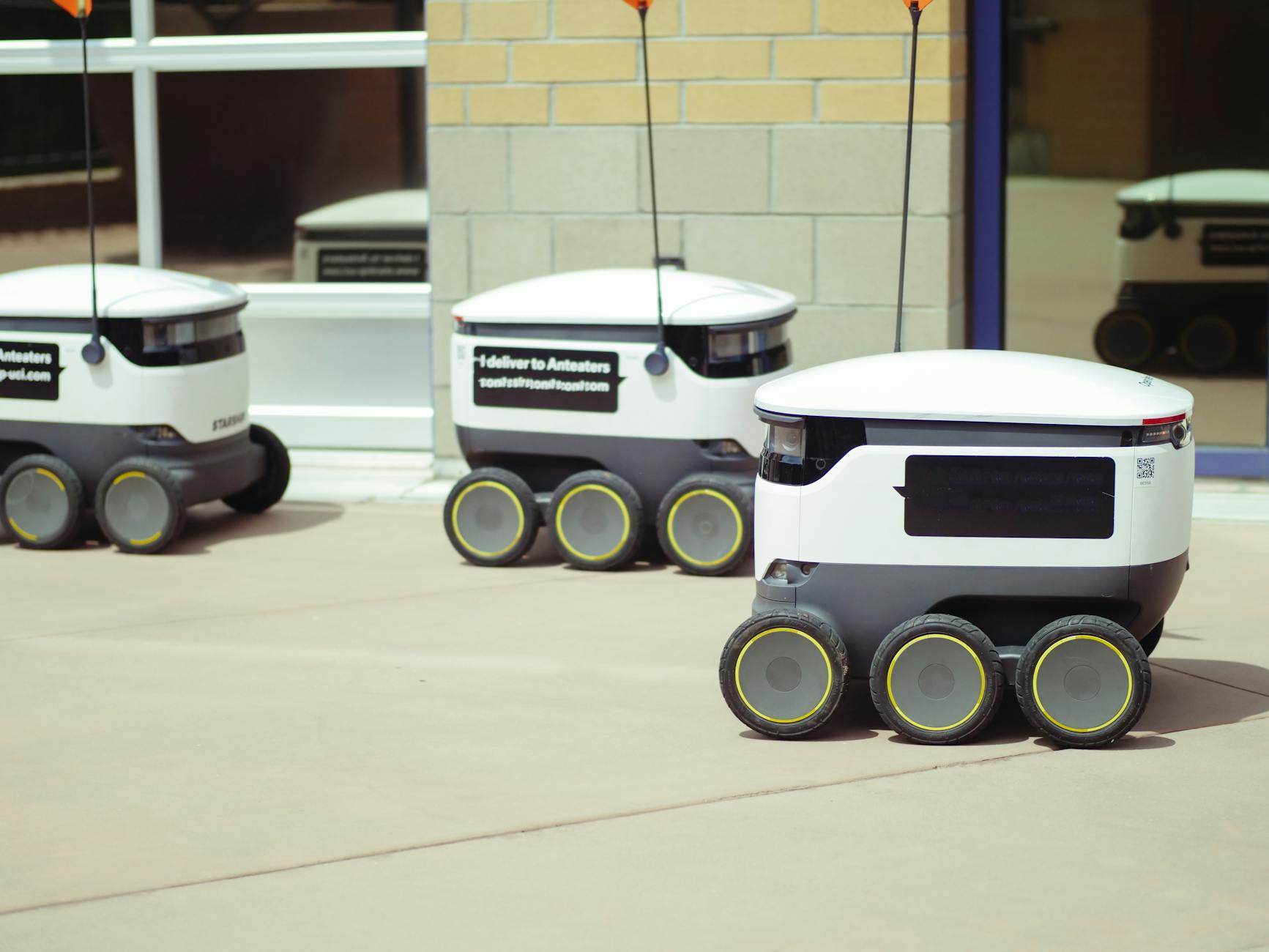
knightscope‘s current lineup spans four distinct robot models, each engineered for specific security environments. The K1 handles stationary indoor monitoring, while the K3 provides mobile indoor patrol capabilities. The K5, perhaps the company’s most recognizable product with its distinctive egg-shaped design, patrols outdoor areas like parking lots and corporate campuses. The newest addition, the K7, was unveiled in November 2025 specifically for large outdoor perimeters, with deployment expected in the second half of 2026. These robots integrate multiple sensor systems including thermal imaging, license plate recognition, and environmental sensors that can detect changes in air quality or temperature. The machines operate autonomously, navigating predetermined patrol routes while identifying anomalies and alerting human security personnel.
This approach positions robots as force multipliers for existing security teams rather than complete replacements””a distinction that matters for practical deployment. However, autonomous security robots face inherent limitations that buyers should understand. They cannot physically intervene in crimes, pursue suspects, or make arrests. Weather conditions affect outdoor operations. The robots require charging infrastructure and maintenance. Perhaps most significantly, they work best in controlled environments with predictable traffic patterns””a corporate campus or shopping mall rather than a chaotic urban street corner.
Knightscope’s Financial Reality and Market Position
The financial picture for Knightscope presents a mixed story that prospective investors should examine carefully. Q3 2025 revenue of $3.1 million marked a 24% improvement over Q3 2024’s $2.5 million, suggesting operational momentum. Yet full-year 2024 revenue of $10.81 million represented a 15.57% decline from 2023’s $12.80 million, indicating that quarterly improvements have not yet translated into sustained annual growth. The company maintains a cash position of $24.2 million as of August 2025, providing operational runway while it pursues growth.
Analyst sentiment remains cautiously optimistic, with Ascendiant Capital Markets maintaining a “buy” rating despite reducing its price target from $27.00 to $25.00 in December 2025. The consensus “Moderate Buy” rating with an average target price of $15.00 suggests analysts see significant upside from current levels around $4.10″”though such targets should be viewed skeptically given the company’s small size and the speculative nature of emerging technology stocks. For context, Knightscope’s current market capitalization of approximately $47.76 million classifies it as a micro-cap stock, carrying all the volatility and liquidity risks that designation implies. The stock traded up 9.4% on January 2, 2026, reaching $4.06″”the kind of percentage swing that larger companies rarely experience but that micro-caps routinely see on modest news or trading volume changes.

The Palantir Partnership and Federal Market Entry
Knightscope’s two-year FedStart program agreement with Palantir Technologies represents a potentially significant strategic pivot toward government contracts. Palantir, known for its data analytics platforms used by intelligence agencies and military organizations, provides Knightscope with both credibility and potential access to federal procurement channels that would otherwise take years to penetrate independently. The federal security market presents both opportunity and challenge. Government facilities””from military bases to federal courthouses to national laboratories””represent substantial potential customers with large security budgets and long contract terms.
Success in this market could provide the recurring revenue stability that consumer and commercial clients cannot always guarantee. The challenge lies in federal procurement complexity, security clearance requirements, and the lengthy sales cycles typical of government contracting. Companies often wait years between initial engagement and first revenue from federal customers. Knightscope’s partnership with Palantir may accelerate this timeline, but prospective investors should not expect immediate revenue impact from federal sales efforts.
Limitations and Risks in Autonomous Security
Autonomous security robots face fundamental constraints that even optimistic observers should acknowledge. These machines excel at surveillance, deterrence through visible presence, and data collection. They cannot tackle intruders, administer first aid, or exercise the judgment that complex security situations often require. A robot can identify that someone has collapsed; it cannot perform CPR. Liability questions remain partially unresolved.
When a security robot fails to detect a crime or malfunctions during a critical moment, responsibility allocation between the robot company, the property owner, and the security provider becomes legally complex. Insurance frameworks for autonomous security systems continue evolving, and some organizations may hesitate to deploy robots until liability standards clarify. Public perception presents another variable. Some people find security robots reassuring; others find them unsettling or intrusive. Properties that welcome visitors””retail centers, hotels, public spaces””must weigh whether robots enhance or detract from the customer experience. Industrial facilities or data centers with limited public access face fewer such concerns.
Leadership and Company Origins
William Santana Li’s background shapes Knightscope’s approach to the security robotics market. His tenure at Ford Motor Company, where he became the youngest senior executive at 28, instilled manufacturing and scale perspectives that influence how Knightscope thinks about robot production. His subsequent founding of Carbon Motors Corporation from 2003 to 2013, focused on purpose-built law enforcement vehicles, demonstrates long-standing interest in the intersection of technology and public safety.
Co-founder Stacy Stephens, a former Dallas police officer, brings operational law enforcement experience to product development. This combination of automotive manufacturing expertise and police work informs design decisions about what security professionals actually need versus what engineers might assume they want. The company’s founding in response to the Sandy Hook tragedy in 2012 provides mission-driven context that influences corporate culture and strategic decisions. Whether that origin story translates into business advantage remains debatable, but it distinguishes Knightscope’s narrative from purely profit-motivated competitors.
The Road Ahead for Security Robotics
The autonomous security robot market remains early-stage, with Knightscope among several companies competing to define industry standards and capture market share. The K7 robot’s expected deployment in the second half of 2026 will test whether Knightscope can successfully serve large outdoor perimeter applications””a market segment that includes critical infrastructure, logistics facilities, and agricultural operations. Broader technology trends favor increased automation in security applications.
Labor costs continue rising, trained security personnel remain difficult to recruit and retain, and sensor technology grows more capable while decreasing in cost. These macro factors create tailwinds for security robotics generally, though they do not guarantee success for any individual company. Whether Knightscope ultimately earns the “Google of Security Robotics” designation depends on execution over the coming years””converting technology demonstrations into recurring revenue, expanding the customer base beyond early adopters, and achieving the scale economies that make robotic security genuinely cost-competitive with traditional alternatives.
Conclusion
Knightscope represents an intriguing bet on the future of autonomous security, combining Silicon Valley technology development with practical law enforcement insight. The company’s $7/hour pricing strategy, diverse robot lineup, and Palantir partnership position it as a serious player in an emerging market. However, current financials””$10.81 million in 2024 revenue, a $47.76 million market cap, and year-over-year revenue decline””reflect a company still working to prove its commercial model.
For security professionals evaluating robotic solutions, Knightscope offers proven technology suitable for specific applications, particularly in controlled environments requiring consistent patrol coverage. For investors, KSCP represents speculative exposure to security automation trends with corresponding risk profiles typical of micro-cap technology stocks. The “Google of Security Robotics” comparison captures ambition and market positioning; whether it predicts future dominance remains genuinely uncertain.