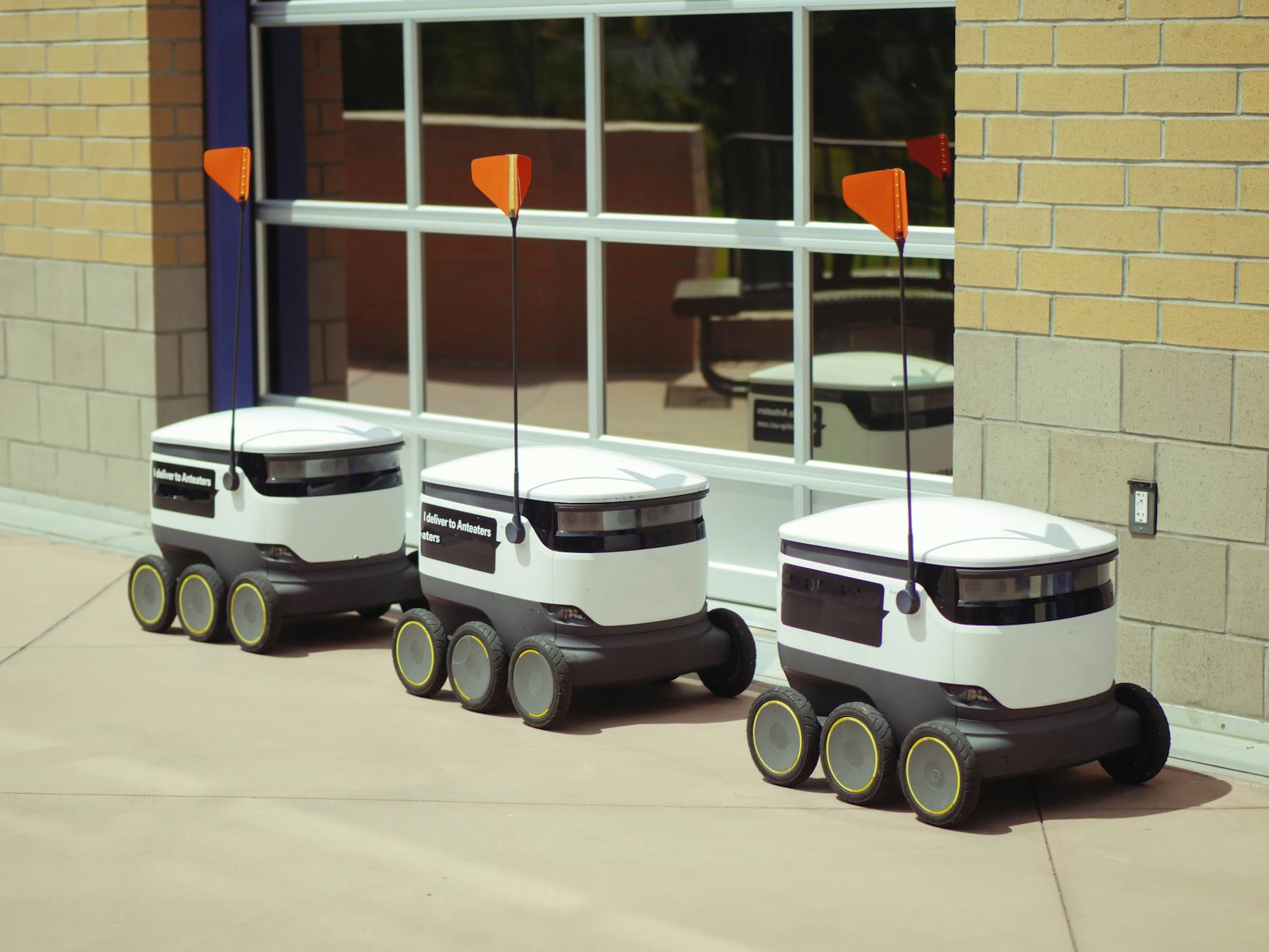

Serve Robotics (NASDAQ: SERV) has emerged as the dominant force in autonomous sidewalk delivery, operating the largest fleet of delivery robots in the United States with over 2,000 units deployed across major metropolitan areas. The company, which spun off from Uber in 2021, has achieved what few robotics startups manage: real-world scale. With partnerships covering more than 80 percent of the U.S. food delivery market through Uber Eats and DoorDash, and a 99.8 percent delivery completion rate, Serve has positioned itself as the infrastructure layer for last-mile urban logistics.
Whether the “Google of Urban Robotics Networks” label sticks depends on execution, but the data suggests Serve is building something with genuine network effects. The comparison to Google, while not an official company tagline, reflects the ambition at play. Google organized the world’s information; Serve is attempting to organize urban delivery through autonomous systems that log approximately one million miles of navigation data monthly””roughly 170 billion image-LiDAR samples. This data flywheel, combined with strategic acquisitions like the $240 million Vayu Robotics deal, gives Serve a technical moat that competitors will struggle to replicate. The following sections examine how Serve built this position, where the real limitations exist, and what investors and industry observers should watch as the company scales toward its projected tenfold revenue growth in 2026.
Table of Contents
- Why Is SERV Being Called the Google of Urban Robotics Networks?
- Fleet Expansion and the Scale That Matters
- The Partnership Strategy Behind 80 Percent Market Access
- What the Vayu Acquisition Means for Technical Capabilities
- Financial Reality: Valuation, Revenue, and What Must Go Right
- Zero Emissions and the Regulatory Advantage
- The $450 Billion Question: Market Size and Competition
- Conclusion
Why Is SERV Being Called the Google of Urban Robotics Networks?
The Google comparison stems from Serve’s approach to building a platform rather than simply deploying robots. Google’s dominance came from indexing information at scale and becoming indispensable infrastructure. Serve is pursuing a similar strategy with urban delivery: the more robots on sidewalks, the more data collected, the better the navigation algorithms become, which enables expansion into new neighborhoods, which generates more data. This cycle mirrors the search engine dynamics that made Google unassailable. Serve’s data advantage is measurable. With approximately one million miles logged monthly and 170 billion image-LiDAR samples, the company has built what may be the most comprehensive dataset of urban sidewalk navigation in existence.
This data trains the AI models that achieve SAE Level 4 autonomy””meaning robots operate without human intervention in complex environments including pedestrian traffic, construction zones, and weather variations. The Vayu Robotics acquisition in August 2025 added foundation model capabilities specifically designed for robot navigation, accelerating this technical advantage. However, the comparison has limits. Google achieved near-monopoly status in search. Serve faces competition from established logistics players, drone delivery services, and the possibility that autonomous vehicles will eventually handle sidewalk-scale deliveries. The $450 billion market opportunity cited by Ark Investment Management for robotic and drone delivery by 2030 is large enough to support multiple winners. Serve’s position is strong but not unassailable.

Fleet Expansion and the Scale That Matters
serve’s operational numbers tell the story of a company that has moved beyond pilot programs. The fleet expanded twentyfold since the start of 2025, reaching 2,000 robots by December. City footprint grew fivefold in the same period. These are not incremental gains; they represent the kind of exponential growth that separates serious infrastructure plays from perpetual startups. The geographic expansion now spans Los Angeles, Atlanta, Dallas-Fort Worth, Miami, Fort Lauderdale, Chicago, and Alexandria, Virginia, with additional cities planned for early 2026.
Within these markets, Serve launched 110 high-density neighborhoods in 2025 alone, serving 3,600-plus restaurant locations””a 45 percent increase from the previous quarter and ninefold growth year-over-year. For context, this density means Serve robots are becoming a routine sight in urban cores, not curiosities. The limitation worth noting: scale in robotics is harder than scale in software. Each robot requires manufacturing, maintenance, and regulatory compliance. Serve’s Gen 3 robots were designed for higher-volume operations, but hardware constraints remain real. A software company can add servers; a robotics company must build physical units, deploy them, and keep them operational across varied urban environments.
The Partnership Strategy Behind 80 Percent Market Access
Serve’s partnerships with Uber Eats and DoorDash provide access to over 80 percent of the U.S. food delivery market. This is arguably more important than the robot fleet itself. Building delivery demand from scratch would be prohibitively expensive; integrating into existing platforms lets Serve focus on execution while established players handle customer acquisition. The 7-Eleven retail partnership signals expansion beyond restaurant delivery. Convenience retail represents a different use case””smaller orders, potentially higher frequency, different time-of-day patterns.
If Serve can prove the economics work for varied delivery types, the addressable market expands significantly. The doubling of major platform partnerships year-over-year suggests this diversification strategy is gaining traction. The tradeoff is dependency. Uber was Serve’s parent company; maintaining that relationship while building DoorDash as a partner requires careful management. If either platform decided to develop in-house robotics or partner exclusively with a competitor, Serve’s market access would compress rapidly. The company’s path to independence requires proving value so clearly that platforms cannot afford to exclude it.

What the Vayu Acquisition Means for Technical Capabilities
The $240 million acquisition of Vayu Robotics in August 2025 was Serve’s largest deal and signals the company’s technical priorities. Vayu brought AI foundation model capabilities specifically designed for robot navigation””the kind of underlying technology that could accelerate autonomy improvements across Serve’s entire fleet. The deal structure””1,696,069 shares upfront plus 560,000 shares in earnout potential””suggests confidence in Vayu’s technology delivering measurable value. More notable was Vinod Khosla joining Serve’s Advisory Board as part of the transaction.
Khosla Ventures has backed transformative companies across multiple technology waves; his involvement adds credibility and likely opens additional funding and partnership opportunities. The strategic logic is straightforward: as robotics moves from rule-based navigation to AI-driven decision-making, companies with superior foundation models will outperform those relying on older approaches. Serve is betting that Vayu’s technology, combined with its massive real-world data advantage, creates a compounding technical lead. Whether this translates to better delivery completion rates, lower per-delivery costs, or faster expansion into new environments will determine if the acquisition justified its price.
Financial Reality: Valuation, Revenue, and What Must Go Right
Serve’s stock has traded between $4.69 and $23.08 over the past 52 weeks, with January 2026 prices in the $11.93 to $14.71 range. Market capitalization sits between $941 million and $1.09 billion depending on the day. For a company operating robots on sidewalks, this valuation reflects substantial expectations. The FY2026 revenue projection of ten times FY2025 revenues is aggressive.
Achieving this requires the fleet expansion to translate into proportional revenue growth, partnerships to deepen, and per-delivery economics to remain stable or improve. The 99.8 percent completion rate suggests operational excellence, but scaling any operation by an order of magnitude introduces failure modes that do not exist at smaller scale. The warning for investors: robotics companies have historically struggled to achieve profitability even at significant revenue levels. Hardware margins, maintenance costs, and regulatory compliance create cost structures that differ fundamentally from software businesses. Serve’s path to sustainable economics likely requires reaching a scale where fixed costs spread across enough deliveries to generate positive unit economics””and then maintaining that efficiency as the fleet grows.
Zero Emissions and the Regulatory Advantage
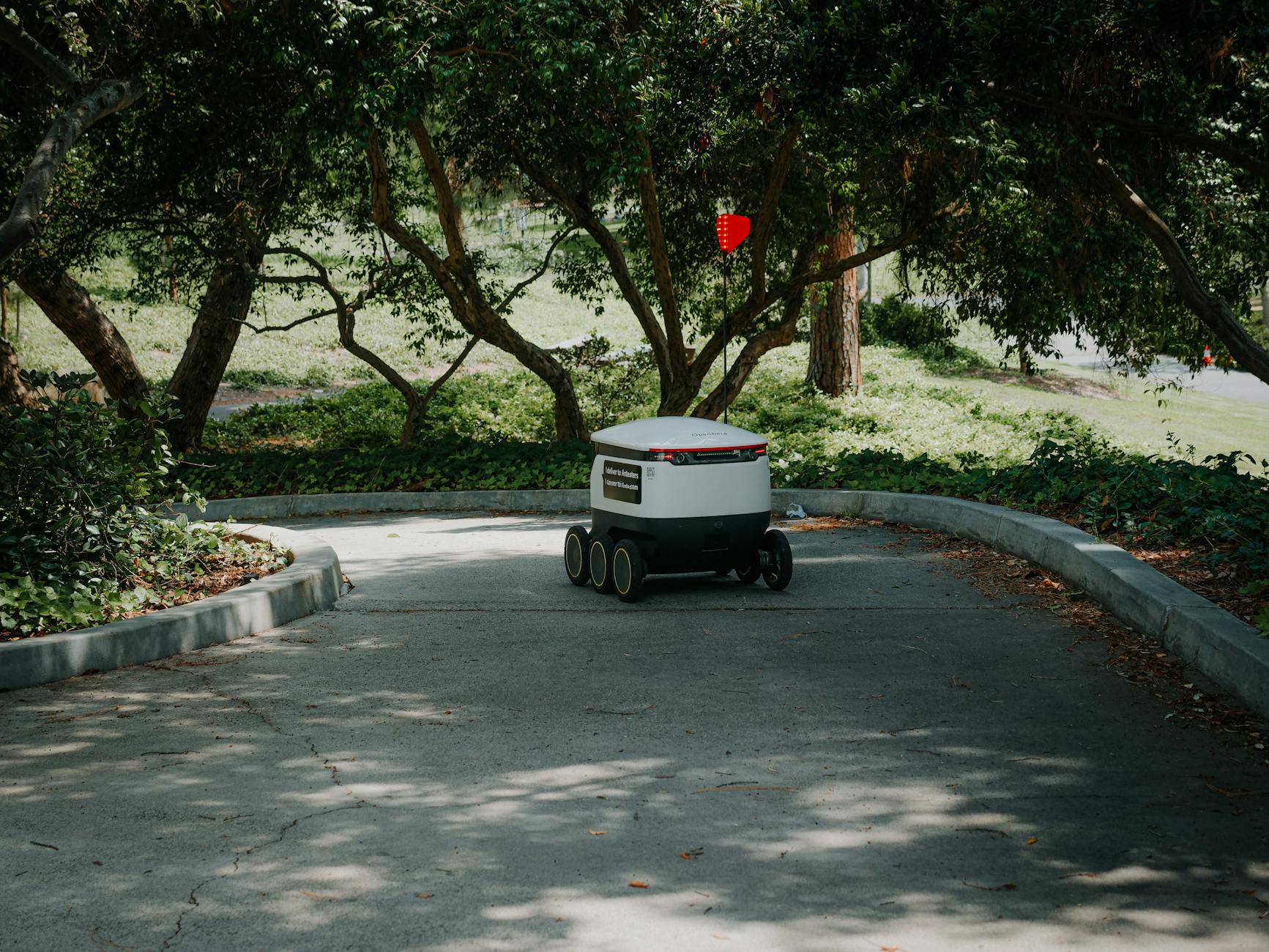
Serve’s robots produce zero tailpipe emissions, which matters beyond environmental credentials. Cities increasingly restrict vehicle access in urban cores, implement congestion pricing, and favor low-emission delivery options. A fleet of sidewalk robots becomes more valuable as these regulatory trends accelerate.
Los Angeles, where Serve has its deepest presence, has aggressive climate goals that favor autonomous electric delivery over traditional vehicles. As other cities adopt similar policies, Serve’s existing operational experience provides a template for rapid expansion. The company has already navigated permitting and operational approval across multiple jurisdictions””institutional knowledge that takes time to replicate.
The $450 Billion Question: Market Size and Competition
Ark Investment Management’s estimate of a $450 billion robotic and drone delivery market by 2030 provides context for Serve’s opportunity. Even capturing a small percentage of this market would justify valuations well above current levels. The question is how competition shapes market share. Drone delivery from companies like Zipline and Amazon’s Prime Air targets different use cases but competes for the same “last-mile autonomy” investment dollars.
Traditional logistics players are developing their own solutions. Autonomous vehicle companies may eventually view sidewalk delivery as a natural extension. Serve’s head start in sidewalk robotics is real, but maintaining leadership requires continued execution as well-funded competitors enter the space. The next two years will reveal whether Serve’s data advantage and partnership network create durable differentiation or merely a temporary lead.
Conclusion
Serve Robotics has built something rare in the autonomous delivery space: actual scale. With 2,000 robots deployed, partnerships covering 80 percent of the food delivery market, and a 99.8 percent completion rate, the company has moved beyond proof-of-concept into genuine operations. The Vayu acquisition, expanding city footprint, and projected tenfold revenue growth in 2026 suggest a company attempting to establish itself as essential infrastructure for urban logistics.
Whether Serve becomes “the Google of Urban Robotics Networks” depends on factors both within and beyond its control. The data flywheel is spinning, the partnerships are deepening, and the technical capabilities are advancing. What remains uncertain is whether the economics work at true scale, whether competitors catch up, and whether cities continue welcoming sidewalk robots. For investors and industry observers, Serve represents the clearest test case for whether autonomous delivery can transition from promising technology to essential urban infrastructure.