
Serve Robotics has emerged as a compelling case study in the autonomous delivery robotics space, representing a low priced robotics play with real deployment news that distinguishes it from many speculative technology stocks. The company, which spun out of Uber in 2021, operates a fleet of sidewalk delivery robots in Los Angeles and has secured significant partnerships with major players including Uber Eats and 7-Eleven. For investors and robotics enthusiasts tracking the commercial viability of autonomous systems, Serve presents an interesting intersection of accessible stock pricing and tangible operational milestones. The robotics industry is notoriously difficult to evaluate.
Many companies operate in stealth mode, burn through capital without clear revenue paths, or remain private beyond the reach of retail investors. Serve Robotics went public through a SPAC merger in 2023, giving everyday investors access to a pure-play autonomous delivery company at a relatively modest market capitalization. This accessibility raises important questions about valuation, growth potential, and the practical realities of deploying robots at commercial scale in urban environments. This article examines the fundamentals behind Serve Robotics, exploring why its stock trades at current levels, what its deployment milestones actually mean for the business, and how to evaluate the company within the broader context of robotics investments. Readers will gain a clearer understanding of the technical capabilities, business model, financial position, and competitive landscape that shape this particular robotics opportunity.
Table of Contents
- What Makes Serve Robotics a Low Priced Entry Point Into the Robotics Sector?
- Real Deployment News and Commercial Milestones That Matter
- Understanding the Autonomous Delivery Robot Technology
- How Serve Robotics Generates Revenue and Approaches Profitability
- Risks and Challenges Facing Serve Robotics Investors
- Comparing Serve Robotics to Alternative Robotics Investments
- How to Prepare
- How to Apply This
- Expert Tips
- Conclusion
- Frequently Asked Questions
What Makes Serve Robotics a Low Priced Entry Point Into the Robotics Sector?
The robotics investment landscape presents significant barriers to entry for many investors. Companies like Boston Dynamics remain privately held, robotics divisions of major corporations are bundled with countless other business units, and many publicly traded robotics firms carry market capitalizations in the billions. Serve Robotics, with its relatively modest market cap and share price, offers a different proposition entirely. The company trades on the NASDAQ under the ticker SERV, making it accessible through standard brokerage accounts without the complexity of private market investments.
Several factors contribute to the current pricing structure. Serve Robotics is still in the early commercialization phase, meaning revenue remains limited compared to mature technology companies. The autonomous delivery market itself is nascent, creating uncertainty about total addressable market projections that institutional investors typically rely upon. Additionally, the company went public through a SPAC merger rather than a traditional IPO, which historically correlates with different valuation dynamics and investor sentiment. These factors combine to create a situation where a company with genuine operational robots and commercial partnerships trades at prices accessible to smaller investment portfolios.
- **Early-stage revenue profile**: The company generates revenue through delivery fees but has not yet reached profitability, which suppresses traditional valuation metrics
- **Market uncertainty**: Autonomous sidewalk delivery represents an unproven market category, leading to conservative institutional positioning
- **SPAC origins**: Companies that went public through special purpose acquisition vehicles often trade at discounts relative to traditional IPO counterparts due to historical performance patterns in this segment

Real Deployment News and Commercial Milestones That Matter
Unlike many robotics companies that exist primarily in demonstration or pilot phases, serve Robotics has accumulated substantive deployment news that indicates genuine commercial traction. The company has completed hundreds of thousands of autonomous deliveries in Los Angeles, operating robots that navigate sidewalks, cross streets, and deliver food orders from restaurant partners to customers. These are not controlled demonstrations but actual commercial operations generating revenue and collecting invaluable real-world data.
The partnership with Uber Eats represents the most significant validation of the company’s technology and business model. In 2024, Uber made an equity investment in Serve Robotics and committed to deploying up to 2,000 robots across multiple markets. This arrangement provides Serve with a powerful distribution channel, as Uber Eats already has the customer base, restaurant relationships, and logistics infrastructure that a standalone delivery robot company would struggle to build independently. The partnership effectively de-risks the go-to-market strategy while allowing Serve to focus on what it does best: building and operating robots.
- **Completed deliveries**: The company has executed over 100,000 commercial deliveries, providing proof of concept beyond laboratory conditions
- **Geographic expansion plans**: Announcements indicate planned expansion beyond Los Angeles to additional metropolitan areas throughout 2025 and 2026
- **Fleet scaling commitments**: The Uber partnership includes commitments for significant robot fleet expansion, creating visible growth trajectory
Understanding the Autonomous Delivery Robot Technology
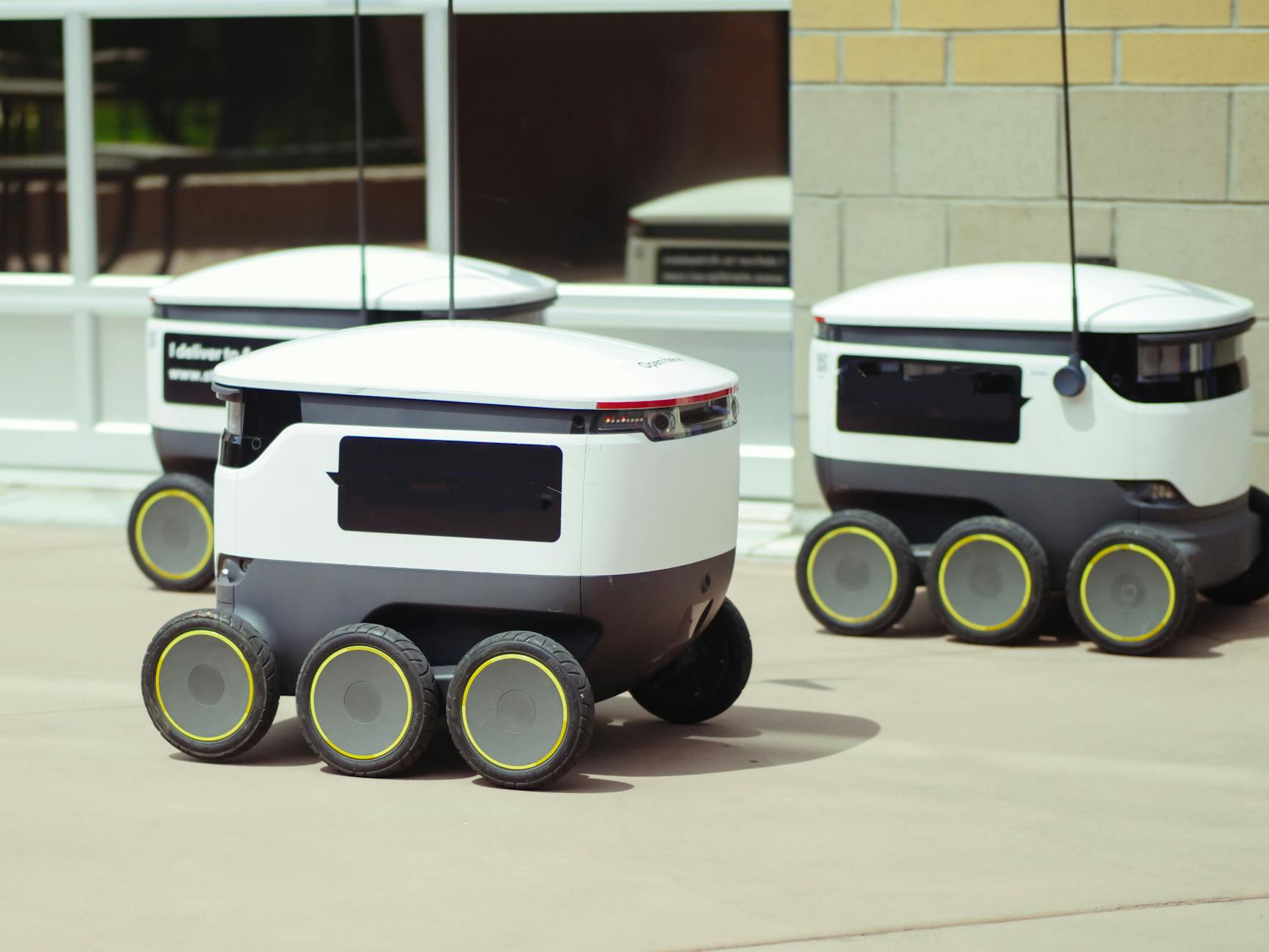
Serve Robotics builds Level 4 autonomous robots designed specifically for sidewalk navigation and last-mile delivery operations. The robots use a combination of cameras, LiDAR, ultrasonic sensors, and GPS to perceive their environment and navigate urban landscapes. Unlike autonomous vehicles that operate on roads at high speeds, sidewalk delivery robots face different challenges: pedestrian interactions, curb navigation, obstacle avoidance in crowded areas, and weather resilience. The technical approach emphasizes reliability over maximum capability. Serve robots travel at pedestrian speeds, typically around 3-4 miles per hour, which provides safety margins that faster vehicles cannot match.
This design philosophy reduces the complexity of autonomous decision-making while still delivering meaningful utility. The robots can carry payloads suitable for food delivery, convenience store items, and small packages, with temperature-controlled compartments available for orders requiring heating or cooling. Machine learning plays a central role in the system’s evolution. Every delivery generates data that feeds back into improved navigation algorithms, object recognition, and decision-making processes. This creates a flywheel effect where more deployments lead to better performance, which enables more deployments. The company has logged millions of miles of autonomous operation, building a dataset that represents meaningful competitive advantage against new entrants.
- **Sensor fusion architecture**: Multiple redundant sensing systems create robust environmental perception
- **Edge computing capabilities**: On-robot processing handles most decisions locally, reducing latency and dependence on connectivity
- **Continuous learning pipeline**: Operational data constantly improves autonomous capabilities through machine learning iteration
How Serve Robotics Generates Revenue and Approaches Profitability
The business model centers on delivery fees charged through partnerships with food delivery platforms and retail businesses. When a customer orders through Uber Eats and a Serve robot completes the delivery, the company earns a fee for that service. This transactional model creates direct alignment between operational performance and revenue generation. More successful deliveries mean more revenue, incentivizing efficiency and reliability. Unit economics represent the critical path to profitability. Each robot has associated costs: initial manufacturing, ongoing maintenance, remote monitoring, charging infrastructure, and software updates.
For the business to work at scale, the revenue generated per robot must exceed these costs by a sufficient margin. The company has indicated that unit economics improve significantly as robot utilization increases and manufacturing costs decline with scale. Early deployments necessarily carry higher per-unit costs, but the trajectory matters more than current margins. The 7-Eleven partnership illustrates diversification of the revenue base. Beyond restaurant delivery, convenience store items represent a substantial delivery opportunity with different demand patterns. Late-night snack runs, forgotten household items, and time-sensitive purchases create delivery opportunities throughout the day and night. This partnership expands the addressable market while utilizing the same robot fleet and infrastructure.
- **Per-delivery fee structure**: Revenue tied directly to completed deliveries rather than subscription or licensing models
- **Partnership economics**: Revenue sharing arrangements with platforms like Uber Eats
- **Fleet utilization metrics**: Profitability depends heavily on maximizing deliveries per robot per day
- **Manufacturing cost trajectory**: Scale production expected to reduce per-robot costs substantially
Risks and Challenges Facing Serve Robotics Investors
Investing in early-stage robotics companies carries inherent risks that merit serious consideration. Serve Robotics operates in a capital-intensive industry with significant regulatory uncertainties, competitive threats, and technological challenges. The path to profitability remains unclear, and the company will likely need additional capital raises to fund expansion, which could dilute existing shareholders. Regulatory risk looms over the entire autonomous delivery sector. While Serve has successfully obtained permits to operate in Los Angeles and other jurisdictions, regulations vary dramatically across municipalities. Some cities have embraced delivery robots while others have banned or severely restricted them.
Federal regulations remain largely undefined, creating uncertainty about eventual national frameworks. A regulatory environment that becomes more restrictive could significantly impair growth prospects. Competition in autonomous delivery continues to intensify. Amazon is developing its own delivery robots, well-funded startups like Nuro and Starship Technologies pursue different approaches, and traditional delivery companies are exploring automation. Serve’s partnerships provide some competitive moat, but the market remains early enough that competitive dynamics could shift substantially. The company’s current lead in commercial deployments is meaningful but not insurmountable.
- **Cash burn considerations**: The company spends more than it earns, requiring ongoing access to capital markets
- **Regulatory variability**: Municipal and state regulations create patchwork operational environment
- **Partnership concentration**: Significant revenue dependence on Uber relationship creates key customer risk
- **Technology commoditization potential**: Autonomous navigation technology may become widely available, reducing differentiation
Comparing Serve Robotics to Alternative Robotics Investments
For investors seeking robotics exposure, the landscape offers varied options with different risk-return profiles. Industrial robotics companies like Fanuc and ABB offer profitable operations but limited growth excitement. Surgical robotics leader Intuitive Surgical trades at premium valuations reflecting its dominant market position.
Warehouse automation companies like Symbotic address clear enterprise needs but face their own competitive pressures. Serve Robotics occupies a distinct niche: pure-play autonomous delivery with genuine commercial operations at accessible valuations. This positioning appeals to investors who want direct exposure to autonomous last-mile delivery without the diversification that makes larger robotics companies less volatile but also less focused. The trade-off involves accepting higher risk for potentially higher reward if the autonomous delivery market develops as proponents anticipate.
How to Prepare
- **Review SEC filings thoroughly**: The company’s 10-K annual reports and 10-Q quarterly filings contain detailed information about operations, finances, risks, and management discussion. These documents provide unfiltered access to information that press releases and news articles often simplify.
- **Understand autonomous delivery market dynamics**: Research the total addressable market estimates, competitive landscape, and regulatory environment. Industry reports from firms like McKinsey, Gartner, and specialized robotics analysts provide market sizing and trend analysis.
- **Analyze unit economics disclosures**: Pay attention to metrics like deliveries per robot, cost per delivery, and revenue per delivery when the company provides this information. These operational metrics matter more than revenue alone for understanding business viability.
- **Track partnership announcements carefully**: New partnerships, partnership expansions, or partnership difficulties provide leading indicators of commercial traction. The terms and structure of these arrangements reveal how counterparties value the technology.
- **Monitor regulatory developments**: Follow autonomous vehicle and robot regulations at federal, state, and municipal levels. Regulatory changes can rapidly shift the opportunity landscape in either direction.
How to Apply This
- **Establish position sizing appropriate to risk**: Early-stage robotics companies can experience significant volatility. Position sizes should reflect both the speculative nature of the investment and conviction in the thesis.
- **Set monitoring triggers**: Identify specific milestones that would increase or decrease confidence in the investment thesis. Fleet expansion announcements, new market launches, and financial results against expectations all merit evaluation.
- **Compare against alternatives regularly**: The relative attractiveness of Serve Robotics depends on how other robotics investments evolve. Regular portfolio review ensures continued alignment with investment objectives.
- **Separate operational progress from stock performance**: Stock prices can diverge from fundamental progress for extended periods. Evaluate the company’s execution independently from market sentiment about the stock.
Expert Tips
- **Focus on deliveries per robot metrics**: This operational efficiency measure indicates how well the business model scales. Improving deliveries per robot suggests the path to profitability is achievable.
- **Watch for insider transaction patterns**: Director and officer purchases or sales, while not predictive, provide signals about internal confidence. Meaningful insider buying often indicates management believes shares are undervalued.
- **Track the Uber relationship closely**: Given the concentration of business with Uber, any changes to this partnership have outsized impact. Expansion of the partnership validates the technology while any friction raises concerns.
- **Compare deployment announcements to actual operations**: Press releases about planned expansions are less meaningful than demonstrated operations in new markets. Verify announced expansions translate into actual commercial service.
- **Consider manufacturing scalability**: The ability to produce robots at costs that enable profitable unit economics determines long-term viability. Manufacturing partnerships and production capacity disclosures indicate progress toward scale.
Conclusion
Serve Robotics represents a genuinely unusual opportunity in public markets: direct exposure to autonomous sidewalk delivery through a company with real commercial operations and meaningful partnerships. The stock’s accessible pricing reflects genuine uncertainties about market development, competitive positioning, and the path to profitability rather than any fundamental flaw in the technology or team. For investors with appropriate risk tolerance and time horizons, the company offers a way to participate in autonomous delivery without the access barriers that characterize much of the robotics industry.
The key insight for evaluating Serve Robotics is that deployment news matters more than typical technology company metrics. Revenue growth, while important, tells less of the story than fleet expansion, geographic scaling, and partnership developments. A company successfully deploying thousands of autonomous robots generating commercial revenue occupies fundamentally different ground than competitors still in demonstration phases. Whether this operational lead translates into investment returns depends on execution, market development, and competitive dynamics that will unfold over years rather than quarters.
Frequently Asked Questions
How long does it typically take to see results?
Results vary depending on individual circumstances, but most people begin to see meaningful progress within 4-8 weeks of consistent effort. Patience and persistence are key factors in achieving lasting outcomes.
Is this approach suitable for beginners?
Yes, this approach works well for beginners when implemented gradually. Starting with the fundamentals and building up over time leads to better long-term results than trying to do everything at once.
What are the most common mistakes to avoid?
The most common mistakes include rushing the process, skipping foundational steps, and failing to track progress. Taking a methodical approach and learning from both successes and setbacks leads to better outcomes.
How can I measure my progress effectively?
Set specific, measurable goals at the outset and track relevant metrics regularly. Keep a journal or log to document your journey, and periodically review your progress against your initial objectives.
When should I seek professional help?
Consider consulting a professional if you encounter persistent challenges, need specialized expertise, or want to accelerate your progress. Professional guidance can provide valuable insights and help you avoid costly mistakes.
What resources do you recommend for further learning?
Look for reputable sources in the field, including industry publications, expert blogs, and educational courses. Joining communities of practitioners can also provide valuable peer support and knowledge sharing.