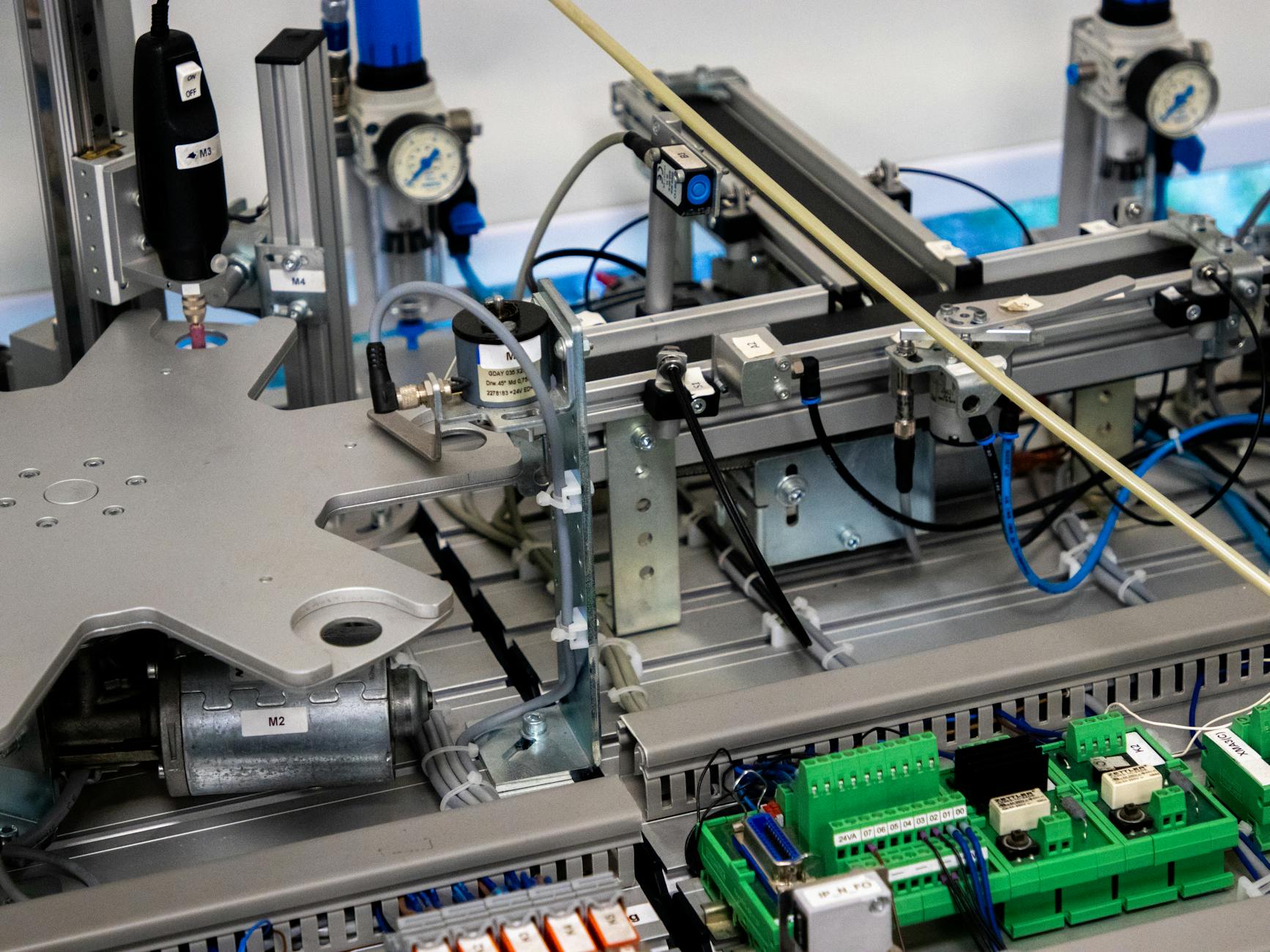

YASKY has established itself as a significant force in the automation hardware space by focusing on precision motion control components, servo systems, and industrial drive technology that competes directly with legacy players like Yaskawa, Mitsubishi, and Siemens. The company, based in China’s manufacturing corridor, has carved out a niche by offering servo motors, drivers, and integrated motion controllers at price points that undercut established Japanese and European brands by 30 to 50 percent, while steadily closing the performance gap in accuracy and reliability. For small and mid-sized manufacturers looking to automate CNC machines, packaging lines, or robotic arms without the capital outlay that a Fanuc or Beckhoff system demands, YASKY has become a name worth knowing.
What makes YASKY’s position interesting is not just cost arbitrage. The company has invested heavily in closed-loop stepper systems and hybrid servo technology that blurs the line between traditional stepper motors and full servo drives. A packaging integrator in Southeast Asia, for example, recently swapped out Panasonic A6 servos for YASKY equivalents on a cartoning machine and reported comparable cycle times at roughly 40 percent lower hardware cost, though they noted that tuning software and documentation lagged behind the Panasonic ecosystem. This article covers YASKY’s core product lines, where they genuinely compete with tier-one brands, where they fall short, and how to evaluate whether their hardware fits your automation project.
Table of Contents
- What Makes YASKY a Contender Among Automation Hardware Leaders?
- Core Servo and Motion Control Products From YASKY
- Where YASKY Hardware Fits in Real-World Automation Projects
- How to Evaluate YASKY Against Tier-One Servo Brands
- Common Issues and Limitations With YASKY Automation Hardware
- YASKY’s Position in the Growing Chinese Automation Ecosystem
- What Comes Next for YASKY and Budget Automation Hardware
- Conclusion
- Frequently Asked Questions
What Makes YASKY a Contender Among Automation Hardware Leaders?
yasky‘s product catalog spans AC servo motors and drives ranging from 100 watts to several kilowatts, closed-loop stepper systems, VFDs (variable frequency drives), and HMI panels. Their servo lines typically use 17-bit or 23-bit absolute encoders, which puts them in the same resolution class as mid-range Yaskawa Sigma series or Delta Electronics ASDA units. The company manufactures its own motors and pairs them with in-house drive electronics, giving them vertical integration that many Chinese automation brands lack. This matters because motor-drive matching is critical for smooth motion and accurate torque control, and companies that source motors from one supplier and drives from another often struggle with compatibility tuning. Compared to established leaders, YASKY’s strongest competitive angle is in applications that need reliable but not bleeding-edge performance. Think conveyor indexing, simple pick-and-place, labeling machines, and textile equipment.
In these contexts, you do not need the nanosecond-level synchronization of a Beckhoff EtherCAT servo system or the advanced vibration suppression algorithms found in Yaskawa’s Sigma-7 line. You need a motor that hits position accurately, a drive that communicates over pulse and direction or Modbus, and hardware that does not fail after six months. YASKY has built a reputation for meeting that bar consistently enough to earn repeat orders from OEMs in India, Turkey, Brazil, and across Southeast Asia. One comparison worth making is between YASKY and other Chinese servo brands like Inovance, Estun, and Delta (technically Taiwanese). Inovance has arguably moved upmarket faster and secured larger enterprise contracts, while Estun has leveraged its acquisition of Germany’s Cloos to gain welding robotics credibility. YASKY remains more focused on the component level, selling individual servos and drives rather than complete robotic systems, which keeps them accessible to smaller integrators but limits their visibility on large-scale projects.

Core Servo and Motion Control Products From YASKY
YASKY’s servo motor lineup includes both 220V and 380V variants with flange sizes from 40mm up to 180mm, covering the torque range that most light to medium industrial applications require. Their drives support pulse train input, analog voltage control, and in newer models, CANopen and EtherCAT communication. The EtherCAT-capable drives are a relatively recent addition and represent YASKY’s attempt to move into fieldbus-connected architectures that dominate modern automation cells. For users building systems around Beckhoff, Omron, or Codesys-based PLCs, EtherCAT support is essentially table stakes. However, if your application demands tight multi-axis synchronization, such as coordinated motion on a six-axis robot or electronic camming on a high-speed bottling line, YASKY’s EtherCAT implementation may not yet match the determinism and jitter performance of Yaskawa or Beckhoff drives.
Early adopters have reported occasional sync drift under heavy interpolation loads, suggesting the firmware stack is still maturing. For single-axis or loosely coordinated multi-axis work, this is unlikely to matter, but for anything requiring sub-millisecond coordination across four or more axes, you should benchmark carefully before committing. Their closed-loop stepper systems deserve separate mention. These pair a stepper motor with an encoder and a drive that can correct for missed steps in real time. For applications like 3D printer motion platforms, laser engravers, and small CNC routers, YASKY’s closed-loop steppers offer a middle ground between the low cost of open-loop steppers and the high performance of full servos. The tradeoff is that closed-loop steppers still lack the high-speed torque curve of a true servo motor, so they struggle above roughly 1,000 RPM in demanding load scenarios.
Where YASKY Hardware Fits in Real-World Automation Projects
A concrete example of YASKY hardware in production comes from a mid-sized packaging OEM in Guangdong province that builds horizontal flow-wrap machines for export. The company uses YASKY 750W servo motors on the film pull rollers and sealing jaw drives, paired with a Wecon PLC for sequencing. The machines run at 60 to 80 packages per minute and ship primarily to food manufacturers in Africa and the Middle East. The OEM reported that warranty claim rates on YASKY servos were under 2 percent over a two-year period, which is acceptable for machines in that price class. By comparison, their earlier machines used Panasonic MINAS servos, which had slightly lower failure rates but cost nearly double.
Another real-world application is in wood-panel CNC routers sold by several Chinese machine tool exporters. These machines use YASKY servos on the X, Y, and Z axes with ball screw drives, and they compete against machines using Yaskawa or Delta servos at higher price points. End users in furniture manufacturing have found that YASKY-equipped routers perform well for standard cutting and drilling operations but may show slightly more positional drift over long continuous runs compared to Yaskawa-equipped equivalents. For shops running one or two shifts, this is negligible. For 24/7 production environments, it is worth factoring into the decision. The takeaway is that YASKY hardware performs well in applications where duty cycles are moderate, precision requirements are in the range of plus or minus 0.02mm or looser, and the total system cost matters more than squeezing out the last fraction of a percent in throughput.
How to Evaluate YASKY Against Tier-One Servo Brands
When comparing YASKY to established brands, the evaluation should focus on five practical dimensions: raw hardware performance, software and tuning tools, documentation quality, supply chain availability, and after-sales support. On raw hardware, YASKY’s motors and drives have reached a point where they meet published specifications reliably. The motors use quality bearings, proper insulation classes (typically Class B or F), and IP65 sealing on many models. The drives handle standard motion profiles without issue. Where the gap widens is in software tooling and documentation. Yaskawa’s SigmaWin+ and Mitsubishi’s MR Configurator provide deep auto-tuning, vibration analysis, and diagnostic capabilities that YASKY’s tuning software cannot match.
YASKY provides basic parameter configuration tools, but advanced tuning often requires manual parameter adjustment by someone who understands servo control theory. Documentation is available but tends to be inconsistent in translation quality and sometimes lacks the application-specific guidance that Yaskawa or Siemens manuals provide. For experienced integrators, this is a manageable inconvenience. For teams without deep servo tuning expertise, it can add meaningful commissioning time. The tradeoff, stated plainly: you save 30 to 50 percent on hardware cost but may spend more time on integration, tuning, and troubleshooting than you would with a tier-one brand. For cost-sensitive OEMs building dozens or hundreds of identical machines, this tradeoff often makes sense because the engineering effort is amortized across many units. For a one-off custom automation cell, the engineering overhead may eat into the hardware savings.
Common Issues and Limitations With YASKY Automation Hardware
The most frequently reported issue with YASKY servo systems is electromagnetic interference sensitivity. Several integrators have noted that YASKY drives can be more susceptible to EMI-induced faults in electrically noisy environments, particularly when proper shielding, grounding, and cable separation practices are not followed. This is not unique to YASKY, as lower-cost drives across all brands tend to have less robust EMI filtering, but it means that skipping best practices on cable routing and grounding is more likely to cause problems than it would with a Siemens S210 or Yaskawa Sigma-7. Another limitation is the availability of certain specialized motor variants.
If your application requires a low-inertia motor for high-acceleration pick-and-place, an IP67-rated motor for washdown environments, or a linear servo motor, YASKY’s catalog thins out compared to Yaskawa or Beckhoff. The company’s strength is in standard rotary servo motors for general industrial use. Once you move into niche form factors, you will likely need to look elsewhere or accept longer lead times for custom orders. A warning for buyers purchasing through third-party distributors: YASKY products are sometimes resold under white-label or rebranded names on platforms like Alibaba, and not all resellers provide genuine YASKY firmware or calibration. Purchasing directly from YASKY or from verified distributors reduces the risk of receiving cloned or improperly configured hardware, which can cause reliability problems that are not reflective of the actual YASKY product line.

YASKY’s Position in the Growing Chinese Automation Ecosystem
China’s industrial automation market has grown rapidly, and domestic brands collectively now account for a significant share of servo motor sales within the country. YASKY operates in a competitive tier alongside brands like Lichuan, VEICHI, and Kinco, all targeting cost-conscious OEMs. What distinguishes YASKY from some of these peers is a stronger focus on servo systems specifically, rather than spreading across broad automation product lines that include PLCs, robots, and SCADA software.
This specialization gives them an edge in motor-drive optimization, since their engineering resources are concentrated rather than diluted. For example, YASKY’s latest generation of drives includes built-in regenerative braking control and dynamic torque limiting that reflect genuine servo engineering effort, not just a repacked VFD with a servo label. These features matter in applications with frequent acceleration and deceleration cycles, such as cut-to-length systems or reciprocating mechanisms, where poor energy handling can overheat the drive bus or trip protective faults.
What Comes Next for YASKY and Budget Automation Hardware
The trajectory for companies like YASKY mirrors what happened in consumer electronics and automotive components: Chinese manufacturers start as cost leaders, gradually improve quality, and eventually compete on performance as well as price. YASKY is currently in the middle phase of this arc. Their hardware is reliable enough for mainstream industrial use, but their software ecosystem, global support infrastructure, and brand trust still trail the established players. Over the next several years, as EtherCAT firmware matures and documentation improves, the performance gap will continue to narrow.
For automation engineers and integrators, the practical implication is straightforward. YASKY and similar brands are no longer a gamble for standard applications. They are a calculated decision with known tradeoffs. Keeping them on your radar, testing them on non-critical machines first, and building internal expertise with their tuning tools is a reasonable strategy for managing hardware costs without compromising production uptime.
Conclusion
YASKY has earned its place as a credible automation hardware supplier by delivering servo motors, drives, and motion controllers that meet the needs of cost-sensitive industrial applications. Their products are strongest in single-axis and loosely coordinated multi-axis systems, moderate-precision CNC and packaging machines, and applications where duty cycles do not demand the absolute peak performance of Japanese or German alternatives. The hardware savings of 30 to 50 percent are real, but they come with tradeoffs in software tooling, documentation depth, and after-sales support that buyers need to account for.
For teams evaluating YASKY, the best approach is to start with a pilot deployment on a non-critical machine, benchmark performance against your specific requirements, and build familiarity with the tuning environment before committing to a full fleet rollout. The automation hardware landscape is shifting, and companies like YASKY are a meaningful part of that shift. Ignoring them entirely means leaving cost savings on the table, but adopting them without due diligence means accepting risks that a careful evaluation can easily mitigate.
Frequently Asked Questions
Is YASKY the same company as Yaskawa?
No. YASKY is a separate Chinese automation hardware manufacturer. Yaskawa is a Japanese company founded in 1915 that is one of the largest servo and robotics manufacturers globally. The similar names cause confusion, but they are entirely different companies with different product lines, manufacturing facilities, and corporate structures.
What communication protocols do YASKY servo drives support?
Most YASKY drives support pulse and direction input, analog voltage and current control, and Modbus RTU over RS-485. Newer models add CANopen and EtherCAT support, though the EtherCAT implementation is still maturing compared to established brands. Check the specific drive model datasheet, as protocol support varies across their product range.
Are YASKY servos suitable for CNC machine retrofits?
For light to medium-duty CNC machines such as routers, plasma cutters, and small milling machines, YASKY servos can work well and offer significant cost savings over retrofit kits using Yaskawa or Mitsubishi hardware. For precision machining centers where positional accuracy below 0.01mm is required, tier-one servo brands remain the safer choice.
Where can I buy genuine YASKY products outside China?
YASKY sells through its own channels and through authorized distributors. Several listings on Alibaba and similar platforms carry genuine products, but buyers should verify the seller’s authorization status. Purchasing directly from YASKY or requesting distributor verification helps avoid counterfeit or white-labeled imitations.
How does YASKY’s warranty and support work for international customers?
YASKY typically offers a 12 to 18 month warranty on servo motors and drives. International support is primarily handled through email and messaging platforms, with response times that can be slower than what you would get from Yaskawa or Siemens regional offices. Having a local integrator with YASKY experience is valuable for troubleshooting, as direct factory support from China can involve time zone and language barriers.