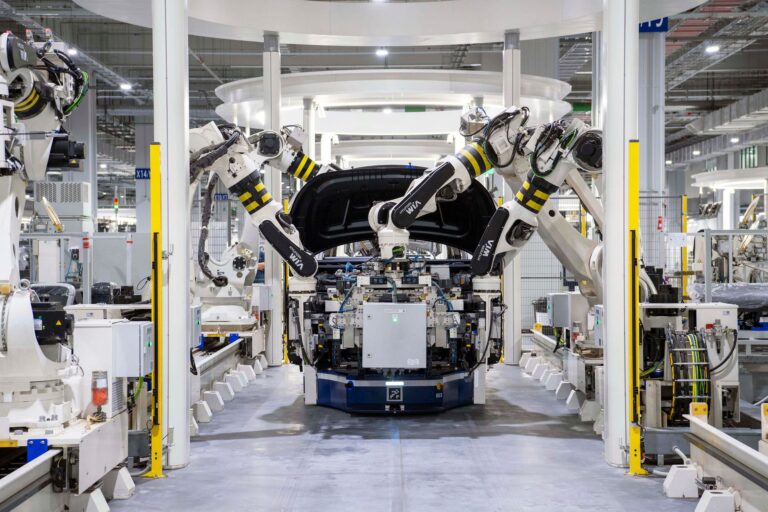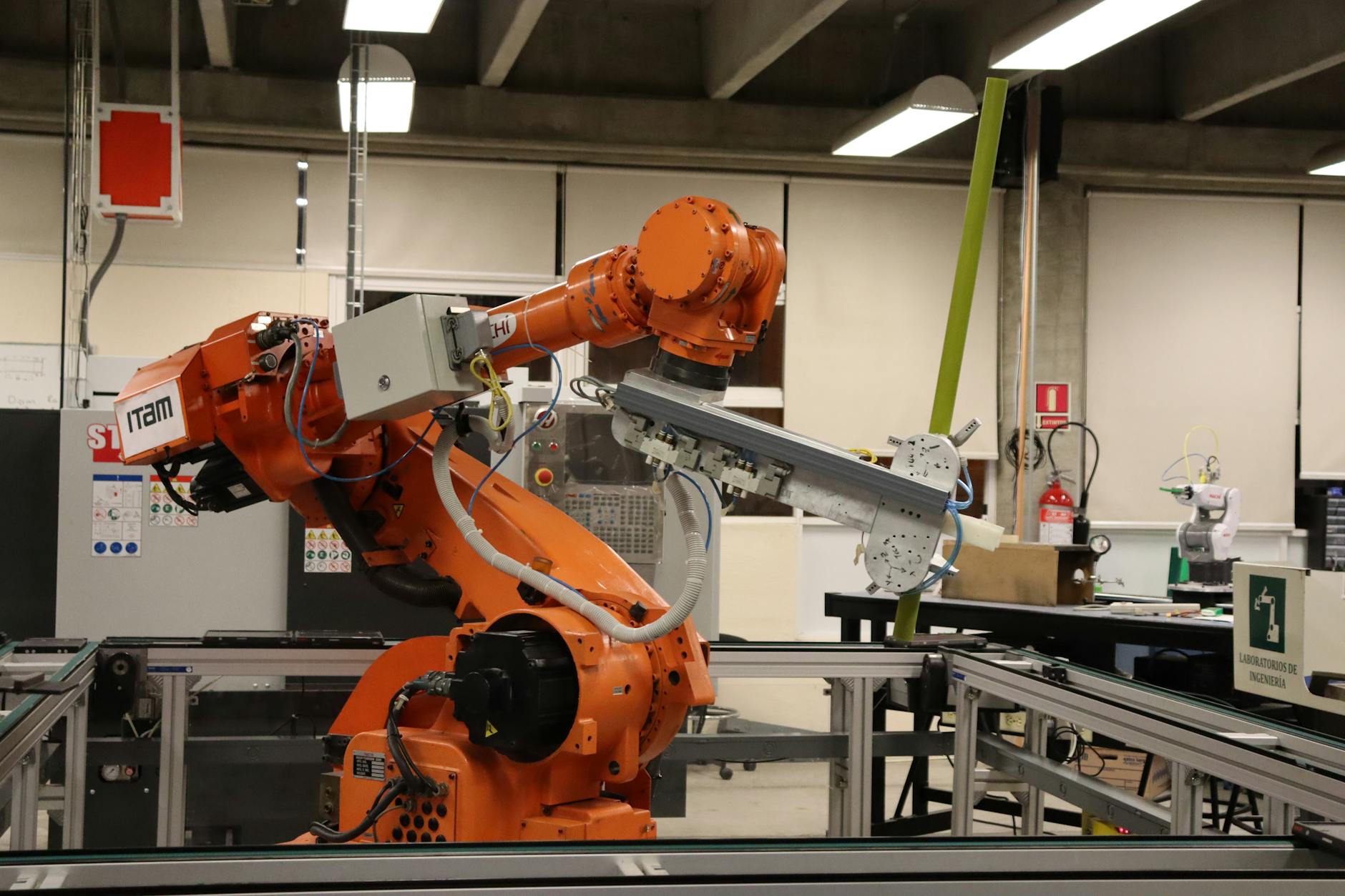

ABB isn’t quite the Nvidia of industrial robotics—but understanding that distinction reveals why the Swiss automation giant matters so much. Where Nvidia provides the foundational AI and simulation technology that powers the entire robotics ecosystem, ABB operates as one of the dominant hardware and software platforms that customers actually deploy on factory floors. ABB Robotics controls roughly 400,000 installed industrial robots globally and generates $2.3 billion in annual revenue from its robotics division alone, making it one of the few companies with both the market reach and technical depth to compete across the entire robotics stack.
The clearer comparison is this: ABB is to industrial robotics what Intel once was to computing—a pervasive infrastructure provider that sets the technical standards everyone else builds around. The recent SoftBank acquisition of ABB’s robotics division for $5.375 billion (announced October 2025, expected to close mid-to-late 2026) signals a strategic inflection point. This isn’t a struggling business being rescued. It’s one of the few truly global robotics companies being consolidated into a portfolio specifically designed to compete in the era of physical AI, where companies like NVIDIA are reshaping the competitive landscape by making simulation and automation software dramatically more powerful and accessible.
Table of Contents
- Why ABB Dominates Where It Dominates
- The NVIDIA Partnership and the New Competitive Landscape
- The SoftBank Acquisition Reshapes the Game
- RobotStudio as Competitive Moat and Weakness
- Competitive Pressure from Below and Across
- The Nvidia Comparison Examined
- What Comes After SoftBank
- Conclusion
Why ABB Dominates Where It Dominates
ABB’s position in industrial robotics rests on installed base rather than flashy innovation. The company operates in over 100 countries with approximately 110,000 employees globally, and roughly 7,000 of those work in the robotics division. More tellingly, more than 60,000 customers use ABB’s RobotStudio software platform—the de facto standard for designing and simulating robotic production lines. RobotStudio matters because it’s where manufacturers spend weeks or months planning a robot deployment before a single physical unit ever touches a factory floor.
Consider a automotive manufacturer setting up a new welding cell in Germany. The engineering team isn’t manually coding robot trajectories anymore; they’re using RobotStudio to virtually prototype the entire operation, test for collisions, optimize paths, and validate cycle times—all before installation. That ubiquity creates switching costs. Once a company has trained engineers, built IP, and embedded RobotStudio into their workflow, migrating to a competitor’s software becomes an expensive, risky proposition. Competitors like FANUC, YASKAWA, and KUKA have their own simulation tools, but none achieve RobotStudio’s breadth of adoption or ecosystem maturity.

The NVIDIA Partnership and the New Competitive Landscape
In 2026, ABB and NVIDIA are reshaping how robots get deployed. RobotStudio HyperReality, rolling out in the second half of 2026, integrates NVIDIA Omniverse libraries directly into the ABB platform. The performance gains are substantial: up to 80 percent reduction in setup and commissioning times, 40 percent cost reduction, and 50 percent faster time-to-market for new robot deployments. Simulation now correlates with real-world behavior at 99 percent accuracy—a ceiling that was aspirational even five years ago. But here’s the critical limitation: this partnership doesn’t make ABB autonomous from NVIDIA’s technology choices.
ABB is one of several “physical AI leaders” building on top of NVIDIA’s platform, alongside FANUC, YASKAWA, and KUKA. NVIDIA, by controlling the underlying simulation and AI infrastructure, effectively controls the ceiling of what all these robotics companies can achieve. If NVIDIA makes a breakthrough in digital-twin fidelity or physics modeling, everyone benefits. But if NVIDIA prioritizes different market segments or raises licensing costs, ABB and its competitors have limited leverage. The partnership is powerful, but it’s not ABB’s technology alone driving the advantage.
The SoftBank Acquisition Reshapes the Game
SoftBank’s $5.375 billion acquisition of ABB’s robotics division signals a fundamental shift in how industrial automation will be funded and developed. ABB takes a pre-tax book gain of approximately $2.4 billion on the sale, freeing capital for other priorities. But the deeper story is what SoftBank intends: consolidating ABB’s robotics business with other automation and robotics assets under unified leadership, positioning the combined entity to compete directly against vertically integrated robotics giants like FANUC, which remains independent and privately controlled.
The acquisition isn’t expected to close until mid-to-late 2026, pending regulatory approvals. During that window, ABB will be operating as a quasi-autonomous unit, still owned by ABB but earmarked for exit. That creates genuine risk: engineering talent often leaves during announced acquisitions, R&D momentum can stall, and customers may hesitate to make long-term commitments with uncertain ownership. However, SoftBank’s track record with robotics investments suggests management stability; the company isn’t known for radically transforming acquired businesses overnight.

RobotStudio as Competitive Moat and Weakness
RobotStudio’s dominance as a software platform creates a powerful economic moat—but also concentrates risk. The software operates on a licensing model that ABB (and soon SoftBank) controls entirely. When customers upgrade RobotStudio versions, feature availability and pricing are non-negotiable. Compare this to open-source robotics frameworks like ROS (Robot Operating System), which are free, community-driven, and platform-agnostic.
ROS has gained serious traction in research labs and smaller manufacturers precisely because it removes vendor lock-in. A company using ROS can swap hardware from different robotics makers without rewriting control software. A company deeply embedded in RobotStudio faces much higher switching costs if they want to diversify suppliers. This tradeoff explains why ABB retains such a strong position in established industrial verticals (automotive, heavy equipment, food processing) while newer entrants and smaller manufacturers increasingly explore ROS-based alternatives. ABB’s advantage is real, but it’s also conditional on customers valuing integration and mature support over flexibility and cost.
Competitive Pressure from Below and Across
ABB’s scale advantage obscures mounting competitive pressure from two directions. Established competitors like FANUC and YASKAWA are investing heavily in AI-powered simulation and digital twins. FANUC’s cloud-based simulation tools are narrowing the gap with RobotStudio, while YASKAWA is aggressively courting customers through partnerships in China and Southeast Asia. Neither company has the installed base ABB does, but both are competent, capital-rich, and motivated. More disruptive is the emergence of collaborative robot (cobot) manufacturers like Universal Robots and Techman, who prioritize ease of use and lower capital costs over the traditional industrial robotics playbook.
These companies don’t compete on sophisticated programming environments; they compete on plug-and-play deployment and accessibility. For ABB, this matters because it fragments the market. Not every manufacturer needs RobotStudio’s depth; many would rather buy a cobot that works out of the box. ABB has responded by launching its own cobot line, but it’s playing catch-up in a segment it dismissed for years. The warning here is clear: ABB’s dominance in traditional industrial robotics doesn’t automatically translate to new market segments.

The Nvidia Comparison Examined
The phrase “Nvidia of industrial robotics” invites a specific misreading. NVIDIA is dominant in AI infrastructure—chips, software, and platforms that enable downstream applications. ABB is dominant in industrial automation—the actual systems that manufacturers deploy. These are adjacent but distinct markets. NVIDIA’s power is increasing precisely because robotics and automation are becoming software-intensive.
ABB benefits from that shift, but it also means ABB is now partially dependent on NVIDIA’s roadmap and licensing terms. In the clearer historical analogy, ABB resembles Intel in the 1990s: a pervasive infrastructure provider with high switching costs, strong margins, and deep customer relationships. But Intel’s dominance eroded as the computing industry shifted from hardware to software and cloud services. The risk for ABB is similar. If robotics becomes increasingly software-defined and cloud-native—a reasonable bet given the NVIDIA partnership and RobotStudio’s trajectory—then ABB’s primary value shifts from hardware vendor to software platform provider. That’s a defensible position, but it’s qualitatively different from its current role.
What Comes After SoftBank
SoftBank’s acquisition closes a significant chapter for ABB while opening a more uncertain one. SoftBank has committed capital and strategic intent, which matters for sustained R&D investment. The company’s vision of “physical AI leaders” suggests it will fund aggressive development in simulation, autonomy, and workforce optimization features. That’s positive for ABB customers and the robotics industry broadly.
But SoftBank’s portfolio-building strategy also implies ABB will be repositioned within a larger ecosystem. Future integration with other SoftBank robotics investments could accelerate innovation but might also dilute ABB’s focus or create organizational friction. The mid-to-late 2026 closing timeline gives the industry time to assess how the transition unfolds, but it also extends a period of operational uncertainty. For customers and partners, the practical advice is simple: lock in long-term support agreements and pricing now, while ABB’s incentives remain aligned with customer retention.
Conclusion
ABB is neither the Nvidia of industrial robotics nor a fading incumbent. It’s a dominant, global platform provider at an inflection point—powerful in its installed base and software ecosystem, but increasingly dependent on NVIDIA’s infrastructure and vulnerable to competitive fragmentation from cobots, open-source frameworks, and cloud-native alternatives. The SoftBank acquisition signals confidence in the robotics market and ABB’s role within it, but it also marks the end of ABB’s three-decade run as an independent robotics company.
For manufacturers evaluating robotics investments, ABB remains a credible, feature-rich choice with deep support and mature workflow integration. But the choice is no longer automatic. The robotics market is splintering into specialized segments—collaborative, mobile, cloud-native—where other players are competing effectively. ABB’s challenge under SoftBank ownership will be evolving fast enough to compete across these segments while maintaining the engineering discipline and customer focus that built its original dominance.