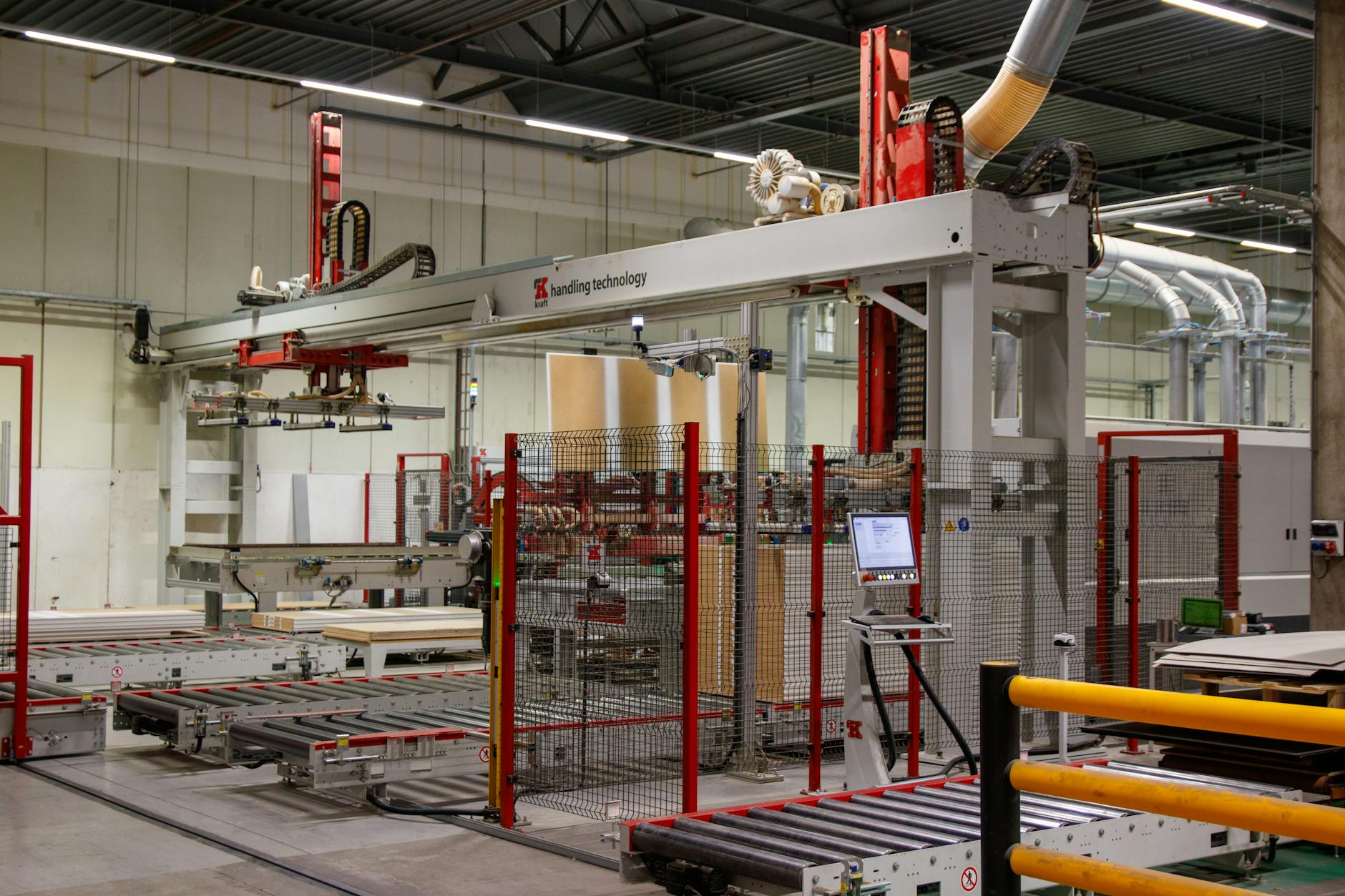

ABB, specifically its North American operations centered in New York and beyond, has become the foundational backbone supporting modern manufacturing automation. The company’s industrial robots, control systems, and integrated automation platforms form the technological core that enables factories worldwide to achieve higher precision, faster production cycles, and greater flexibility than traditional manual or semi-automated processes. For decades, ABB has dominated the landscape by providing not just robots, but complete ecosystem solutions—from collaborative arms working alongside human workers to massive gantry systems handling tons of material, making them indispensable to how manufacturing actually functions at scale.
What makes ABB’s role truly central is that they don’t just manufacture individual components; they architect entire production systems. A typical automotive plant might rely on ABB robotic arms for welding, ABB’s motion control software for coordinating dozens of machines in sequence, and ABB’s analytics platforms to monitor performance across the factory floor. This integration means that when you optimize one part of the system, the software and hardware work together seamlessly rather than fighting against incompatible interfaces.
Table of Contents
- How Have Industrial Robots Transformed Manufacturing Flexibility?
- What Are the Limitations of Current Robotic Manufacturing Systems?
- What Real-World Applications Demonstrate ABB’s Manufacturing Impact?
- What Are the Trade-offs Between Speed, Cost, and Integration Complexity?
- What Are Common Implementation Failures and Hidden Challenges?
- How Are AI and Data Analytics Changing ABB’s Role in Manufacturing?
- What Does the Future of Manufacturing Robotics Look Like?
- Conclusion
- Frequently Asked Questions
How Have Industrial Robots Transformed Manufacturing Flexibility?
The traditional assembly line, popularized a century ago, was rigid by design—once set up for a specific product, retooling for a different variant required weeks of downtime and expensive reconfiguration. ABB’s collaborative and programmable robotic solutions inverted this constraint. Modern ABB robots can be reprogrammed in hours, not weeks, allowing manufacturers to switch between product lines or adapt to custom orders without paralyzing production. Electronics manufacturers, for example, can now use the same robotic workcell to assemble different phone models or laptop configurations simply by uploading new software, rather than physically replacing fixtures and tooling. However, this flexibility comes with a significant caveat: the initial programming and system integration requires skilled engineers and specialized knowledge.
Many manufacturers discover that moving from one product to another smoothly requires more preparation than anticipated. Additionally, the collaborative robots that work safely alongside humans operate at somewhat reduced speeds compared to traditional industrial robots, creating a tradeoff between worker safety and throughput that manufacturers must evaluate for their specific needs. The comparison with non-roboticized competitors is stark. Factories in developing regions that relied on low-wage manual labor for decades are now facing obsolescence because they cannot match the speed, consistency, and adaptability of even mid-sized roboticized facilities. Companies that invested in ABB systems ten years ago have significantly lower per-unit costs today, while those that delayed are struggling to compete.
What Are the Limitations of Current Robotic Manufacturing Systems?
While ABB’s systems are sophisticated, they operate within real physical and economic constraints that often go unmentioned in marketing materials. Robotic systems excel at repetitive, well-defined tasks in controlled environments—welding identical seams, moving objects from point A to point B, applying precise coatings. They struggle with tasks that require genuine adaptability: picking random, unpredictable objects from a pile (computer vision is improving but remains unreliable in variable lighting), responding to unexpected changes mid-cycle, or handling materials that are fragile or of inconsistent quality. Consider pharmaceutical manufacturing, where ABB robots handle precise dispensing and packaging, but human technicians must still oversee quality control because the cost of a contaminated batch is catastrophic. The robots handle the deterministic portions while humans manage the high-stakes judgment calls.
This hybrid model is actually the norm in advanced manufacturing, not the exception—the industry fantasy of “fully autonomous” factories doesn’t match reality. The capital cost also remains substantial. A moderately equipped ABB robotic system, installed and integrated into an existing line, can easily exceed several million dollars. For small manufacturers, this investment is simply unaffordable, which is why certain industries remain stubbornly manual or semi-automated. Smaller companies often cannot achieve the per-unit cost reductions that justify such investment, creating a widening gap between large corporations with capital and smaller competitors without it.
What Real-World Applications Demonstrate ABB’s Manufacturing Impact?
Automotive manufacturing provides the most visible example—Tesla, BMW, and Ford facilities rely heavily on ABB’s large industrial robots for welding, material handling, and assembly. In Tesla’s factories, ABB robots work in coordinated teams, with each unit specialized for a specific task. The company’s “Giga Press” operations, which cast entire vehicle underbodies, depend on ABB’s industrial hydraulics and motion control systems to position and hold massive castings with micron-level precision while they cool. Without this precision, automotive bodies wouldn’t achieve the tolerances required for safety, aerodynamics, and structural integrity. In the food and beverage sector, ABB’s innovations in hygiene-compliant robotic design have transformed production scales.
Factories processing fresh food, where contamination risks are high and daily cleaning is mandatory, use ABB robots with sealed joints and stainless steel construction to maintain both sanitation and throughput. A facility that once required dozens of workers for repetitive packaging and sorting tasks can now achieve higher volumes with a fraction of the labor, while reducing contamination incidents. The semiconductor industry pushes ABB’s precision even further. In wafer fabrication plants, where tolerances are measured in nanometers and any contamination can destroy a batch worth millions, ABB’s cleanroom-compatible robots transport and position wafers through multi-step chemical processes. The stakes are so high that redundant systems and multiple verification checkpoints are built into every operation—a failure mode that would be acceptable in automotive assembly is unacceptable here.

What Are the Trade-offs Between Speed, Cost, and Integration Complexity?
Manufacturers typically face three competing demands: they want robots that are fast (to maximize throughput), affordable (to improve ROI), and easy to integrate (to minimize disruption during implementation). ABB products exist across this spectrum, but you cannot optimize all three simultaneously. High-speed ABB systems designed for maximum throughput are expensive and require careful integration with substantial safety margins—the faster a robot moves, the more potential for damage if something goes wrong. Mid-range systems offer better balance but are still complex to program and integrate. Entry-level collaborative robots are most affordable and easiest for non-experts to deploy, but operate more slowly and require more floor space. A typical comparison: an automotive manufacturer needing ultra-high speed for a high-volume product line will invest in ABB’s fastest industrial arms with extensive safety infrastructure, pushing total project cost upward but achieving the lowest per-unit production cost over time.
A consumer goods company with moderate volumes and periodic product changes might choose ABB’s collaborative robots instead, accepting slower cycles but gaining flexibility and faster ROI. The wrong choice can mean either overbuilding (paying for speed you don’t need) or underbuilding (investing in collaborative robots for a task that demands the throughput of industrial-grade equipment, then discovering you’ve created a bottleneck). Integration complexity is often underestimated. Even with ABB’s software ecosystem, connecting a new robotic system to legacy manufacturing equipment requires custom engineering, network configuration, and extensive testing. A midsize manufacturing facility expanding automation often needs 3-6 months of integration work after hardware installation, during which production is constrained. Larger corporations with dedicated automation engineering teams absorb this overhead more easily than smaller manufacturers, reinforcing the competitive advantage of scale.
What Are Common Implementation Failures and Hidden Challenges?
Many manufacturers discover that installing ABB robots is only half the battle—the real challenge is the human and organizational side. Workers initially feel threatened by automation and may resist training or cooperation during implementation. More subtly, factories often underestimate the need for ongoing maintenance expertise. ABB systems require specialized technicians for troubleshooting, spare parts availability can be a bottleneck, and downtime becomes critical—if a single robotic arm fails in a coordinated assembly line, the entire line often stops, not just that station. Supply chain vulnerability emerged as a serious issue during the COVID-19 pandemic and semiconductor shortage. Because ABB components are critical and highly specialized, when supply chains break, manufacturers face weeks or months of downtime.
Companies learned the hard way that having inventory buffers and contingency contracts matters more than they’d anticipated. A secondary warning: proprietary software ecosystems mean that if ABB discontinues support for a particular control system generation, older installations may struggle to find replacement parts or compatible upgrades, creating technical debt. Another underappreciated challenge is the learning curve for programming and optimization. While ABB’s software has improved significantly, extracting full performance from a complex multi-robot system requires genuine engineering skill. Facilities often operate robots at 60-70% of theoretical capacity because nobody on staff has mastered the optimization techniques, effectively leaving money on the table. This is not ABB’s failure—it’s an industry-wide reality that automation expertise is scarce and expensive.
How Are AI and Data Analytics Changing ABB’s Role in Manufacturing?
Modern ABB systems collect enormous volumes of operational data—every movement, every cycle time, every temperature reading, every error state. Manufacturers are increasingly applying machine learning to this data to predict maintenance needs before failures occur (predictive maintenance) and identify optimization opportunities that aren’t visible through conventional analysis. A factory running ABB robots might discover through data analysis that adjusting cycle timing by 2 seconds across multiple stations saves 15% energy consumption, or that certain product variants consistently cause slight delays, enabling process redesign.
This data-driven evolution is transforming ABB from a pure hardware/software vendor into something closer to a manufacturing intelligence platform. Customers who embrace this shift achieve significantly better results than those treating robots as static production tools. However, this also means manufacturers are becoming increasingly dependent on ABB’s ecosystem—switching vendors becomes harder once your entire operation depends on their analytics platforms and predictive models.
What Does the Future of Manufacturing Robotics Look Like?
The trajectory is clear: robots will become more autonomous, more capable of handling variable and unpredictable conditions, and more integrated with AI-driven decision-making. ABB is investing heavily in machine vision, soft robotics for handling delicate materials, and autonomous mobile robots that can navigate unstructured environments rather than operating in fixed positions. The next generation of manufacturing will likely feature more hybrid systems where robots collaborate more naturally with human workers, sharing workspace without rigid separation barriers.
However, this future remains years away for most facilities. The vast majority of manufacturing today still runs on decades-old automation principles, with human-robot separation and highly structured processes. ABB’s role as the backbone will likely intensify rather than diminish—as manufacturers automate further, they’ll deepen their reliance on ABB’s systems, expertise, and ecosystem, making integration and switching costs even more significant than they are today.
Conclusion
ABB’s position as the robotics backbone of manufacturing is not accidental—it reflects decades of engineering excellence, ecosystem integration, and willingness to support manufacturers through the full complexity of automation adoption. From automotive to pharmaceuticals to semiconductors, the company’s robotic arms, control systems, and software platforms are essential infrastructure. However, this centrality also means manufacturers must carefully evaluate their dependencies, maintain adequate technical expertise, and view robotic automation as a long-term commitment requiring ongoing investment rather than a one-time capital purchase.
For manufacturers considering or expanding robotic automation, the essential takeaway is that ABB’s systems enable genuine competitive advantages—but only when properly implemented, integrated, and optimized by teams with real expertise. The robots themselves are reliable and capable; success or failure comes down to the organizational capacity to use them effectively. Companies that treat automation as a strategic transformation rather than a simple equipment upgrade tend to capture the value ABB’s systems promise.
Frequently Asked Questions
How long does it typically take to implement an ABB robotic system at a manufacturing facility?
Installation of the hardware takes weeks, but full system integration, programming, testing, and staff training typically requires 3-6 months. Larger, more complex implementations can extend to 9-12 months. The timeline depends heavily on how well your existing systems integrate and how skilled your integration team is.
What happens if an ABB robot breaks down? How long is production interrupted?
For a single robot failure, downtime depends on whether the facility has spare parts on-site and can replace the unit quickly. In coordinated production lines, a single robot failure often stops the entire line, making downtime highly disruptive. Most manufacturers maintain spare components and service contracts to minimize this risk.
Can older ABB robotic systems be upgraded to newer technology, or do they become obsolete?
Partial upgrades are possible—you can often update control systems, software, and sensors on existing robots. However, complete replacement is sometimes more economical than extensive upgrades, especially for robots 15+ years old. Software obsolescence is a real risk as older systems lose vendor support.
How much does a complete ABB robotic system cost to install at a small-to-medium manufacturing facility?
Costs vary widely based on complexity and existing infrastructure. A single robotic arm with controls and integration might cost $500,000-$1.5 million. A coordinated multi-robot system for a manufacturing line can easily exceed $5-10 million when you include infrastructure, integration, safety systems, and training.
What is the difference between ABB’s collaborative robots (cobots) and traditional industrial robots?
Cobots are designed to work safely alongside human workers with lighter force limits and built-in safety features, operating at slower speeds. Industrial robots operate faster and with greater force, but require isolation from human workers. Choose cobots for flexibility and human collaboration; choose industrial robots for maximum speed and throughput.
How do you measure whether an ABB robotic system is delivering expected ROI?
Track per-unit production cost, cycle time, quality metrics (defect rates), and downtime. Compare these against your pre-automation baseline and against competitor benchmarks. Most well-implemented systems show positive ROI within 3-5 years, but this depends entirely on whether you’re using the system at its actual capacity rather than well below its potential.