
An exoskeleton robot is a wearable frame that senses user intent and adds controlled force at the joints. Reliable designs combine appropriate sensors, stable control, and fail-safe mechanical and electrical behavior. Readers can use this guide to compare approaches, spot weak points, and ask better questions before building, buying, or deploying a system. Each choice involves trade-offs among weight, responsiveness, comfort, and maintenance.
Table of Contents
- How do exoskeletons sense intent and motion?
- Which control approach fits the task?
- How is safe force delivered at the joint?
- What makes a design reliable?
- How should you test fit and performance?
How do exoskeletons sense intent and motion?
Joint encoders measure angle and speed at each assisted joint. Inertial sensors track trunk and limb orientation, while force and pressure sensors detect contact, load transfer, and interaction force between wearer and frame.
Surface muscle signals and foot or hand switches can provide earlier intent cues for starting assistance. These signals vary with sweat, placement, fatigue, and fit, so practical systems fuse several inputs rather than trusting one channel.
Which control approach fits the task?
Impedance and admittance control shape how the device responds to the wearer's force. A stiff position controller suits repetitive lifting, while a compliant follower suits walking assistance and rehabilitation.
State machines often separate standing, walking, lifting, and sitting. Transitions should depend on sustained sensor conditions, not a single threshold crossing, to prevent jerky mode changes.
- Select high assistance for heavy lifting and low assistance for free movement.
- Use gravity compensation when holding postures matters more than speed.
- Add adjustable limits for range, torque, and speed for each joint.
How is safe force delivered at the joint?
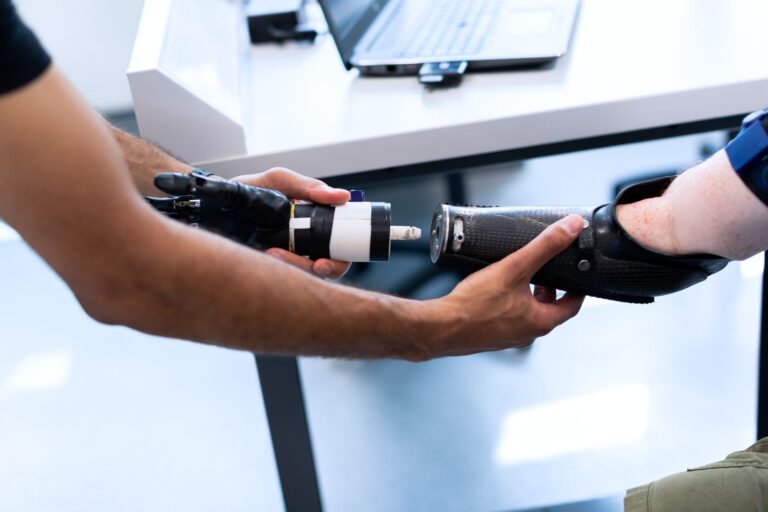
Actuators, gears, linkages, and cuffs determine comfort as much as power. Series elasticity, backdrivability, and torque limits help the joint yield safely when the wearer resists or collides with an obstacle.
Alignment matters because cuffs apply force through soft tissue. Adjustable links, padded interfaces, and hard stops reduce rubbing, pressure points, and overextension during long use.
What makes a design reliable?
Reliability comes from handling faults as normal events. Power loss, sensor dropout, cable damage, and software errors should leave the device in a safe state, usually low resistance or locked support for standing.
Good practice includes redundant sensing for critical joints, watchdog timers, separate safety limits, and clear error signals. Sealed connectors, strain relief, washable straps, and accessible fasteners reduce failures from sweat, dust, and repeated donning.
- Check emergency stop, power-off behavior, and joint backdrivability before routine use.
- Inspect cuffs, cables, fasteners, and batteries for wear and heat.
- Log faults, operating hours, and maintenance actions for each unit.
How should you test fit and performance?
Test with the intended tasks, clothing, footwear, and loads. Measure task time, perceived effort, skin pressure, walking stability, and the time needed to don, doff, adjust, and charge the system.
Include edge cases such as stairs, uneven ground, narrow spaces, heat, and interruptions. A design that works only with expert fitting, perfect calibration, or frequent restarts will struggle in daily operation. Keep acceptance criteria tied to completed work with acceptable comfort and upkeep.