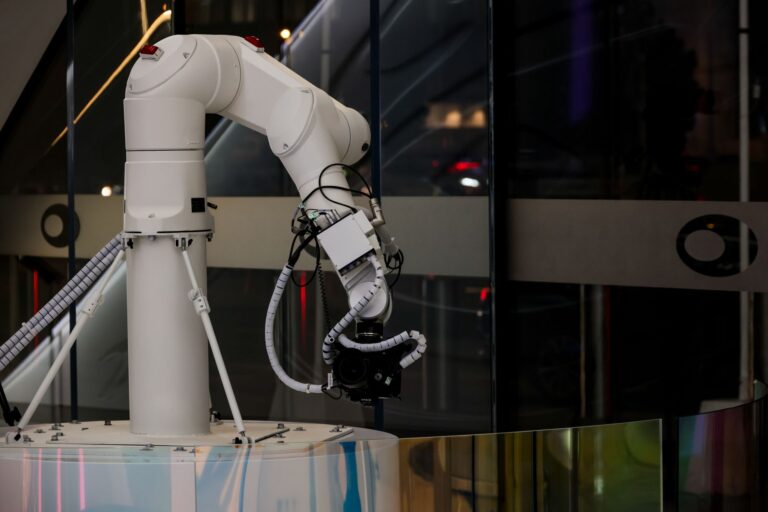

Robots help most in data-center construction by taking over layout and drilling. On concrete slabs they print full-scale walls, MEP runs, embeds and anchors, and on ceilings and floors they mark and drill anchor holes. Data centers reward that focus because small errors multiply across thousands of racks and supports. Trimble technology VP Aviad Algamor says in a Data Centre Magazine interview that demand for efficiency and accuracy makes data centers ideal for prefabrication and automation.
Table of Contents
- What layout robots print on the floor
- How much time layout automation can save
- Where ceiling-drilling robots help MEP work
- Where high-volume floor drilling pays off
What layout robots print on the floor
Dusty Robotics says its FieldPrinter prints BIM and CAD layout directly onto concrete at 1/16-inch accuracy, according to the FieldPrinter product page. BIM means the digital building model, and CAD means the design drawings, so crews see walls, MEP, embeds and anchors full-size where they will build. That matters in large electrical and IT rooms with tight tolerances.
Workers can set hangers, sleeves and rack bases from printed lines instead of measuring from control points. The result is fewer layout mistakes before concrete, steel and MEP work advances. General contractor JE Dunn has used the system since 2021 on hyperscale and mission-critical jobs to improve quality and reduce onsite labor. Data-center builder Align offers one concrete example of the payoff.
How much time layout automation can save
Dusty Robotics reports that Align saved 784 layout person-hours on one data-center project, as described in the Align customer story. Two workers finished a 15,000-square-foot IT-rack room layout in one day. The gain comes from speed plus fewer callbacks. A robot can move steadily across open slab while staff handle control, materials and checks.
For managers, the practical step is to schedule layout as a short robot pass, then keep electricians and fitters ready to build from fresh marks. The limit is scope. Printing shows exact locations but does not place conduit, pipe, fixtures or racks. Teams should plan installation labor separately and protect printed lines from traffic and water.
Where ceiling-drilling robots help MEP work
Hilti says its Jaibot marks and drills overhead MEP anchor holes from AutoCAD and Revit data through Hilti Cloud. It runs cordless for up to 8 hours and collects dust during drilling. Overhead drilling is slow, tiring and dusty for people on lifts.
A semi-autonomous unit can work a corridor of hangers with steady spacing while crews stage rod, strut and pipe nearby. That fit suits long data halls with repeated supports for cable tray, duct and piping. Use it where ceilings are clear and models are current:.
- finished MEP model with anchor points and heights
- clear access for the robot and lift support
- dust control and edge protection for overhead work
- crew assigned to install supports right after drilling
Where high-volume floor drilling pays off
DEWALT reports that its fleet-capable DALE downward-drilling robot drilled over 230,000 holes at 99.97% accuracy during a year-long hyperscaler pilot. The system was built with August Robotics and is now commercially available for data-center work. DEWALT also reports 190 weeks saved across 26 construction phases, cutting about eight to nine weeks of layout plus drilling to about seven to nine days.
The lesson is to deploy fleets where thousands of floor anchors repeat, such as rack lines and electrical equipment pads. Robots still do not finish the job. Contractors pair drilling and layout robots with prefab spool welding and connected BIM-to-field workflows to meet compressed 12-month schedules amid pipefitter and electrician shortages, based on Hilti and Novarc reporting. Order prefab early, verify the model before printing, then install immediately after holes are drilled.