
SERV Robotics has positioned itself as the dominant infrastructure play in autonomous delivery, earning comparisons to Amazon’s marketplace model by building a scalable platform that partners with major brands rather than competing against them. The Pasadena-based company, which spun off from Uber in 2021, operates the largest fleet of Level 4 autonomous delivery robots in the United States and has secured exclusive partnerships with Uber Eats across multiple metropolitan areas. Where Amazon transformed retail by becoming the essential middleman between sellers and consumers, SERV is attempting the same disruption in last-mile delivery by becoming the robotic fulfillment layer that restaurants and retailers plug into rather than build themselves. The comparison to Amazon carries weight when examining SERV’s strategic approach.
Rather than launching a competing food delivery app, SERV embedded itself within the existing Uber Eats ecosystem, handling the physical delivery while Uber manages customer relationships and order flow. This mirrors how Amazon Web Services became essential infrastructure for companies that technically compete with Amazon’s retail arm. SERV has expanded this playbook to include partnerships with 7-Eleven for convenience store delivery and Magna International for manufacturing scale. The company’s robots have completed over 100,000 commercial deliveries in Los Angeles alone, providing real operational data that most competitors lack. This article examines how SERV built its platform advantage, the technology enabling autonomous sidewalk navigation, limitations that could slow expansion, and how the company’s approach differs from vertically integrated competitors like Starship Technologies and Nuro.
Table of Contents
- What Makes SERV the Amazon of Delivery Robotics?
- How SERV Robots Navigate Urban Sidewalks Autonomously
- SERV’s Partnership Strategy With Uber Eats and Beyond
- Comparing SERV to Starship, Nuro, and Other Delivery Robot Competitors
- Limitations and Risks in SERV’s Business Model
- SERV’s Manufacturing Partnership With Magna International
- The Future of Autonomous Delivery Infrastructure
- Conclusion
What Makes SERV the Amazon of Delivery Robotics?
The roboticsreports.com/kscp-the-amazon-of-autonomous-patrol-robots/” title=”KSCP The Amazon of Autonomous Patrol Robots”>amazon comparison stems from SERV’s deliberate choice to become infrastructure rather than a consumer-facing brand. Amazon succeeded by making itself indispensable to both sellers and buyers through fulfillment centers, logistics networks, and a trusted marketplace. SERV applies similar logic to delivery robotics: restaurants don’t want to operate robot fleets, and consumers don’t care which robot brings their food as long as it arrives hot. By integrating directly with Uber Eats, SERV handles the complex robotics while letting established brands maintain customer relationships. This platform model creates network effects that single-operator competitors struggle to match. Each new restaurant on Uber Eats becomes a potential SERV customer without SERV spending anything on merchant acquisition.
Each successful delivery generates training data that improves navigation algorithms across the entire fleet. The company claims its robots can complete deliveries at roughly half the cost of human couriers in dense urban areas, though this figure depends heavily on delivery density and local regulations. In markets like Los Angeles and Dallas, SERV robots operate on public sidewalks with minimal human oversight, achieving what the company calls “supervisory autonomy” where one remote operator can monitor multiple robots simultaneously. However, the Amazon comparison has limits. Amazon built infrastructure that other businesses literally cannot function without””few companies can match AWS’s scale or replicate Prime’s logistics network overnight. SERV’s moat is narrower. A well-funded competitor could theoretically build equivalent robots and negotiate similar partnerships, though doing so would require years of operational learning and regulatory groundwork that SERV has already completed.

How SERV Robots Navigate Urban Sidewalks Autonomously
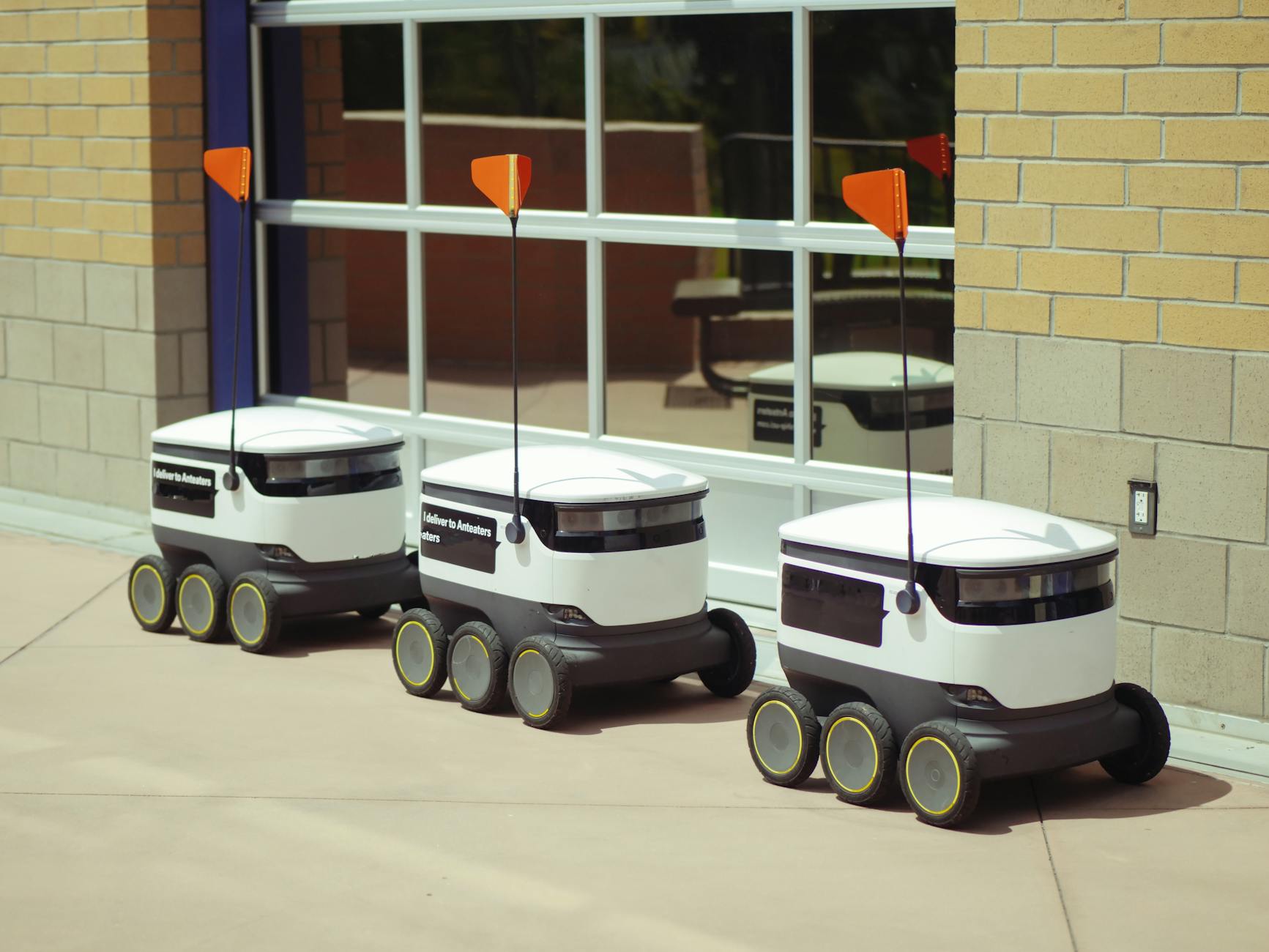
SERV’s robots use a sensor fusion approach combining cameras, lidar, ultrasonic sensors, and GPS to navigate sidewalks without human intervention. The vehicles weigh approximately 100 pounds, travel at pedestrian speeds of three to four miles per hour, and carry insulated compartments capable of holding multiple food orders simultaneously. Unlike delivery drones that face airspace restrictions or larger autonomous vehicles that require street-legal certification, SERV’s sidewalk robots operate in a regulatory gray zone that has proven easier to navigate in most jurisdictions. The autonomy system processes environmental data through onboard computers running proprietary navigation software. When a robot encounters an unexpected obstacle””a construction barrier, a dog on a long leash, a person blocking the path””it can typically route around the obstruction without human assistance. For edge cases the system cannot resolve, the robot stops and requests help from a remote operator who can see through its cameras and provide guidance.
SERV reports that intervention rates have dropped significantly as the system accumulated real-world miles, though the company does not publish specific intervention frequency data. Limitations emerge in certain environments. Heavy rain degrades camera and lidar performance, requiring reduced speeds or temporary service pauses. Steep hills challenge the robot’s motors and stability, restricting service areas in cities like San Francisco. Extremely crowded sidewalks, common during events or rush hours in dense urban cores, can slow robots to the point where delivery times become uncompetitive with human couriers. SERV has concentrated deployment in suburban-dense corridors and university campuses where these constraints matter less.
SERV’s Partnership Strategy With Uber Eats and Beyond
The Uber partnership gives SERV access to demand without the enormous expense of building a consumer brand and merchant network from scratch. Under their agreement, SERV robots appear as a delivery option within the Uber Eats app when customers order from participating restaurants within robot service areas. Uber handles payment processing, customer support, and merchant relationships; SERV handles the physical delivery. Revenue splits are not publicly disclosed, but the arrangement lets both companies focus on their core competencies. Beyond Uber, SERV has pursued partnerships that diversify its revenue base and use cases. The 7-Eleven partnership enables convenience delivery for items like snacks, beverages, and over-the-counter medications””products with lower time sensitivity than restaurant food but higher margins for the retailer.
The manufacturing partnership with Magna International addresses a critical bottleneck: SERV’s ability to scale depends on producing thousands of robots at automotive-grade quality and cost. Magna, which builds components for most major car manufacturers, brings manufacturing expertise that a startup could not develop internally. These partnerships create mutual dependencies that can be either stabilizing or risky. If Uber decided to develop its own robotic delivery capability””the company briefly operated a robotics division before selling it””SERV would lose its primary demand channel overnight. Conversely, Uber now depends on SERV to deliver the cost reductions that make robotic delivery economically viable. This interdependence resembles the relationship between Amazon and third-party sellers who generate a majority of marketplace volume but remain vulnerable to Amazon’s platform decisions.

Comparing SERV to Starship, Nuro, and Other Delivery Robot Competitors
The delivery robotics sector includes several well-funded competitors with different strategic approaches, and SERV’s position is not unassailable. Starship Technologies, founded by Skype co-founders, has deployed smaller robots primarily on college campuses and achieved over five million deliveries globally. Nuro operates larger road-legal vehicles designed for grocery and package delivery rather than restaurant meals. Each approach involves tradeoffs that make direct comparisons complicated. Starship’s campus focus generates reliable, dense demand in controlled environments where navigation is simpler than public sidewalks. Universities provide captive customer bases of students who often lack cars, creating conditions where robotic delivery makes obvious sense. However, campus deployments rarely translate to broader urban markets, and Starship has struggled to expand beyond the educational niche.
Nuro’s road-based vehicles can carry heavier loads and travel faster than sidewalk robots but face stricter regulatory requirements and higher development costs. Nuro has secured regulatory approval in California and Texas but operates at smaller scale than SERV’s sidewalk fleet. SERV occupies a middle ground: more versatile than Starship’s campus-specific model, less capital-intensive than Nuro’s road vehicles. The tradeoff is that sidewalk regulations vary dramatically by city, creating a patchwork of operating environments. Some cities have banned delivery robots from sidewalks entirely, citing pedestrian safety concerns and accessibility issues for wheelchair users. Others have embraced the technology. SERV’s expansion depends partly on regulatory arbitrage””growing fastest in jurisdictions with favorable rules while lobbying for changes elsewhere.
Limitations and Risks in SERV’s Business Model
Despite strong positioning, SERV faces constraints that could prevent the Amazon-scale dominance the comparison implies. The most fundamental limitation is geographic: robotic delivery works best in specific built environments featuring wide sidewalks, moderate weather, relatively flat terrain, and sufficient order density. Large portions of the United States””rural areas, hilly cities, regions with harsh winters””may never be viable markets for sidewalk robots regardless of how good the technology becomes. Unit economics remain unproven at scale. SERV claims cost advantages over human couriers, but these calculations typically assume high utilization rates that depend on dense order volume. A robot sitting idle between deliveries burns through its capital cost without generating revenue.
The company has raised over $100 million in funding, including a 2024 IPO via SPAC merger, but has not demonstrated consistent profitability. If delivery density proves harder to achieve than projected, or if robot hardware costs decline more slowly than expected, the economic case weakens. Regulatory risk compounds operational uncertainty. Several cities have introduced or considered legislation restricting delivery robots on public sidewalks, often in response to complaints from disability advocates who argue the robots create obstacles for wheelchair users and visually impaired pedestrians. A single high-profile accident involving a SERV robot and a pedestrian could trigger restrictive regulation across multiple jurisdictions simultaneously. The company maintains strong safety records to date, but the risk is inherent to operating autonomous vehicles in public spaces.
SERV’s Manufacturing Partnership With Magna International
The Magna partnership announced in 2023 addresses a constraint that has bottlenecked other robotics startups: the difficulty of manufacturing complex electromechanical systems at scale. Building prototypes in small batches differs fundamentally from producing thousands of reliable units with consistent quality. Magna operates manufacturing facilities across North America and Europe with existing supply chains, quality control systems, and workforce expertise that would take SERV decades to replicate.
Under the partnership, Magna manufactures SERV’s next-generation robots at a dedicated facility, targeting production capacity sufficient for significant fleet expansion. The robots incorporate automotive-grade components””sensors, motors, batteries””sourced through Magna’s existing supplier relationships, potentially reducing costs through volume purchasing. This arrangement mirrors how consumer electronics companies like Apple outsource manufacturing to specialists like Foxconn, focusing internal resources on design and software rather than factory operations.
The Future of Autonomous Delivery Infrastructure
SERV’s trajectory over the next several years will test whether the Amazon comparison proves prescient or merely aspirational. The company has announced expansion plans covering additional cities and expects to deploy thousands of robots by 2026, assuming manufacturing scales as planned. Success would validate the platform model and potentially attract acquisition interest from logistics companies, retailers, or technology firms seeking autonomous delivery capabilities. The broader market context favors growth in delivery robotics.
Labor costs for delivery drivers continue rising, gig economy regulations increasingly require companies to provide benefits that inflate costs further, and consumers expect ever-faster delivery. These pressures create genuine demand for autonomous alternatives. Whether SERV captures that demand depends on execution””maintaining safety records, improving unit economics, navigating regulations, and defending against competitors who observe its playbook and attempt replication. The Amazon comparison is flattering but premature; Amazon’s infrastructure dominance took decades to construct, and SERV is barely three years into its independent existence.
Conclusion
SERV Robotics has built a credible claim to being the infrastructure layer for autonomous delivery, partnering with established brands rather than competing against them and operating the largest Level 4 sidewalk robot fleet in the United States. The company’s integration with Uber Eats, expansion into convenience retail, and manufacturing partnership with Magna create a foundation that most competitors lack. The Amazon comparison reflects strategic intent more than current scale, but the approach mirrors the platform logic that made Amazon essential to online retail.
Significant uncertainties remain around unit economics, regulatory durability, and competitive moats. Investors, partners, and observers should watch delivery density metrics, intervention rates, and geographic expansion for signals of whether the model can achieve the scale necessary to justify valuations. The technology works; the question is whether the business model works at the scale necessary to transform last-mile logistics.