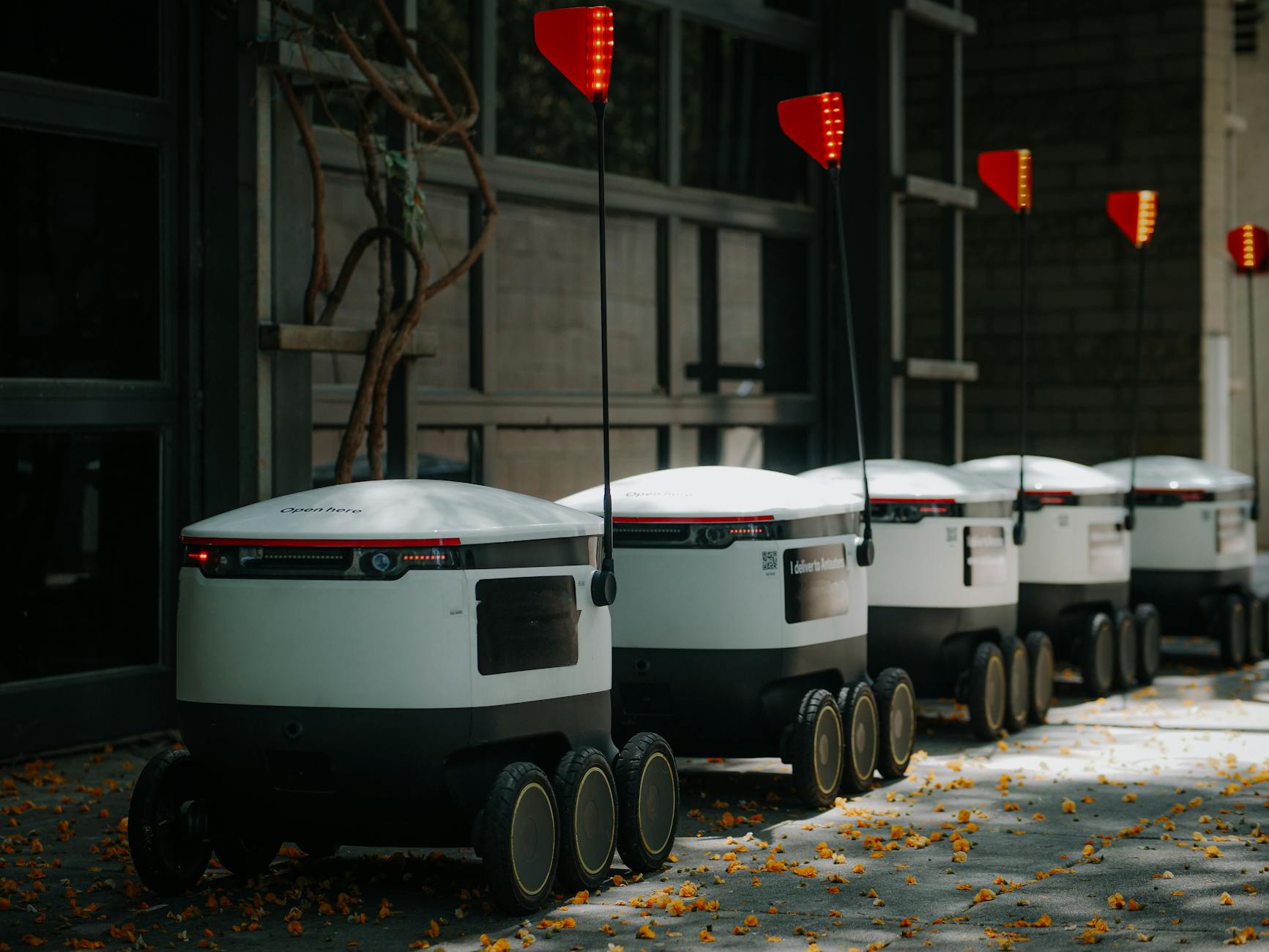

SERV Robotics has emerged as the early frontrunner in last-mile delivery robotics, carving out a dominant position in a market that larger, better-funded competitors have struggled to crack. The company, spun out of Uber in 2021, has executed where others have stumbled””deploying thousands of sidewalk delivery robots across Los Angeles, Dallas, and other major markets while securing landmark partnerships with Uber Eats, 7-Eleven, and Shake Shack. While rivals like Amazon’s Scout program quietly shuttered and Starship Technologies remained confined to college campuses, SERV scaled commercial operations in dense urban environments, completing over 100,000 deliveries by late 2024. What separates SERV from the pack isn’t just technology””it’s a pragmatic business model built on unit economics rather than science fiction promises.
The company charges delivery fees competitive with human couriers while eliminating labor costs that consume 60-70% of traditional delivery expenses. A single SERV robot completing 10-15 deliveries per day in a busy urban corridor can generate meaningful revenue at margins impossible for gig-economy drivers. This article examines how SERV built its lead, the technical and regulatory moats protecting that position, the limitations that could slow expansion, and what the competitive landscape looks like heading into the late 2020s. The logistics robotics space has seen billions in investment yield remarkably few success stories. Understanding why SERV succeeded where well-capitalized competitors failed offers lessons for the broader autonomous systems industry””and signals where the market is heading next.
Table of Contents
- Why Has SERV Dominated the Sidewalk Delivery Robot Market?
- The Technical Architecture Behind SERV’s Reliability
- Unit Economics: Why Investors Are Betting on SERV
- Geographic Expansion: Where SERV Operates and Why
- Competitive Threats and Market Risks
- The Uber Relationship: Asset or Liability?
- What Comes After Sidewalk Delivery?
- Conclusion
Why Has SERV Dominated the Sidewalk Delivery Robot Market?
serv‘s dominance stems from a combination of timing, technical pragmatism, and strategic partnerships that competitors failed to replicate. The company inherited uber‘s Postmates delivery robot program, which provided years of real-world operational data from Los Angeles streets””a head start that pure-technology startups couldn’t match. Rather than chasing full autonomy from day one, SERV deployed a hybrid model where remote operators could take control when robots encountered edge cases, allowing commercial service to launch years before fully autonomous operation was technically feasible. The Uber Eats partnership proved transformative. Unlike competitors who had to build demand from scratch, SERV plugged directly into an existing delivery network with millions of active users.
When an Uber Eats customer in West Hollywood orders lunch, the app can seamlessly route that delivery to a SERV robot without the customer needing to download a new app or change behavior. This integration solved the chicken-and-egg problem that killed many delivery startups: you need customer demand to justify robot deployment, but you can’t attract customers without robots already in position. Regulatory strategy also played a crucial role. While some competitors fought city governments or operated in legal gray areas, SERV invested heavily in municipal relationships. The company obtained permits in cities like Los Angeles and San Jose through lengthy approval processes that, once complete, created barriers for competitors who hadn’t done the same groundwork. By early 2025, SERV had authorization to operate in jurisdictions covering over 100 million Americans””a regulatory moat that takes years to replicate.
- —

The Technical Architecture Behind SERV’s Reliability
SERV’s robots rely on a sensor fusion approach combining cameras, LiDAR, ultrasonic sensors, and GPS to navigate sidewalks safely. The fourth-generation hardware, deployed throughout 2024, can handle rain, darkness, and crowded pedestrian environments that earlier iterations struggled with. Critically, the robots maintain cellular connectivity to a remote operations center where human supervisors can intervene within seconds if the autonomous systems encounter situations they can’t resolve””a drunk pedestrian blocking the path, construction detours, or unusual obstacles like fallen trees. The remote supervision model represents a key philosophical difference from companies pursuing pure autonomy. SERV accepts that edge cases will occur and builds human oversight into unit economics from the start, rather than betting everything on achieving 99.99% autonomy before launching. Each remote operator can monitor multiple robots simultaneously, stepping in only when needed.
As the autonomous systems improve, the ratio of robots to operators increases””SERV reported moving from roughly 3:1 in 2022 to over 15:1 by late 2024, with the goal of reaching 50:1 or higher. However, this architecture has limitations. Remote operation requires robust cellular coverage, making rural or underground deployments problematic. Latency issues in network-congested areas can delay human intervention during critical moments. And while remote operators cost far less than delivery drivers, they remain a significant expense that pure-autonomy competitors hope to eventually eliminate entirely. If a rival achieves reliable unsupervised operation, SERV’s cost advantage could evaporate quickly.
- —
Unit Economics: Why Investors Are Betting on SERV
The investment thesis behind SERV centers on unit economics that improve dramatically with scale. A delivery robot costing approximately $5,000-$10,000 to manufacture can complete thousands of deliveries over its operational lifetime. At $2-3 in delivery fees per trip and minimal marginal costs once deployed, payback periods of 12-18 months become achievable in high-density markets. Compare this to human delivery, where labor costs recur with every single order and driver retention remains a persistent challenge. SERV’s 2024 SPAC merger valued the company at approximately $800 million””modest by autonomous vehicle standards but reflecting investor confidence in near-term profitability rather than distant promises.
The company reported reaching profitability on a per-delivery basis in several Los Angeles zones, though overall corporate profitability remained elusive due to R&D expenses and geographic expansion costs. Management has targeted company-wide profitability by 2026-2027, assuming continued deployment growth. For comparison, Nuro””which pursued larger autonomous delivery vehicles operating in streets rather than sidewalks””burned through over $2 billion before dramatically scaling back operations in 2024. Starship Technologies, SERV’s closest sidewalk competitor, has remained operationally limited despite raising over $200 million. The pattern suggests that SERV’s scrappier approach””incremental deployment, hybrid autonomy, platform partnerships””may prove more viable than the moonshot strategies favored by better-funded rivals.
- —

Geographic Expansion: Where SERV Operates and Why
SERV has deliberately concentrated operations in a handful of high-density markets rather than spreading thin across dozens of cities. Los Angeles remains the core territory, with robots operating in neighborhoods from Hollywood to Santa Monica. Dallas-Fort Worth followed, with deployments around specific commercial corridors. San Diego, San Jose, and Vancouver have seen pilots or limited rollouts. The strategy prioritizes markets with permissive regulations, high delivery demand, consistent weather, and flat terrain””not coincidentally, the same criteria that favor sidewalk traversal. The concentration approach maximizes operational efficiency. Dense robot deployment in limited areas means shorter distances between deliveries, higher utilization rates, and more efficient maintenance logistics.
A repair technician in Los Angeles can service dozens of robots; the same technician supporting scattered robots across multiple cities would spend most of their time traveling. SERV has resisted the temptation to announce headline-grabbing expansion into every major metro, focusing instead on depth before breadth. Geographic limitations remain real constraints. Cities with harsh winters pose challenges for sidewalk robots that struggle with snow and ice. Hilly terrain like San Francisco creates battery and navigation difficulties. Many suburban areas lack the sidewalk infrastructure and pedestrian density that make robot delivery economically viable. SERV’s addressable market, while substantial, excludes large portions of the United States””a ceiling that investors should consider when evaluating growth projections.
- —
Competitive Threats and Market Risks
SERV’s early lead doesn’t guarantee long-term dominance. Amazon, despite shuttering Scout, retains enormous logistics infrastructure and could re-enter delivery robotics if the economics improve. Waymo and Cruise, focused on autonomous vehicles, could pivot toward smaller delivery robots using their self-driving technology. International competitors like China’s Neolix operate in markets SERV hasn’t touched, potentially developing advantages that transfer to U.S. expansion. The regulatory environment that currently protects SERV could shift unpredictably.
Cities that welcomed robot pilots might impose new restrictions as fleets scale””sidewalk congestion, pedestrian safety incidents, or public backlash against “robots taking jobs” could prompt regulatory crackdowns. San Francisco briefly banned delivery robots from most sidewalks in 2017 before partially reversing course, demonstrating how quickly municipal sentiment can shift. A high-profile accident involving any company’s robot could trigger industry-wide restrictions. Labor dynamics present another wildcard. Gig-economy delivery drivers have organized protests against robot deployment in several cities, framing automation as a threat to working-class livelihoods. While these efforts haven’t yet produced significant regulatory changes, political winds could shift””particularly if unemployment rises or automation becomes a more prominent political issue. Companies operating delivery robots may face labor-relations challenges that purely software businesses avoid.
- —
The Uber Relationship: Asset or Liability?
SERV’s partnership with Uber Eats provides distribution advantages no startup could replicate independently, but also creates dependency risks. Uber currently owns a significant stake in SERV and routes substantial delivery volume through the robot fleet. If Uber decided to develop competing technology in-house, acquire a different robotics company, or simply deprioritize robot delivery, SERV would lose its primary demand channel overnight.
The relationship also limits SERV’s ability to partner with Uber’s competitors. DoorDash, Grubhub, and Instacart might hesitate to integrate with a company partially owned by their rival. SERV has pursued independent partnerships””7-Eleven and Shake Shack don’t route through Uber””but scaling beyond the Uber ecosystem remains a strategic priority that hasn’t yet been fully demonstrated.
- —
What Comes After Sidewalk Delivery?
SERV’s platform could extend beyond restaurant delivery into adjacent logistics markets. Pharmacy delivery, grocery runs, and small-package shipping represent natural expansions that leverage existing hardware and operational capabilities. The company has announced pilots with healthcare and retail partners exploring these use cases. If successful, total addressable market expands substantially beyond the $30-40 billion U.S.
food delivery sector. Longer-term, sidewalk robots could serve as data collection platforms for other autonomous systems. High-definition maps of urban environments, pedestrian behavior patterns, and infrastructure conditions have value to autonomous vehicle developers, city planners, and commercial real estate investors. Whether SERV monetizes this data or keeps it proprietary for competitive advantage remains to be seen, but the information accumulating with every delivery represents an underappreciated asset.
- —
Conclusion
SERV has established itself as the clear leader in last-mile delivery robotics through strategic partnerships, regulatory groundwork, and pragmatic technology choices that prioritized commercial viability over theoretical purity. The company’s hybrid autonomy model, Uber Eats integration, and concentrated geographic strategy have produced operational scale that competitors haven’t matched. Unit economics are trending toward profitability in core markets, validating the thesis that sidewalk robots can compete with human delivery drivers on cost. Challenges remain substantial.
Geographic expansion is constrained by weather, terrain, and infrastructure limitations. Regulatory and labor-relations risks could materialize unpredictably. Dependency on Uber creates strategic vulnerability. And well-capitalized competitors might yet develop superior technology that erases SERV’s early advantages. For investors, operators evaluating robotics partnerships, and industry observers, SERV represents the clearest proof yet that autonomous delivery can work at commercial scale””and the most relevant case study for understanding where logistics robotics heads next.