
Industrial cable demand is surging because manufacturing automation is expanding faster than ever before, and every new automated system requires specialized cabling infrastructure. The global industrial automation cable market is projected to grow from $8.78–$11.25 billion in 2026 to $9.5–$20.12 billion by 2035, expanding at a compound annual growth rate of 6.7–8.2%. This explosive growth reflects a fundamental shift in how factories operate: as production floors move away from hardwired, legacy systems toward networked, sensor-rich environments, they consume vastly more cable—and that cable must meet far stricter performance standards than traditional industrial wiring.
The acceleration is driven by three converging forces: the proliferation of industrial robots, the adoption of Industry 4.0 architecture, and the explosion of real-time data communication on factory floors. These trends are not speculative; they are already embedded in operational facilities worldwide. Understanding why cable demand is surging requires looking at the actual state of global manufacturing automation today, not theoretical projections.
Table of Contents
- How Fast Is Industrial Cable Demand Really Growing?
- The Automation Adoption Wave That Is Transforming Manufacturing
- Industrial Robots and the Physical Demand for Cable
- Industrial Ethernet and the Data Cable Explosion
- Hybrid Cables and the Shift Away from Single-Purpose Designs
- High-Flex Cables for Continuous Motion and Flexible Automation
- Industrial Automation’s Outsized Share of Multicore Cable Demand
- Frequently Asked Questions
How Fast Is Industrial Cable Demand Really Growing?
The industrial automation cable market sits within a larger industrial cable ecosystem, but it is growing much faster than the overall market. While the global industrial cable market is projected to reach $168.4 billion by 2035 with a more modest 2.77% compound annual growth rate, the automation-specific segment is expanding at more than double that pace. By 2030—just four years away—the industrial automation cable market alone is expected to reach $12.48–$12.49 billion, a landmark that highlights how quickly this market is transitioning from niche to mainstream.
The disparity in growth rates reveals where capital and production capacity are flowing. Grid modernization and renewable energy infrastructure account for significant portions of the broader industrial cable market, but those segments grow steadily. Automation cable growth, by contrast, is volatile and upward because manufacturers are ripping out and replacing entire control systems, not merely upgrading them incrementally. A factory automating its first production line may consume 10,000 meters of cable in a single project; a facility expanding from 50 robots to 200 robots might double its annual cable consumption overnight.
The Automation Adoption Wave That Is Transforming Manufacturing
As of 2024, 72% of global manufacturing facilities have integrated at least one form of automated control system, and over 70% of large-scale manufacturing facilities worldwide have implemented Industry 4.0 systems. These are not early-adopter statistics—they describe a fundamental reshaping of how production works. Facilities that had not adopted automation a decade ago are now forced to do so by competitive pressure, customer expectations for speed and customization, and the labor economics of manufacturing in developed markets.
This transition carries real costs and constraints. Retrofitting an older factory with automation is expensive and disruptive, requiring temporary production stoppages, extensive re-cabling, and staff retraining. Many facilities that have not yet automated are delaying because the capital expenditure is substantial and the supply chain for automation equipment remains strained. However, the momentum is undeniable: the facilities that have not yet automated are the ones driving incremental cable demand now, and they represent the largest pool of future growth.
Industrial Robots and the Physical Demand for Cable
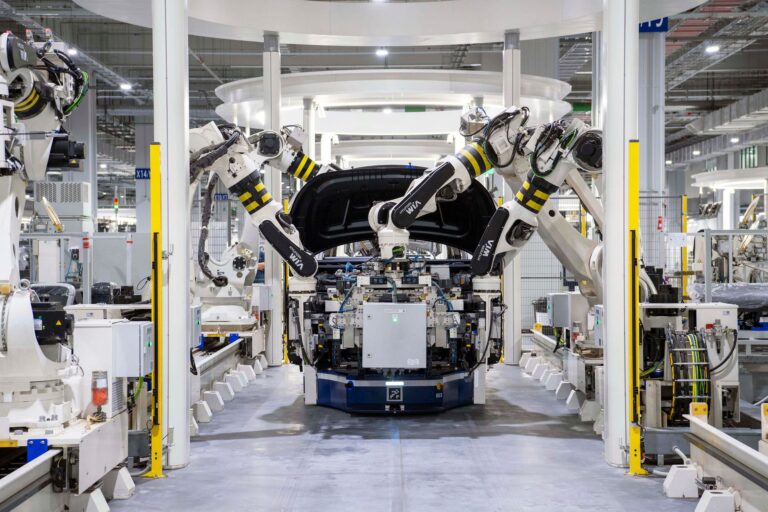
The International Federation of robotics reported that operational industrial robots reached 4,281,585 units in 2023, a 10% increase compared to 2022. More striking than the absolute number is the density metric: robotics density increased 37% between 2020 and 2024. This means that factories are not just deploying robots in isolated cells—they are saturating production floors with them, creating densely interconnected environments where every robot must communicate with others, with vision systems, with programmable logic controllers, and with centralized manufacturing execution systems.
Each robot is an endpoint that consumes cable. A 6-axis collaborative robot moving 100 kilograms might require 15–25 meters of multi-conductor cable just for power and control, plus additional high-flex cables for the wrist and end-effector. A factory deploying 50 such robots is consuming 750–1,250 meters of specialized cable just for motion control, before accounting for sensor cables, pneumatic lines, and communication cabling. At a robotics density increase of 37% over four years, the aggregate cable consumption across all factories globally is skyrocketing.
Industrial Ethernet and the Data Cable Explosion
Industrial Ethernet has become the default communication standard for modern automation systems. Sixty-seven percent of new automation systems deploy industrial Ethernet, and adoption of this technology increased 64% between 2020 and 2024. This transition is not backward-compatible—industrial Ethernet requires M12 connectors, shielded twisted-pair cabling, and cable management that differs fundamentally from legacy parallel relay logic or analog 4–20 milliamp control signals.
Demand for industrial Ethernet cables (M12- and RJ45-based Cat5e/Cat6 variants) is growing 8–12% annually, outpacing standard unshielded cable categories. The fastest-growing segment within industrial automation cables is data cables overall, driven by industrial IoT adoption, smart factory expansion, and the need for real-time data-driven operations. Forty-four percent of installations now require cables supporting data speeds above 1 Gbps, placing them outside the range of legacy category 3 or category 5 cabling. This creates a hard constraint: older cable stock cannot be repurposed; it must be replaced with new, higher-performance variants.
Hybrid Cables and the Shift Away from Single-Purpose Designs
A striking trend in cable selection is the adoption of hybrid fiber-copper designs. Fifty-nine percent of new systems utilize hybrid fiber-copper cables, and 33% of installations overall now prefer hybrid cables. This represents a major departure from traditional industrial practice, where power cables, signal cables, and fiber optic cables were routed separately.
Hybrid cables reduce the cable count in a conduit, simplify installation, and provide isolation between power and sensitive signal lines—all advantages in a densely automated environment. However, hybrid cables are more expensive than traditional alternatives, more difficult to terminate, and require technicians trained in both copper and fiber termination practices. A factory that has outsourced its skilled trades over the past 10 years may struggle to find installers capable of properly terminating M12 hybrid connectors. This creates a bottleneck: demand for hybrid cables is rising, but supply-side constraints—including installer skill gaps and manufacturing capacity for specialized terminations—may limit growth in the near term.
High-Flex Cables for Continuous Motion and Flexible Automation
Forty-one percent of new automation installations are shifting to high-flex rated cable designs, driven by the expansion of continuous-motion robots, articulated handling systems, and collaborative arms that move through the full range of their workspace thousands of times per day. Traditional industrial cable, designed for fixed runs in cable trays, fails quickly in high-flex applications where the cable is bent to a small radius repeatedly.
High-flex cable costs 2–3 times more than standard industrial cable, but it lasts 5–10 times longer in motion applications. The return on investment is clear for continuous-motion applications, but many automation integrators and smaller manufacturers still specify standard cable to reduce upfront costs, then discover during commissioning that the cable flexing around the robot’s moving arm has already begun to crack the outer jacket. This creates retrofit demand: a facility discovers the wrong cable was specified, and now they must partially re-cable while the production line is offline—a scenario happening frequently enough that it represents a non-trivial portion of cable market growth.
Industrial Automation’s Outsized Share of Multicore Cable Demand
Industrial automation accounts for 32% of global multicore cable demand, even though automation represents a smaller percentage of total industrial cable consumption. This concentration reflects the shift from legacy hardwired systems, where control required individual pairs for each circuit, to networked systems where complex functions are communicated over multiconductor bundles. A control panel that once required 200 individual wires routed to 200 individual terminals now requires five multiconductor cables carrying multiplexed signals to distributed nodes.
This transition is still in its early stages. Many facilities are hybrid—running both legacy relay logic and modern Ethernet-based distributed control in parallel—which actually increases total cable consumption beyond what either system alone would require. As these hybrid systems are rationalized and fully migrated to networked architecture, the multicore cable segment will capture an even larger share of automation spending. The data cable segment within industrial automation is expected to be the fastest-growing category through 2035, driven by industrial IoT adoption and the requirement for real-time data collection from every node on the factory floor.
- —
Frequently Asked Questions
Why does industrial automation cable cost more than standard industrial cable?
Industrial automation cables must meet stricter performance standards for shielding, flexibility, and data integrity. M12 and RJ45 industrial Ethernet cables include foil shielding and precision terminations that add cost; hybrid cables integrate multiple materials; and high-flex variants use more durable jacket compounds. Standard cable cannot carry the same signal reliability or withstand the same flex cycles.
What is driving the shift to hybrid cables?
Hybrid fiber-copper cables reduce the number of cable runs needed in crowded conduits, provide electrical isolation between power and signal lines, and simplify cable management on complex automation equipment. The tradeoff is higher cost and more specialized installation skills required.
Will data cables really outpace power and control cables in growth?
Yes. As factories add more sensors, vision systems, and networked I/O devices, data traffic on factory floors is growing exponentially. Industry 4.0 requires real-time data collection, and that data must flow over high-speed cables. Power and control cables grow at a steady rate tied to new equipment deployment, but data cables grow at the rate of increased connectivity and sensor density.
Why is robotics density increasing so fast?
Labor costs and supply chain reliability favor automation in high-wage markets. Factories that resisted automation a decade ago are now forced to deploy robots to remain competitive. Additionally, collaborative robots are safer and easier to program than traditional industrial robots, lowering the barrier to adoption across facility sizes.
What happens to facilities that specify the wrong cable and discover it during startup?
They must retrofit—partially or fully re-cable the installation while the production line is offline. This creates unplanned demand and premium pricing for expedited cable delivery and emergency labor. It is a common scenario in the automation integration industry.
How much cable does a typical automated production line consume?
A small line with 10–15 robots and supporting vision and sensor equipment might consume 2,000–5,000 meters of various cable types. A large automotive assembly line with 100+ robots, extensive sensor networks, and networked I/O can consume 50,000–100,000 meters or more. Each facility is unique, but the density of cabling in modern automation is several orders of magnitude higher than in legacy hardwired systems.