
Microrobots, robots that operate at millimeter scale and below, work inside confined spaces while traditional industrial arms move larger parts across factory cells. A microrobot trades strength and reach for fine motion, while an industrial arm trades fineness for payload, reach, and steady force.
Choose based on part size, access, and force. Small and fragile targets point toward microrobots. Heavy parts and repeated pick-and-place over a wide area point toward an industrial arm.
Table of Contents
- How do size and workspace differ?
- How do movement and gripping work?
- Which tasks fit each type?
- What limits each approach?
- How do you choose the right type?
How do size and workspace differ?
Microrobots operate where fingers and standard tools cannot reach. They can travel through narrow channels, work inside small chambers, or handle tiny components under a microscope. Traditional arms need open floor space, mounting, and clearance for full motion.
The workspace shapes safety and setup. A microrobot system often centers on a bench, chip, dish, or enclosed test area. An industrial arm needs a guarded cell with fixtures, conveyors, and room for operators to load and unload.
How do movement and gripping work?
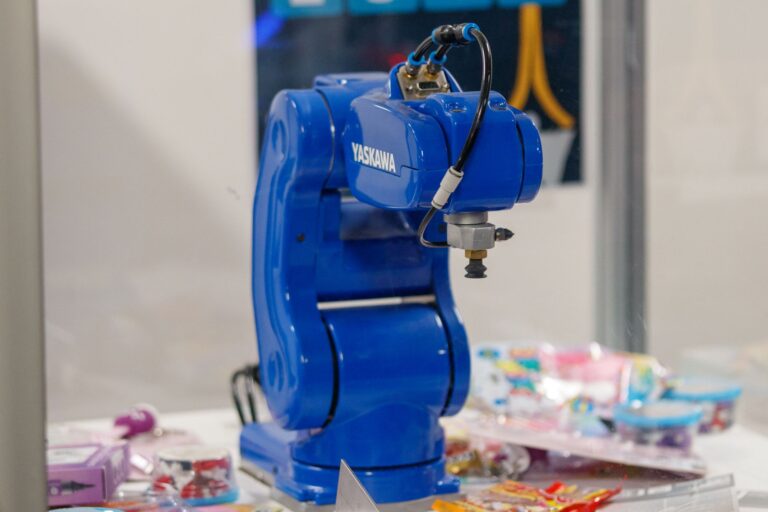
Most industrial arms use powered joints that bend and rotate in programmed paths. They grip with mechanical fingers, suction cups, or task tools such as welders and spray heads. Control focuses on repeatable position, speed, and force at human scale.
Microrobots use a wider mix of drives because small motors are hard to fit. Many respond to magnetic fields, electric fields, light, vibration, or fluid flow. Gripping may mean pushing, pulling, trapping, sticking, or guiding a particle rather than closing a claw.
Which tasks fit each type?
Microrobots fit sorting cells, placing microelectronic parts, inspecting narrow tubes, and moving samples in lab tools. They also support research uses such as targeted delivery tests and precise handling of soft material. The common thread is a small target in a tight or sensitive place.
Industrial arms fit welding, painting, machine tending, packaging, palletizing, and assembly of larger goods. They excel when the same motion must repeat many times with firm force. They also carry sensors and cameras for inspection across large parts.
What limits each approach?
Microrobots have little force and limited range. They can stall against friction, fluid currents, rough surfaces, or small debris. Control and tracking also get harder as size drops, especially outside clear lab conditions.
Industrial arms take floor space and need guarding, power, and careful programming. They are too large for work inside small channels and too stiff for very soft targets. Changeover can also take time when parts, fixtures, or tools change.
How do you choose the right type?
Start from the smallest part and the tightest access point. Then check force, speed, cleanliness, and human safety.
Test with the real parts and fluids before committing. Match the robot to the smallest feature and hardest reach first, then confirm payload and guarding.
- Pick microrobots when the work happens inside narrow, sealed, wet, or delicate spaces.
- Pick an industrial arm when parts are heavy, the reach is wide, or cycle time matters.
- Use both when tiny handling must feed into larger assembly, packing, or transport.