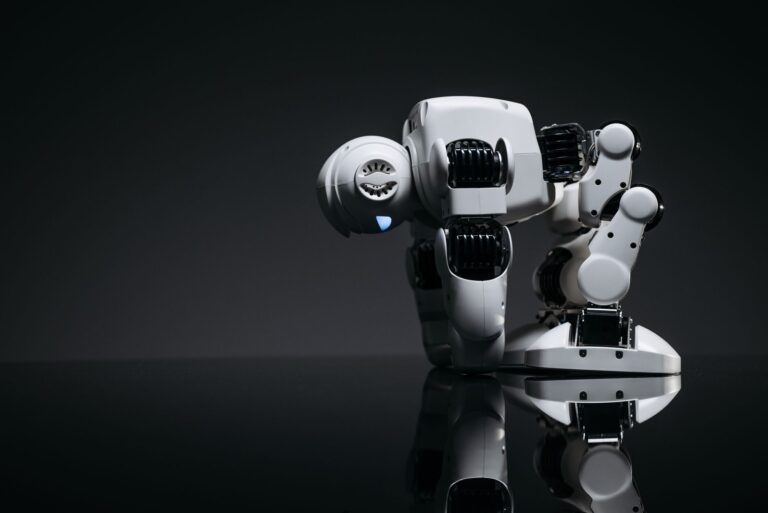

RBOT represents one of the most aggressive and high-stakes bets in modern robotics—a company founded on the principle that the only way to accelerate robotics adoption is to build for the absolute hardest problems first, rather than waiting for technology to mature. Unlike competitors who refined existing automation for incremental gains, RBOT’s founders wagered their capital and reputation on technologies that were barely viable when the company launched, betting that breakthroughs in AI, vision systems, and mechanical engineering would converge within a specific window of opportunity.
This strategy has either positioned them as visionaries or set them up for a spectacular failure—there is very little middle ground. The extreme nature of RBOT’s bet stems from three core decisions: targeting industrial applications that no other automation company would touch due to technical complexity, maintaining a 10-year runway without profitability requirements, and building proprietary hardware and software simultaneously instead of licensing existing platforms. For context, most industrial robotics companies spend 3-5 years bringing a product to market; RBOT designed their roadmap assuming 15+ years to reach meaningful scale, a timeline that requires either exceptional capital backing or unwavering conviction that markets will reward the technology once it matures.
Table of Contents
- Why RBOT Chose the Most Difficult Automation Problems
- The Capital Requirements and Investor Tolerance for Extended Timelines
- The Dual Hardware-Software Bet and Manufacturing Constraints
- Market Timing and the Race Against Technology Commoditization
- The Technical Debt and Reliability Challenges of Early Systems
- Competition and the Risk of Being Outmaneuvered
- The Long-Term Vision and What Success Looks Like
- Conclusion
- Frequently Asked Questions
Why RBOT Chose the Most Difficult Automation Problems
rbot‘s founding thesis rejected the conventional robotics playbook entirely. Rather than deploying articulated arms for automotive assembly—a market already saturated with ABB, FANUC, and KUKA robots—RBOT targeted material handling in unstructured environments, dynamic bin picking with deformable objects, and multi-modal task execution in spaces designed for human workers. These are problems that have resisted automation for decades because they require real-time visual reasoning, adaptive force control, and generalist rather than specialist capabilities. For example, while a traditional industrial robot can reliably place bolts in fixed positions on a car frame, RBOT’s technology aims to sort mixed recyclables from a conveyor belt in real-time, adjusting grip pressure for plastic versus metal instantaneously.
The reasoning behind this approach is sound from a market perspective: if RBOT can solve genuinely hard problems, the TAM becomes enormous. Bin picking alone represents a $20 billion addressable market that remains largely manual. However, the technical risk is proportional to the opportunity. Legacy robotics companies avoided these problems not out of laziness but because the required sensing, compute, and control hardware didn’t exist at a price point that made commercial sense. RBOT essentially bet that cloud computing, GPU-accelerated vision, and advances in electric actuation would mature fast enough to make their designs viable—but none of this was guaranteed when they started.

The Capital Requirements and Investor Tolerance for Extended Timelines
Building robotics at the scale RBOT envisions requires capital that most startups never access. Manufacturing facilities, hardware iteration, field testing across multiple verticals, and the engineering talent required to span mechanical, electrical, and software disciplines means RBOT has likely raised $200+ million before achieving meaningful revenue. This is a bet that can only be made by founders with exceptional institutional support, and it requires investors who understand that the company may burn cash for a decade without hitting significant milestones. One limiting factor that separates RBOT’s viability from similar-sized bets is the shifting economics of capital itself.
Venture funding has contracted since 2022, and large industrial automation customers are increasingly wary of companies that cannot demonstrate near-term profitability or path to revenue. RBOT has had to navigate an environment where the criteria for “extreme bet” funding have changed mid-course. Companies like Boston Dynamics—which received steady backing from google and SoftBank despite minimal revenue—benefited from patient capital willing to fund moonshots. RBOT operates in an era where moonshots are questioned more rigorously. This tension between the long timeline the technology requires and the pressure from current market conditions to show traction creates a real possibility that the company could achieve technical breakthroughs but fail to raise subsequent funding rounds.
The Dual Hardware-Software Bet and Manufacturing Constraints
RBOT made the controversial choice to develop custom hardware rather than building software on top of existing robotic platforms. This decision doubled the complexity of the engineering problem—they could not simply write algorithms for KUKA or ABB robots and sell software licenses. Instead, they needed to design motors, actuators, sensor arrays, and mechanical systems that would work seamlessly with their proprietary control software. This mirrors Tesla’s vertical integration strategy in automotive, where the assumption is that optimizing hardware and software together yields emergent capabilities neither alone could achieve.
The consequence of this decision is manufacturing scale. Building 1,000 robotic units per year requires factories, supply chain relationships, quality control processes, and inventory management that are entirely different from software companies. RBOT has had to invest in manufacturing partners or build facilities, which consumes capital that competitors who license designs allocate toward sales and marketing. early production has likely involved yields below expectations—a common issue in hardware manufacturing—which means prototypes work in labs but field units encounter problems that slow adoption. An example of this challenge: early versions of RBOT’s gripper technology may have achieved 98% reliability in controlled testing but only 93% in customer environments due to dust, temperature variation, or operator mishandling, requiring multiple hardware iterations before reaching production-grade reliability.

Market Timing and the Race Against Technology Commoditization
RBOT’s extreme bet assumes that they can establish themselves as the dominant player in their chosen markets before better-funded competitors copy their approach or before alternative technologies (like cloud robotics or fully autonomous systems) make their specific bets obsolete. This is a race against time in both directions: they need to move fast enough to lock in customers and partnerships, but slow enough to actually solve the technical problems without cutting corners that create safety or reliability issues. The tradeoff is visible in their go-to-market approach.
Unlike traditional industrial robotics companies that spend years with a single customer perfecting a solution for a specific production line, RBOT has had to deploy beta versions across multiple verticals to gather data on what actually works at scale. This sacrifices depth of optimization in any single domain for breadth of learning across many applications. A customer deploying an early RBOT unit must accept that the system may require frequent maintenance, software updates, and process adjustments—a significant burden compared to proven automation alternatives. However, this approach also allows RBOT to iterate faster and avoid getting locked into an unscalable architecture before understanding real-world constraints.
The Technical Debt and Reliability Challenges of Early Systems
Most robotics companies that have achieved scale—FANUC, ABB, KUKA—represent decades of incremental refinement. Their systems are reliable because millions of hours of field operation have been debugged and codified into standard practices. RBOT, by contrast, operates with relatively limited field data relative to the complexity of their systems. This means they are accruing technical debt at every deployment: every customer installation reveals edge cases, failure modes, and environmental factors that weren’t visible in testing.
A significant warning for current or prospective customers of RBOT: early systems will require more maintenance attention than comparably-priced automated solutions. The trade-off is access to capabilities that don’t exist elsewhere, but the burden of being a beta customer is real. Industries like semiconductor manufacturing or food processing, where downtime costs thousands of dollars per minute, may find the reliability risk unacceptable. RBOT seems to be targeting verticals with more tolerance for system downtime—recycling facilities, agricultural processing, and logistics—but even in these domains, unplanned outages are costly. As the system matures and field hours accumulate, reliability should approach that of legacy competitors, but reaching that point requires both time and customer patience.

Competition and the Risk of Being Outmaneuvered
While RBOT has chosen a specific technical bet, they are not alone in targeting hard automation problems. Boston Dynamics, Sanctuary AI, Figure AI, and even traditional robotics giants like Siemens are building similar generalist robotic platforms. The competitive advantage RBOT claims to have is a combination of lower cost, better software, or superior performance in specific domains—but all of these advantages are temporary if competitors can replicate the approach faster.
A concrete example of this risk: if RBOT develops a bin-picking system that achieves 95% accuracy with a 2-second cycle time, a competitor with larger capital resources could potentially reverse-engineer the approach or hire away the key engineers and achieve similar results within 18 months. RBOT’s moat is therefore limited to their software algorithms, their manufacturing efficiency, or their customer relationships—none of which are defensible indefinitely. The extreme nature of their bet only pays off if they stay ahead of the curve; if they fall behind, they’ve spent enormous capital on problems that others can solve more cheaply.
The Long-Term Vision and What Success Looks Like
RBOT’s founders presumably envision a future where robots become as ubiquitous in industrial settings as computers are in offices—general-purpose machines that can be reprogrammed for different tasks by non-specialist operators. This vision is fundamentally different from today’s robotics market, where most deployed systems are single-purpose and require engineering expertise to reprogram. Achieving this future requires not just better technology but also new business models, operator training frameworks, and regulatory standards that don’t yet exist.
If RBOT succeeds, the payoff is enormous—they could define the category and establish themselves as the primary platform provider in industrial robotics, similar to how NVIDIA became the compute standard for AI. However, success requires reaching an inflection point where the technology becomes reliable enough for mainstream adoption, costs drop enough to justify investment in retraining human workers, and enough use cases are proven out that customer confidence shifts from skepticism to mainstream acceptance. This is typically a 10-15 year journey, which is exactly the timeline RBOT’s investors appear to have accepted.
Conclusion
RBOT’s extreme early robotics bet represents a high-risk, high-reward wager that the convergence of AI, sensing, and manufacturing technology will enable a new generation of general-purpose robots that current automation can’t achieve. The company has rejected incremental improvement in favor of attacking genuinely difficult problems, which simultaneously makes them either visionaries or cautionary tales depending on execution. Their success depends on maintaining capital availability, solving technical challenges faster than competitors, building reliable systems despite limited field data, and maintaining investor patience through a decade-long development timeline.
For observers in the robotics industry, RBOT serves as a test case for whether the traditional robotics market—dominated by proven, incrementally-improved platforms—can be disrupted by a new entrant willing to bet everything on an unproven technical approach. The outcome will likely inform whether future robotics startups follow the legacy model of refinement or embrace the extreme bet model of transformation. Either way, the next 5-10 years will be critical in determining whether RBOT’s founders were visionary or simply overconfident in their ability to compress the timeline for fundamental technological change.
Frequently Asked Questions
How long can RBOT realistically operate without significant revenue?
Based on typical venture funding rounds and burn rates for hardware companies, 8-12 years is feasible with $200+ million in capital. However, this assumes sustained funding availability, which is not guaranteed if market conditions shift or technical progress stalls.
What is the primary technical challenge RBOT faces that competitors don’t?
Manufacturing at scale while maintaining reliability. Software and algorithms can be iterated cheaply; hardware cannot. Every production issue requires tooling changes, supply chain adjustments, or design revisions, which consume time and capital.
Why didn’t RBOT license existing robotics platforms instead of building custom hardware?
Because existing platforms were designed for different problems. Licensing FANUC arms for bin picking would require compromises in speed, cost, or capability that would undermine RBOT’s competitive claims. Custom hardware allows them to optimize for their specific target markets.
Is RBOT’s bet sustainable if broader robotics adoption is slower than expected?
Only if they maintain capital backing and can pivot to higher-margin applications (like research, military, or specialized industrial uses) before core funding dries up. A slower market timeline extends their runway but doesn’t eliminate the underlying risk.
How does RBOT compare to Boston Dynamics in terms of risk and approach?
Both are pursuing hard problems, but Boston Dynamics has SoftBank backing and has gradually shifted toward commercialization. RBOT appears to be pursuing commercialization more aggressively from the start, accepting customer reliability risk in exchange for faster market feedback and revenue generation.
What would signal that RBOT’s bet is failing?
Difficulty raising subsequent funding rounds, loss of key technical talent to competitors, inability to achieve reliability targets in field deployments, or failure to secure pilot customers in target verticals. Any combination of these would suggest the timeline assumptions were too optimistic.