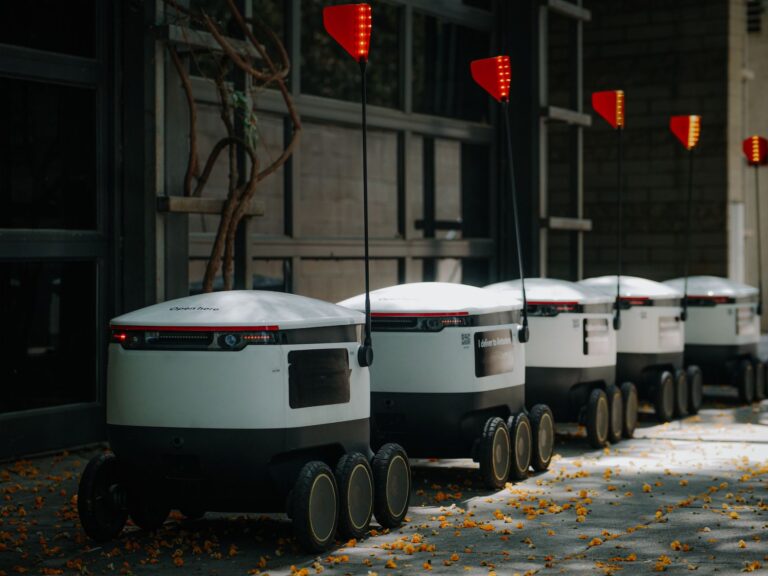

SYM, more formally known as Symbotic, has earned comparisons to Google because of its ambitious attempt to become the dominant intelligence layer for warehouse automation””not just selling robots, but building an integrated software and hardware ecosystem that could eventually power a significant portion of global supply chain logistics. The Massachusetts-based company, founded by Rick Cohen (who also leads C&S Wholesale Grocers), has developed an AI-driven system that coordinates fleets of autonomous robots to store, retrieve, and organize inventory in warehouse settings. The “Google” comparison stems from Symbotic’s platform approach: rather than competing purely on hardware, the company positions its artificial intelligence and software orchestration as the central value proposition, with physical robots serving as extensions of that digital brain.
A concrete example of this strategy in action is Symbotic’s landmark deal with Walmart, historically one of the largest warehouse automation contracts ever announced. Walmart committed to deploying Symbotic systems across its distribution network, signaling that even the world’s largest retailer saw something different in Symbotic’s approach compared to traditional material handling equipment vendors. The deal’s structure””with ongoing software and service components””mirrors the recurring revenue models that made tech giants like Google so financially powerful. This article examines what makes Symbotic’s technology distinctive, the challenges the company faces in scaling its vision, how it compares to competitors in the warehouse robotics space, and what supply chain professionals should realistically expect from this “Google of logistics” narrative.
Table of Contents
- What Technology Makes Symbotic the “Google of Supply Chain Robots”?
- How Does Symbotic Compare to Amazon and Other Warehouse Robotics Players?
- The GreenBox Joint Venture and Software-as-a-Service Model
- Real-World Performance: What Deployments Have Shown
- Challenges and Limitations of the Symbotic Approach
- The Investment Case and Public Market Performance
- Future Outlook: Can Symbotic Maintain Its Platform Position?
- Conclusion
What Technology Makes Symbotic the “Google of Supply Chain Robots”?
symbotic’s core system combines autonomous mobile robots (AMRs) with a proprietary AI platform that handles the complex orchestration of thousands of simultaneous movements within a warehouse. The robots themselves””called “SymBots”””travel along a grid structure installed in warehouses, retrieving cases of goods and positioning them for outbound shipment. What distinguishes the technology is the software layer: an AI system that continuously optimizes storage density, picking sequences, and robot routing in real time. The “Google” comparison becomes clearer when examining the data dimension. Symbotic’s platform ingests enormous amounts of operational data””every robot movement, every case location, every demand signal””and uses machine learning to improve performance over time.
This creates a potential network effect: the more warehouses running Symbotic systems, the more data flows into improving the algorithms, theoretically widening the gap with competitors who lack similar scale. Google achieved dominance partly by making its search algorithm better with every query; Symbotic aims for something analogous in physical logistics. However, warehouse environments present challenges that digital-only platforms don’t face. Physical robots break down, warehouse layouts vary dramatically, and integration with existing enterprise systems (WMS, ERP) requires significant customization. Early deployments reportedly required extensive fine-tuning, and the company has had to invest heavily in field service capabilities””a very un-Google-like operational burden.

How Does Symbotic Compare to Amazon and Other Warehouse Robotics Players?
The warehouse robotics market includes several well-funded competitors, and Symbotic’s positioning as the industry’s “Google” invites comparison to what might be considered the “Amazon” of the space””Amazon itself. Amazon’s acquisition of Kiva Systems in 2012 brought mobile robotics in-house, and Amazon has since developed proprietary systems including Sparrow, Proteus, and various robotic arms. The critical difference: Amazon builds for Amazon. Symbotic, by contrast, aims to be the platform that powers everyone else. Other competitors approach the market differently.
Companies like AutoStore offer cube-based storage systems with a proven track record but less sophisticated AI orchestration. Ocado has developed impressive automated fulfillment technology but focused primarily on grocery and licensed its systems selectively. Traditional material handling giants like Dematic and Honeywell Intelligrated offer automation solutions but with more conventional architectures. Symbotic’s bet is that its AI-first, high-density approach represents a generational leap. The limitation here is clear: companies with existing automation investments face significant switching costs, and Symbotic’s system requires substantial infrastructure changes to implement. For warehouses with recent capital expenditures in competing technologies, a Symbotic deployment may not be economically viable regardless of performance advantages.
The GreenBox Joint Venture and Software-as-a-Service Model
In 2023, Symbotic announced GreenBox Systems, a joint venture with SoftBank that represents perhaps the clearest manifestation of its platform ambitions. GreenBox purchases Symbotic systems and then offers warehouse-as-a-service to customers, meaning companies can access Symbotic’s technology without massive capital outlays. This mirrors the cloud computing model that transformed enterprise software. The GreenBox structure addresses one of automation’s biggest barriers: upfront cost. A full Symbotic deployment at a major distribution center reportedly costs tens of millions of dollars.
By shifting to an operational expenditure model, GreenBox potentially opens the technology to mid-market companies that couldn’t justify capital purchases. SoftBank’s involvement””and its multi-billion-dollar commitment to the venture””signals confidence in this approach. For supply chain professionals evaluating options, the GreenBox model introduces different considerations. Operating expenses versus capital expenditures have different implications for balance sheets and financial metrics. Some organizations may prefer owning their automation infrastructure outright, particularly if they have long planning horizons and strong balance sheets. The service model also creates dependency on a third party for critical logistics operations””a tradeoff some companies may be unwilling to accept for strategic assets.

Real-World Performance: What Deployments Have Shown
Assessing Symbotic’s actual performance requires acknowledging that much operational data remains proprietary or disclosed only in general terms. The company has cited metrics around storage density improvements, labor productivity gains, and order accuracy in various presentations, but independent verification is limited. What public information exists comes primarily from customer announcements and investor communications. The Walmart deployment represents the most significant test case. Walmart’s distribution network handles enormous complexity””tens of thousands of SKUs, high variability in demand, and relentless pressure on cost efficiency.
The fact that Walmart expanded its Symbotic commitment over time suggests the technology delivered acceptable results in initial installations. However, large retailers often receive favorable terms as anchor customers, and performance at Walmart may not directly translate to smaller operations. A specific example of the technology’s capabilities: Symbotic systems can reportedly achieve storage densities significantly higher than traditional racking, with some installations storing more cases in the same footprint than manual operations. This matters particularly for operators facing real estate constraints or high lease costs. However, achieving these density gains requires purpose-built facilities or substantial retrofits””not every existing warehouse can accommodate the system.
Challenges and Limitations of the Symbotic Approach
Symbotic’s growth trajectory has not been without difficulties. The company has faced the classic scaling challenge of any hardware-plus-software business: manufacturing capacity, installation complexity, and customer onboarding all create bottlenecks. At various points, Symbotic’s backlog has grown faster than its deployment capacity, meaning customers waited extended periods between contract signing and operational systems. Integration complexity deserves particular attention. Symbotic’s system must interface with warehouse management software, enterprise resource planning systems, transportation management platforms, and sometimes multiple legacy technologies. Each integration requires customization, testing, and ongoing maintenance.
Companies with heterogeneous IT environments may face longer implementation timelines and higher total costs than initially projected. There’s also the question of what happens when things go wrong. A highly integrated, AI-driven system creates single-point-of-failure risks. If the orchestration software encounters problems, an entire fulfillment operation could halt. Symbotic has built redundancy into its systems, but the complexity introduces failure modes that simpler automation approaches don’t face. Prospective customers should examine business continuity provisions carefully and understand disaster recovery capabilities.

The Investment Case and Public Market Performance
Symbotic went public via a SPAC merger in 2022, a period when special purpose acquisition companies were popular vehicles for high-growth technology firms. Like many SPAC-era public offerings, Symbotic’s stock has experienced significant volatility since listing, with price movements reflecting both company-specific developments and broader market sentiment toward growth stocks. The investment narrative centers on total addressable market and competitive positioning.
Proponents argue that warehouse automation remains in early stages globally, with vast room for penetration. If Symbotic captures a meaningful share of this expanding market””and if the “Google” analogy holds, meaning the company builds defensible network effects””current valuations could prove justified. Skeptics point to execution risks, competitive threats, and the capital intensity of scaling physical infrastructure businesses.
Future Outlook: Can Symbotic Maintain Its Platform Position?
Looking forward, Symbotic’s trajectory depends on several factors outside its direct control. The pace of e-commerce growth, labor market dynamics, and real estate costs all influence demand for warehouse automation. A tight labor market with rising wages accelerates automation adoption; an economic downturn that increases labor availability could slow it. Competitive response also matters.
Amazon continues advancing its robotics capabilities. Traditional automation vendors are integrating more sophisticated software. Well-funded startups target specific niches. Symbotic’s “Google of supply chain” status requires continuous innovation to maintain””the company cannot simply coast on current technology. Whether the platform approach proves durably defensible, or whether warehouse automation fragments into multiple specialized solutions, remains an open question that will play out over the coming decade.
Conclusion
Symbotic has built a genuinely differentiated approach to warehouse automation, combining AI orchestration with purpose-built robotics in a platform model that aims for ecosystem dominance rather than point-solution sales. The Google comparison, while inevitably imperfect, captures something real about the company’s ambitions and architecture. Major customers like Walmart have validated the technology with substantial commitments, and the GreenBox venture opens new market segments.
Supply chain professionals considering Symbotic should approach with clear eyes about both potential and limitations. The technology offers compelling capabilities for high-volume, high-complexity distribution operations, but requires significant infrastructure investment and integration effort. Implementation timelines can extend longer than anticipated, and total cost of ownership depends heavily on site-specific factors. As with any transformative technology, the decision should be grounded in operational requirements rather than hype””even when that hype invokes names as powerful as Google.