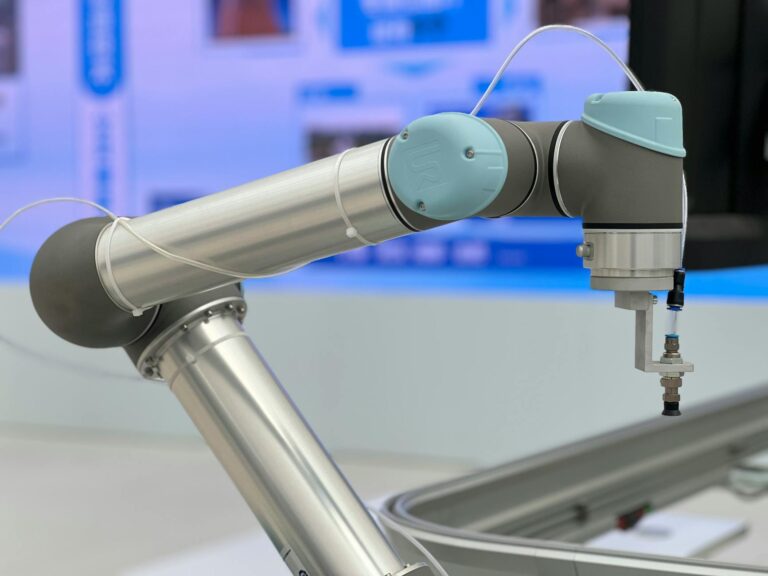

Teradyne (TER) has positioned itself as the dominant semiconductor-style enabler of the collaborative robotics industry, earning comparisons to Nvidia’s role in GPU computing. Through its ownership of Universal Robots, Mobile Industrial Robots (MiR), and AutoGuide Mobile Robots, Teradyne has assembled what many analysts consider the most comprehensive cobot ecosystem in the world. The company’s strategy mirrors Nvidia’s approach to AI infrastructure: rather than competing in every end application, Teradyne provides the foundational platforms that enable thousands of other companies to build automation solutions. The comparison to Nvidia is not merely rhetorical.
Just as Nvidia’s CUDA platform created a moat around GPU computing by building an ecosystem of developers and applications, Universal Robots’ UR+ platform has cultivated over 300 certified third-party products and applications. This network effect means that when manufacturers consider collaborative automation, they often default to Teradyne’s platforms because of the existing tooling, training infrastructure, and integration support. However, readers should note that market dynamics in robotics shift rapidly, and Teradyne’s competitive position should be verified against current financials and market share data. This article examines why institutional investors have drawn the Nvidia comparison, what makes Teradyne’s robotics strategy distinctive, the limitations of this analogy, and how the company’s semiconductor testing heritage influences its automation ambitions.
Table of Contents
- Why Is Teradyne Called the Nvidia of Collaborative Robots?
- How Teradyne’s Semiconductor Roots Shape Its Robotics Strategy
- The UR+ Ecosystem and Its Network Effects
- Mobile Robotics: Teradyne’s Expansion Beyond Arms
- Limitations of the Nvidia Comparison
- The Competitive Landscape and Teradyne’s Moat Durability
- What Teradyne’s Future in Collaborative Robotics Might Look Like
- Conclusion
Why Is Teradyne Called the Nvidia of Collaborative Robots?
The nvidia comparison stems from Teradyne’s platform-centric approach rather than a pure product sale model. When Universal Robots introduced its cobots in the early 2010s, it pioneered a programming interface simple enough that factory workers without robotics backgrounds could deploy automation. This accessibility created what industry observers have described as the “iPhone moment” for industrial robotics””suddenly, small and medium-sized manufacturers could afford and operate robotic arms without dedicated engineering teams. Teradyne acquired Universal Robots in 2015 for approximately $285 million, a figure that seems remarkably modest given the company’s subsequent growth trajectory. The acquisition represented a strategic bet that collaborative robots would follow a different adoption curve than traditional industrial automation.
Instead of selling expensive systems to automotive giants, cobots could penetrate the long tail of manufacturing””the tens of thousands of smaller operations that previously found automation economically impractical. The platform comparison extends to Teradyne’s ecosystem strategy. Universal Robots doesn’t just sell hardware; it provides the development environment, certification programs, and marketplace that enable hundreds of peripheral manufacturers to create compatible grippers, vision systems, and software applications. For system integrators, this reduces risk and development time. For end customers, it provides optionality and faster deployment. This network effect is precisely what made Nvidia’s CUDA dominant in machine learning infrastructure.

How Teradyne’s Semiconductor Roots Shape Its Robotics Strategy
Teradyne’s original business””automated test equipment for semiconductors””provides an underappreciated advantage in robotics. The company has spent decades building machines that must operate with extreme precision, handle delicate components, and integrate into complex manufacturing workflows. These capabilities transferred directly to collaborative robotics, where force sensitivity and positioning accuracy determine whether a cobot can perform useful work. The semiconductor testing business also generates substantial cash flow that Teradyne has reinvested into robotics acquisitions and R&D. This financial structure resembles how Nvidia’s gaming GPU revenue funded its AI research for years before that segment became commercially dominant.
However, this dependency cuts both ways: semiconductor industry downturns can constrain Teradyne’s ability to invest in robotics growth during critical competitive windows. One limitation of the semiconductor heritage is cultural. Test equipment customers are primarily large semiconductor manufacturers with sophisticated engineering teams and long procurement cycles. Collaborative robotics, by contrast, requires selling to customers who may have never automated anything. Teradyne has had to build entirely new distribution channels and support infrastructure to reach these buyers””a transformation that remains ongoing.
The UR+ Ecosystem and Its Network Effects
Universal Robots’ UR+ platform represents perhaps the clearest parallel to Nvidia’s ecosystem strategy. The platform certifies third-party hardware and software products for compatibility with UR cobots, creating a marketplace where customers can configure solutions from multiple vendors with confidence that components will work together. As of recent reports, the ecosystem included grippers from companies like Robotiq and OnRobot, vision systems from multiple vendors, and software tools ranging from simulation packages to palletizing applications. This ecosystem approach shifts the competitive dynamic in Teradyne’s favor. Potential competitors must not only match UR’s hardware capabilities but also replicate years of ecosystem development.
A new cobot entrant with theoretically superior specifications still faces the challenge that most integrators and peripheral manufacturers have optimized their offerings for UR compatibility. This switching cost mirrors the difficulty of displacing CUDA in machine learning, where the theoretical advantages of alternatives often cannot overcome the practical benefits of established tooling. A concrete example illustrates this dynamic: a manufacturing engineer evaluating cobots for a palletizing application can find dozens of pre-configured UR solutions with certified grippers, vision systems, and programming templates. Choosing a competing platform might require custom integration work, extending deployment timelines and increasing risk. For many buyers, this ecosystem breadth outweighs marginal hardware specification differences.

Mobile Robotics: Teradyne’s Expansion Beyond Arms
Teradyne’s 2018 acquisition of Mobile Industrial Robots (MiR) extended the Nvidia analogy to autonomous mobile robots (AMRs). MiR’s products handle internal logistics””moving materials between workstations, delivering parts to assembly lines, and transporting finished goods to shipping areas. Combined with Universal Robots’ collaborative arms, Teradyne can offer integrated solutions where mobile platforms deliver components and stationary cobots perform assembly or processing tasks. This vertical integration creates cross-selling opportunities but also introduces strategic complexity. Mobile robotics involves different technical challenges (navigation, fleet management, facility mapping) and different buyer personas (logistics managers rather than manufacturing engineers).
Teradyne must maintain excellence across both domains while competitors can focus resources more narrowly. The tradeoff between platform breadth and focus represents a genuine strategic tension. Companies like Boston Dynamics (now under Hyundai) or Locus Robotics can concentrate entirely on mobile platforms, potentially out-innovating Teradyne in that specific domain. Conversely, Teradyne’s integrated offering may prove more valuable to large enterprises seeking to standardize on a single automation partner. The optimal strategy likely depends on whether the market rewards specialization or integration””a question that remains unresolved.
Limitations of the Nvidia Comparison
The Nvidia analogy, while useful, obscures important differences between the companies’ competitive positions. Nvidia’s CUDA ecosystem benefits from software lock-in that has no direct equivalent in robotics. A manufacturer using Universal Robots can, with effort, switch to a competing cobot platform without rewriting fundamental infrastructure. The switching costs are real but not as severe as migrating machine learning workloads from CUDA to alternatives. Additionally, Nvidia operates in a market where performance improvements follow somewhat predictable scaling laws””larger models require more compute, creating steady demand growth. Collaborative robotics adoption depends on factors that are harder to forecast: labor market dynamics, small business capital investment trends, and the rate at which cobot capabilities expand into new application categories.
These demand drivers can shift based on macroeconomic conditions in ways that GPU demand for AI training does not. Another limitation involves margin structure. Nvidia’s gross margins on data center GPUs have historically exceeded 60%, reflecting both competitive moats and the software-like economics of semiconductor design. Teradyne’s robotics margins, while healthy, reflect the hardware-intensive nature of the business. Cobots require physical manufacturing, distribution, and support infrastructure that constrain profitability even as volumes scale. Investors expecting Nvidia-like margin expansion may find the robotics segment disappointing.
The Competitive Landscape and Teradyne’s Moat Durability
Teradyne faces competition from multiple directions. Traditional industrial robotics giants like Fanuc, ABB, and KUKA have all introduced collaborative robot lines, leveraging their existing manufacturing relationships and service networks. Chinese competitors, particularly companies like Dobot and AUBO, offer lower-priced alternatives that may prove sufficient for price-sensitive applications.
Perhaps more concerning for the long term, major technology companies have shown increasing interest in robotics. Amazon’s warehouse automation efforts, while focused on proprietary applications, demonstrate that well-funded entrants can rapidly develop capable systems. If a technology giant decided to create an open cobot platform with aggressive pricing, Teradyne’s ecosystem advantages could erode faster than the Nvidia comparison suggests.
What Teradyne’s Future in Collaborative Robotics Might Look Like
The next phase of collaborative robotics will likely emphasize intelligence over mechanical capability. Cobots that can perceive their environments more accurately, adapt to variations in workpiece positioning, and learn from demonstration rather than explicit programming will unlock applications currently beyond reach. Teradyne’s substantial R&D spending positions it to compete in this evolution, though the company’s specific AI and machine learning capabilities remain less visible than its hardware engineering.
Regardless of how the Nvidia comparison ages, Teradyne has established a meaningful position in a market with secular growth potential. The fundamental economics of collaborative automation””enabling small manufacturers to address labor constraints and improve consistency””remain compelling. Whether Teradyne maintains its platform leadership or faces disruption from competitors with superior AI integration will determine whether the Nvidia analogy proves prescient or merely flattering.
Conclusion
Teradyne’s position in collaborative robotics genuinely resembles Nvidia’s role in GPU computing: a platform provider that enables an ecosystem rather than merely selling products. Through Universal Robots, MiR, and AutoGuide, the company has assembled the most comprehensive cobot portfolio available from a single vendor, with network effects that create meaningful switching costs for customers and integrators. However, the analogy has limits.
Robotics lacks the software lock-in that makes CUDA so durable, margin structures differ meaningfully, and demand drivers depend on harder-to-predict factors. Investors and industry observers should appreciate both the strategic parallels and the fundamental differences. Teradyne has built something valuable in collaborative robotics, but whether that value compounds in Nvidia-like fashion remains an open question that only market developments will answer.