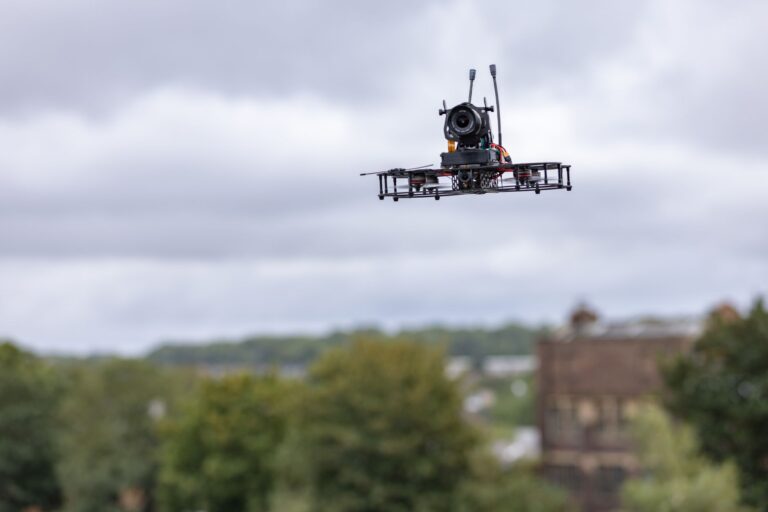
Machine learning helps identify enemy infrastructure by analyzing vast quantities of sensor data, satellite imagery, and network traffic to detect patterns that would be impossible for human analysts to process in real time. These algorithms automatically classify structures, predict facility purposes based on thermal signatures and activity patterns, and flag anomalies in communications networks that indicate command-and-control nodes or supply chain hubs. For example, during recent conflicts, ML systems have reduced the time to identify concealed military installations from weeks of manual analysis to hours, processing thousands of satellite images simultaneously while cross-referencing them with electromagnetic emission data. The technology works by training neural networks on labeled examples of known infrastructure types, from airfields and ammunition depots to radar installations and logistics centers.
Once trained, these models can scan new imagery or signals intelligence and assign probability scores to potential targets, prioritizing them for human review. This approach has proven particularly effective against adversaries who use camouflage, decoys, and dispersal tactics that would overwhelm traditional reconnaissance methods. This article examines the specific techniques ML systems use to detect and classify enemy infrastructure, the limitations defense analysts must account for, and the practical steps organizations take to deploy these capabilities. We will also cover the training requirements for effective models, common failure modes, and emerging applications that are reshaping military intelligence operations.
Table of Contents
- What Machine Learning Techniques Best Detect Hidden Military Facilities?
- Understanding Multi-Sensor Data Fusion in Infrastructure Detection
- Real-Time Change Detection for Tracking Infrastructure Development
- Choosing Between Cloud-Based and Edge-Deployed ML Systems
- Adversarial Attacks and ML System Vulnerabilities
- Emerging Applications in Subsurface and Underground Facility Detection
- How to Prepare
- How to Apply This
- Expert Tips
- Conclusion
- Frequently Asked Questions
What Machine Learning Techniques Best Detect Hidden Military Facilities?
Convolutional neural networks form the backbone of most infrastructure detection systems, excelling at identifying visual patterns in satellite and aerial imagery. These networks learn hierarchical features, starting with edges and textures before building up to complex structures like runway configurations or antenna arrays. Object detection architectures like YOLO and Faster R-CNN can process imagery in near real-time, flagging potential targets as new satellite passes occur. The U.S. National Geospatial-Intelligence Agency reportedly processes over 12 million images daily using such systems, a volume that would require tens of thousands of human analysts working continuously.
Beyond imagery, recurrent neural networks and transformer models analyze sequential data from signals intelligence sources. These systems can detect patterns in communication frequencies, timing, and network topology that reveal command hierarchies and operational relationships between dispersed facilities. When combined with graph neural networks that model infrastructure as interconnected nodes, analysts can identify supply chains and dependency relationships that expose critical vulnerabilities. However, these techniques perform unevenly depending on the environment and adversary sophistication. Dense urban areas produce far more false positives than rural terrain because civilian and military structures share similar signatures. One NATO study found that detection accuracy dropped from 94 percent in open terrain to 67 percent in mixed urban-industrial zones, requiring additional data fusion and human oversight to maintain operational reliability.

Understanding Multi-Sensor Data Fusion in Infrastructure Detection
Modern ML systems rarely rely on a single data source. Instead, they fuse inputs from electro-optical satellites, synthetic aperture radar, thermal infrared sensors, and signals intelligence to build comprehensive facility profiles. SAR imagery penetrates cloud cover and operates at night, compensating for the limitations of optical systems. Thermal data reveals activity patterns, such as heat signatures from vehicle engines or industrial processes, that static imagery would miss. This fusion approach increases detection confidence while reducing the success rate of camouflage and concealment efforts. The technical challenge lies in aligning these disparate data types both spatially and temporally.
A facility might appear dormant in daytime optical imagery but show significant thermal activity at night, indicating a deliberate operational security posture. ML systems trained on fused datasets learn to weight these discrepancies appropriately, but the training data must reflect realistic adversary behavior to be effective. Models trained primarily on exercises or historical conflicts may fail against opponents who have studied and adapted to known detection methods. Limitations become significant when adversaries employ sophisticated denial and deception tactics. If an opponent uses thermal blankets, radio frequency shielding, or activity scheduling designed to confuse ML classifiers, detection rates can drop precipitously. A 2023 RAND Corporation analysis found that relatively inexpensive countermeasures, costing under one million dollars per site, reduced ML detection accuracy by 40 to 60 percent in controlled testing. Defense planners must account for this adversarial dynamic rather than assuming static detection performance.
Real-Time Change Detection for Tracking Infrastructure Development
Change detection algorithms represent one of the most valuable ML applications for infrastructure monitoring. These systems compare sequential images of the same location to identify construction activity, equipment movements, or damage assessment after strikes. Rather than requiring analysts to review entire regions, change detection highlights only areas with significant alterations, reducing the cognitive load by orders of magnitude. The Sentinel Hub platform, which processes European Space Agency satellite data, demonstrates this capability at scale. Its ML-powered change detection services can identify construction of new facilities within days of ground-breaking, tracking progress through completion.
Military applications extend this to detecting hardening activities, such as the addition of concrete shelters or earth berms, that indicate a facility is being prepared for conflict. During the construction of Chinese military installations in the South China Sea, commercial satellite providers using these techniques documented island-building progress in near real-time, providing strategic warning that supplemented classified intelligence. Temporal resolution remains a critical constraint. Satellites in sun-synchronous orbits may only revisit a location every several days, creating gaps that allow rapid construction or movement to occur unobserved. Adversaries aware of satellite schedules can time sensitive activities to these windows. Some military systems address this through constellations that increase revisit rates, but the ML models must also be trained to interpolate between observations and flag locations where activity patterns suggest concealment attempts.

Choosing Between Cloud-Based and Edge-Deployed ML Systems
Defense organizations face a fundamental architectural decision when deploying infrastructure detection capabilities: centralized cloud processing versus edge deployment on platforms like reconnaissance drones or forward operating bases. Cloud systems offer superior computational power, enabling larger and more accurate models, but introduce latency and require robust communications links that may not exist in contested environments. Edge deployment provides real-time analysis but constrains model complexity and requires frequent updates to remain current. The tradeoff affects operational effectiveness in concrete ways. A cloud-based system might achieve 95 percent classification accuracy using a model with billions of parameters, but a 30-second transmission delay could render targeting data obsolete for time-sensitive strikes. An edge system running a compressed model might achieve only 85 percent accuracy but deliver results in milliseconds, enabling immediate tactical decisions.
The U.S. Army’s Project Maven initially relied on cloud processing but has increasingly shifted toward edge-capable models that can operate on disconnected platforms. Hybrid architectures attempt to capture benefits of both approaches. These systems run lightweight detection models at the edge to flag potential targets, then transmit only relevant data to cloud systems for detailed analysis when bandwidth permits. This reduces communications requirements by 90 percent or more while maintaining high-confidence classifications for priority targets. However, implementing such systems requires careful engineering to ensure edge and cloud models remain synchronized and that transmission priorities reflect operational needs.
Adversarial Attacks and ML System Vulnerabilities
Machine learning systems are susceptible to adversarial manipulation in ways that traditional analysis is not. Adversarial examples, inputs carefully crafted to fool classifiers, can cause ML systems to misclassify targets or miss them entirely. Research has demonstrated that small perturbations to imagery, sometimes as simple as specific paint patterns or added structures, can reduce detection accuracy dramatically. A hostile nation aware of the ML architectures used against it could design facilities specifically to evade detection. The vulnerability extends beyond imagery to signals intelligence applications.
Adversaries can generate decoy communications traffic that mimics command-and-control patterns, causing ML systems to flag false targets while actual infrastructure operates under different signatures. This electronic deception has historical precedent, but ML systems may be more susceptible because they rely on statistical patterns rather than contextual understanding that human analysts bring to interpretation. Defense against these attacks remains an active research area with no complete solutions. Adversarial training, which includes manipulated examples in training data, improves robustness but cannot anticipate all possible attacks. Ensemble methods that combine multiple model architectures reduce the chance that a single adversarial perturbation defeats all classifiers. Organizations deploying these systems must assume adversaries will attempt to exploit them and build human oversight into targeting chains rather than fully automating decisions based on ML outputs alone.

Emerging Applications in Subsurface and Underground Facility Detection
Underground facilities present particular challenges for infrastructure detection because they produce minimal above-ground signatures. Machine learning is increasingly applied to indirect indicators: unusual construction patterns, ventilation requirements, power line routing, and ground-penetrating radar returns. These systems integrate with geological databases to assess where underground construction is feasible and what tunneling signatures to expect in different soil and rock types.
North Korea’s extensive tunnel network has driven significant investment in these capabilities. ML systems analyzing commercial satellite imagery have identified probable tunnel entrances by detecting associated features such as spoil piles, access roads, and security perimeters, even when the entrances themselves are concealed. When combined with seismic monitoring data that can detect underground excavation, these systems provide warning of new construction that would otherwise remain invisible until facilities become operational.
How to Prepare
- Assemble representative training datasets that include examples from the specific geographic regions and adversary types relevant to your mission, ensuring coverage of seasonal variations, weather conditions, and known camouflage techniques.
- Establish ground truth validation processes using human analysts or field confirmation to verify ML outputs before incorporating them into training data, preventing error propagation.
- Define clear performance metrics tied to operational requirements rather than abstract accuracy scores, specifying acceptable false positive and false negative rates for different target categories.
- Build data pipelines that can ingest sensor feeds at operational tempo, including preprocessing for format conversion, georeferencing, and quality filtering.
- Train personnel on both system capabilities and limitations, emphasizing that ML outputs are decision support tools requiring human judgment rather than autonomous targeting authorities.
How to Apply This
- Begin with constrained pilot deployments focused on specific facility types or geographic areas where you have sufficient training data and can validate results against known ground truth.
- Implement confidence thresholds that route high-certainty detections directly to analysts while flagging uncertain cases for additional sensor collection or expert review.
- Establish feedback loops where analyst corrections flow back into model retraining, continuously improving performance against the specific target sets and environments you encounter.
- Integrate ML outputs with existing intelligence workflows rather than creating parallel processes, ensuring detections receive appropriate context from other sources before informing decisions.
Expert Tips
- Retrain models quarterly at minimum to account for adversary adaptation; detection performance degrades over time as opponents learn to evade previously effective signatures.
- Do not rely solely on commercial satellite imagery for sensitive operations; revisit rates and resolution limitations create exploitable gaps that dedicated reconnaissance assets can fill.
- Invest in synthetic data generation to augment training sets, particularly for rare facility types or scenarios you cannot collect real examples of without compromising sources.
- Maintain model version control with rollback capabilities; updates that improve performance on one target type sometimes degrade performance on others.
- Avoid overconfidence in detection scores; a 95 percent confidence classification still means one in twenty identifications may be wrong, which has serious consequences in targeting applications.
Conclusion
Machine learning has fundamentally transformed infrastructure detection by enabling analysis at scales and speeds impossible for human analysts alone. The combination of computer vision for imagery analysis, sequence models for signals intelligence, and data fusion across multiple sensor types creates detection capabilities that stress even sophisticated adversaries employing camouflage and deception. However, these systems require substantial investment in training data, continuous adaptation to adversary countermeasures, and careful integration with human oversight to realize their potential.
Organizations implementing these capabilities should approach them as decision support tools rather than autonomous solutions. The technology excels at processing volume and flagging anomalies but remains vulnerable to adversarial manipulation and performs unevenly across different environments. Success depends on realistic expectations, robust validation processes, and sustained investment in the personnel and data infrastructure that keep ML systems operationally relevant.
Frequently Asked Questions
How long does it typically take to see results?
Results vary depending on individual circumstances, but most people begin to see meaningful progress within 4-8 weeks of consistent effort. Patience and persistence are key factors in achieving lasting outcomes.
Is this approach suitable for beginners?
Yes, this approach works well for beginners when implemented gradually. Starting with the fundamentals and building up over time leads to better long-term results than trying to do everything at once.
What are the most common mistakes to avoid?
The most common mistakes include rushing the process, skipping foundational steps, and failing to track progress. Taking a methodical approach and learning from both successes and setbacks leads to better outcomes.
How can I measure my progress effectively?
Set specific, measurable goals at the outset and track relevant metrics regularly. Keep a journal or log to document your journey, and periodically review your progress against your initial objectives.
When should I seek professional help?
Consider consulting a professional if you encounter persistent challenges, need specialized expertise, or want to accelerate your progress. Professional guidance can provide valuable insights and help you avoid costly mistakes.
What resources do you recommend for further learning?
Look for reputable sources in the field, including industry publications, expert blogs, and educational courses. Joining communities of practitioners can also provide valuable peer support and knowledge sharing.