
KSCP is positioning itself as a comprehensive autonomous policing platform, but calling it “the next Google” overstates its current market dominance and underestimates the fragmented nature of autonomous robot deployment in law enforcement. Unlike Google’s near-monopoly in search, KSCP faces a crowded field of specialized robotics companies, municipal procurement barriers, and regulatory resistance. The comparison captures an aspiration—that KSCP could become the default infrastructure for autonomous policing—but the reality is far more complex and constrained.
The autonomous policing robot market remains nascent and heavily localized. Cities like San Francisco, Boston, and Las Vegas have deployed robots for bomb disposal, crowd monitoring, and perimeter patrol, but each deployment uses different platforms from different vendors. KSCP’s potential lies not in replacing these point solutions, but in building a unified management, data, and deployment layer that makes multiple robots and sensor systems work together. That integration play could be valuable, but it requires adoption momentum that Google earned over two decades.
Table of Contents
- How Does KSCP Compare to Google’s Market Strategy?
- What Technical and Regulatory Barriers Limit KSCP’s Expansion?
- What Real-World Deployments Show About Adoption Patterns?
- How Does Market Fragmentation Prevent KSCP from Becoming the Default?
- What Risks Does Autonomous Policing Introduce That KSCP Must Address?
- What Drives Current Adoption Among Early-Adopter Departments?
- What Does Proof of Concept Look Like for Autonomous Policing Systems?
- Frequently Asked Questions
How Does KSCP Compare to Google’s Market Strategy?
google became dominant in search because it solved a problem faster and better than competitors, then built network effects through scale and data. KSCP enters autonomous policing without those initial conditions. The “problem” it solves—coordinating multiple autonomous systems for law enforcement—is real but not universally perceived as urgent. Most police departments still rely on traditional patrol models, and those interested in automation tend to buy single-purpose robots (bomb detection units from iRobot, for example, or mobile surveillance platforms from Knightscope).
The Google comparison also breaks down because search is a consumer product with viral adoption potential. Autonomous policing robots are purchased by governments through procurement processes, subject to budget cycles, union negotiations, and public scrutiny. A city council can’t vote to “use Google” the way it can vote to buy a Boston Dynamics robot for specific tasks. KSCP must win dozens of institutional customers rather than billions of individual users. Boston Dynamics, for comparison, has spent years navigating municipal procurement for a handful of Spot robot deployments, and even then, the robots get reassigned or retired when political winds shift.
What Technical and Regulatory Barriers Limit KSCP’s Expansion?
Autonomous policing systems face higher regulatory friction than most technology sectors. Police use of robots involves weapons integration (taser, lethal-force protocols), civilian safety liability, and union opposition. When the San Francisco Police Department requested approval to use robots with lethal weapons, public backlash was severe enough to force policy reversals. kscp must navigate these objections not just once but in every city it enters, creating a slow, case-by-case adoption curve that Google never faced in search.
Technical interoperability is another barrier. Police departments have existing CCTV networks, dispatch systems, evidence management platforms, and communication radios built from different vendors and decades of legacy infrastructure. KSCP must integrate cleanly with these disparate systems, or it becomes just another point solution on top of existing chaos. A police precinct using Motorola radios, Axon evidence systems, and older networked cameras can’t simply plug in a KSCP cluster and expect everything to talk. The integration work is expensive, specific to each city, and requires vendors like Axon and Motorola to cooperate—cooperation that doesn’t always happen when integration threatens their own margins.
What Real-World Deployments Show About Adoption Patterns?
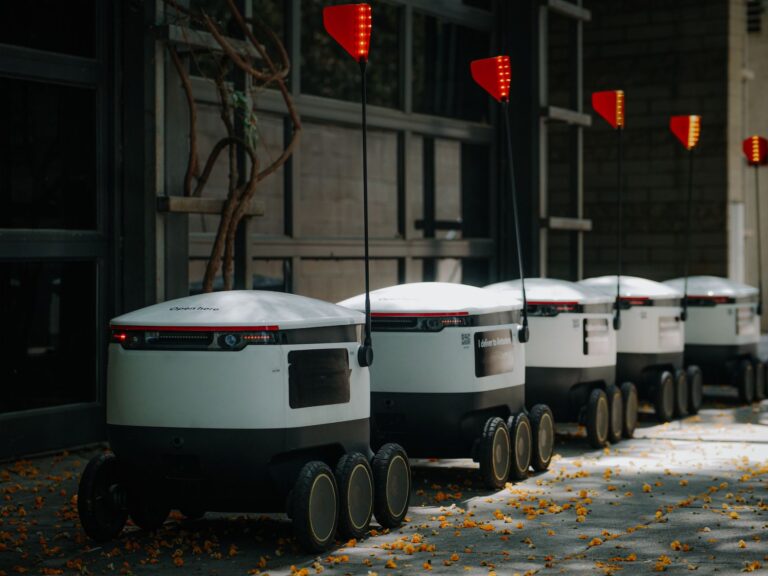
Las Vegas’s use of Knightscope robots for parking lot and perimeter patrol offers a realistic case study. The robots operate in controlled, open environments with minimal unpredictable civilian interaction. They detect unusual activity, and humans respond. But deploying that same robot in downtown areas, busy parks, or high-crime neighborhoods introduces new failure modes: protesters deliberately blocking or deflating the robot, civilians complaining about surveillance, technical failures in crowds. Knightscope’s robots have been vandalized multiple times, and in at least one case, a robot drove into a fountain, raising questions about operational reliability under real-world conditions.
Extending to autonomous systems means accepting higher stakes. A surveillance robot failure is annoying. An autonomous system that makes enforcement decisions—prioritizing arrest targets, determining where to deploy patrol assets, or even recommending use-of-force escalation—creates liability if it fails or exhibits bias. Boston Dynamics’ Spot has been tested in nursing homes, construction sites, and inspection tasks, but none of these applications involve autonomous decision-making about human subjects. A police-focused KSCP version would need to operate differently, with human oversight baked into every critical decision, which negates much of the automation advantage.
How Does Market Fragmentation Prevent KSCP from Becoming the Default?
The autonomous systems market for policing is deliberately fragmented by design. Police departments want competition among vendors because monopoly pricing is politically toxic (see public outcry over Axon’s evidence platform pricing). When one company controls infrastructure, budget scrutiny intensifies. A city council that unanimously approves a $2 million mixed-vendor robotics pilot will fight harder over a $5 million single-vendor contract for KSCP exclusive deployment. This fragmentation is a feature, not a bug, from the procurement perspective.
Competing platforms are also deeply entrenched. iRobot has 30 years of bomb detection expertise and police relationships. Axon (formerly Taser) owns evidence management and officer communication systems, giving it distribution advantages for any related services. Knightscope has years of deployed units and operational data. For KSCP to become the Google of policing robots, it would need to either acquire several of these competitors (cost-prohibitive and politically controversial) or convince municipalities to replace working systems with a new unproven integration layer (unlikely). A more realistic scenario is KSCP becomes a middleware platform that some departments adopt, while others continue with proprietary integrations.
What Risks Does Autonomous Policing Introduce That KSCP Must Address?
Bias in autonomous policing systems is not a theoretical risk—it’s an observed problem. Predictive policing tools built from historical arrest data have demonstrated racial bias because arrest data reflects enforcement patterns, not crime rates. An autonomous system that inherits this data will perpetuate the bias at scale and at speed. KSCP must account for this, but the solution isn’t simple: auditing the system for bias requires transparency into training data and algorithms, which police departments often resist for liability reasons.
Furthermore, if KSCP’s system flags certain neighborhoods for increased robot patrol, and that leads to more arrests in those areas, distinguishing between bias and correlation becomes a public policy debate, not a technical fix. Liability and accountability also remain unresolved. If a KSCP-managed autonomous system makes a mistake—misidentifies a person, deploys force against the wrong individual, or contributes to a harmful policing action—who is responsible? The software vendor, the municipality, the individual officer? Courts have not established clear precedent, and this ambiguity may prevent adoption by risk-averse municipalities. An autonomous vehicle company can handle liability through insurance and regulations. Police robotics systems lack that infrastructure, making departments hesitant to adopt fully autonomous decision-making.
What Drives Current Adoption Among Early-Adopter Departments?
Police departments that have deployed autonomous systems tend to focus on high-value, low-discretion tasks: bomb and hazmat response, inspection of dangerous locations, evidence documentation in controlled scenes. These roles minimize the need for autonomous judgment and reduce liability exposure. A robot inspecting a suspicious package in a crowded plaza is less controversial than a robot deciding whether to approach a person matching a description.
This fundamental difference in task selection shows where autonomous systems add genuine value in policing versus where they remain too risky to deploy without heavy human oversight. Tech-forward cities like Boston, San Francisco, and Las Vegas have the budgets and institutional capacity to absorb early failures. Smaller, less-resourced police departments watch these pilots carefully but wait for proven technology and clearer policy frameworks before investing. KSCP’s growth depends on expanding beyond early adopters, but that transition happens slowly in government procurement.
What Does Proof of Concept Look Like for Autonomous Policing Systems?
For KSCP to credibly claim a Google-like position, it must demonstrate platform advantages that are difficult to replicate. This might mean showing that a multi-system KSCP deployment catches crimes or responds to incidents measurably faster than traditional approaches, with clear accountability, user adoption by officers, and political support across stakeholder groups.
As of 2026, no autonomous policing system has achieved this level of demonstrated superiority across multiple jurisdictions. Until one does, comparisons to Google remain aspirational rather than descriptive.
Frequently Asked Questions
Has KSCP actually been deployed in any police departments?
KSCP’s current deployment footprint is limited and undisclosed in public records. Most autonomous systems in police work today come from specialized vendors like iRobot, Knightscope, and Boston Dynamics, not from a unified KSCP platform.
What tasks are autonomous policing robots actually good at?
Bomb detection, hazmat inspection, evidence documentation in controlled scenes, and perimeter patrol in open spaces. Autonomous systems struggle with unstructured environments, unpredictable civilian interactions, and decision-making about human subjects.
Why don’t more cities adopt autonomous policing systems?
Public opposition to surveillance, union concerns about job displacement, budget limitations, unclear liability frameworks, and lack of demonstrated ROI over traditional patrol methods all create adoption barriers.
Could KSCP eventually dominate policing technology the way Google dominates search?
Unlikely, because police procurement is deliberately fragmented, fully autonomous decision-making in law enforcement faces regulatory and public resistance, and the scale is much smaller than consumer technology markets.
What would need to change for autonomous policing to become widespread?
Clear legal precedent on liability, demonstrated effectiveness with minimal bias, successful political consensus in multiple jurisdictions, and integration that doesn’t displace officers but augments their capabilities.
What’s the biggest technical challenge KSCP faces?
Integrating with legacy police infrastructure (dispatch systems, evidence management, communication networks) while maintaining security, reliability, and accountability standards that exceed commercial applications.