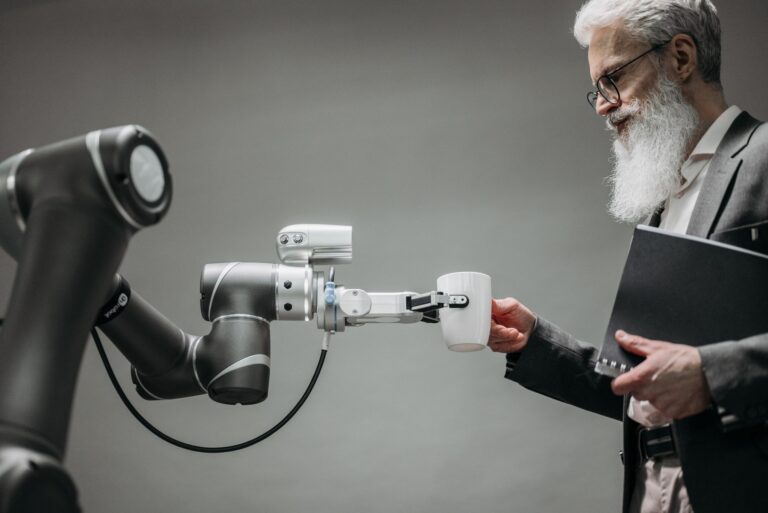

Research robotics in 2026 means testing humanoids, mobile manipulators, and drones in real work settings before full rollout. This guide explains current capabilities, applicable safety rules, and deployment questions for lab and industry teams. Research robotics uses full-scale robots as experimental platforms to measure performance, failure modes, and human interaction. Recent pilots focus on factory tasks, supervised autonomy, and conversion from short trials to longer deployments.
Table of Contents
- What can humanoids do now?
- Which robot safety standards apply?
- What covers drones and European machines?
- How do workplace and AI risks fit?
- What should you ask before deployment?
What can humanoids do now?
According to Boston Dynamics, the company unveiled a fully electric commercial Atlas humanoid at CES 2026 in the Atlas announcement. It committed all 2026 fleets to Hyundai's Robotics Metaplant Application Center and Google DeepMind for manufacturing training and field testing. Counterpoint Research reports global humanoid shipments exceeded 22,000 units in H1 2026 in the shipment analysis.
Agibot shipped about 9,700 units for 43% share, and Counterpoint forecasts over 50,000 units for full-year 2026 on pilot-to-deployment conversion. Expect supervised operation tied to specific stations, tools, and safety zones. Ask vendors for cycle times, intervention rates, and failure handling in your layout.
Which robot safety standards apply?
The ISO/TC 299 catalogue lists ISO 10218-1:2025 and 10218-2:2025 as replacements for the 2011 editions in the ISO catalogue entry. The revisions fold collaborative-robot guidance from ISO/TS 15066 into the main standards and add cybersecurity requirements tied to physical safety. According to the Association for Advancing Automation, the U.S.
adopted those rules as ANSI/A3 R15.06-2025 in the standard announcement. It adds clarified functional safety, integrated collaborative-application guidance, updated robot classifications and test methods, plus cybersecurity in safety planning. For deployment, match the classification, operating mode, and test method to the actual task. Treat network access, software updates, and operator overrides as safety issues, not IT extras.
What covers drones and European machines?
According to the FAA, the agency proposed Part 108 for routine beyond-visual-line-of-sight operations on Aug. 7, 2025. Beyond-visual-line-of-sight means the drone flies outside the operator's direct view. The proposal covers aircraft up to 1,320 lbs with tiered approvals, entered OIRA final review July 10, 2026, so BVLOS still requires Part 107 waivers.
According to EU summaries of the Machinery Regulation, EU Machinery Regulation 2023/1230 fully applies from Jan. 20, 2027. It replaces the Machinery Directive and imposes mandatory risk assessment, cybersecurity against corruption of safety functions, and third-party conformity for AI-based safety components. Check approval status before scheduling outdoor flights or European installations. A system legal for indoor testing may still need a waiver, reassessment, or outside review for wider use.
How do workplace and AI risks fit?
According to OSHA, it has no robotics-specific standard. It enforces robot hazards through the General Duty Clause, machine-guarding rules, and its Technical Manual chapter on industrial robot systems. According to a Cloud Security Alliance summary of NIST work, NIST's voluntary AI Risk Management Framework 1.0 organizes AI governance into Govern, Map, Measure, and Manage functions.
The framework is widely used as the deployment risk anchor for AI-enabled robots, with a Jan. 2026 RFI extending work to AI-agent security. Use the OSHA manual for guarding, lockout, training, and incident review. Use the NIST functions to assign ownership, map uses and harms, measure performance and incidents, then manage fixes.
What should you ask before deployment?
Ask for evidence tied to your site, not brochure specifications. A short written checklist prevents missed safety, security, and schedule risks. Require pilot metrics, safeguard settings, and update procedures in writing before wider rollout.
- What classification, operating mode, and test method apply to this task?
- What hazards, safeguards, and residual risks appear in the site-specific risk assessment?
- How are cybersecurity, access control, and software updates tied to safety functions?
- What approvals, waivers, or conformity reviews are complete, pending, or required?
- What pilot metrics define success: uptime, interventions, near misses, and stop events?
You Might Also Like
- Sensors and Perception Robotics 2026 Guide: capabilities, safety, and deployment; Key Facts and Questions to Ask
- Programming Robotics 2026 Guide: capabilities, safety, and deployment; Key Facts and Questions to Ask
- Natural Language Processing Robotics 2026 Guide: capabilities, safety, and deployment; Key Facts and Questions to Ask