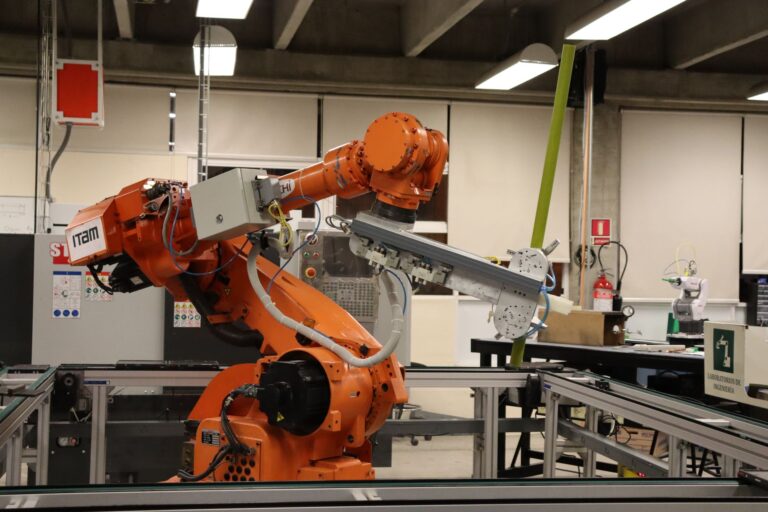
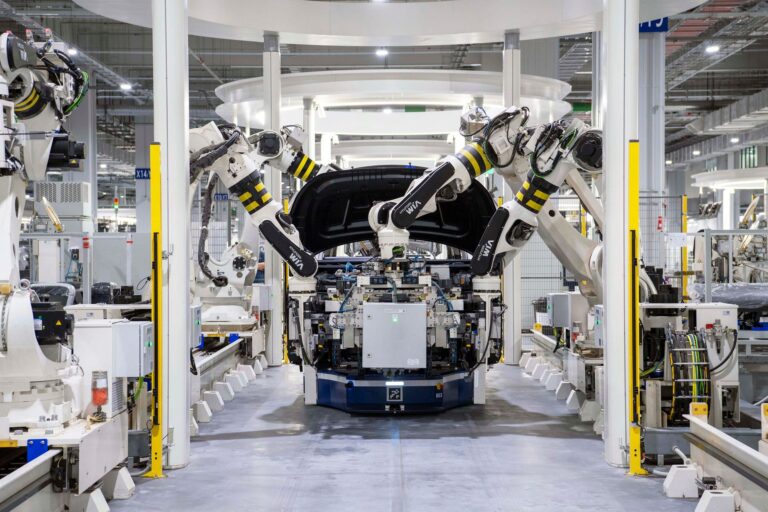
Prefabrication automation builds complete building modules inside a factory using robots, conveyors, and controlled workstations. A module is a finished three-dimensional section of a building, with structure, walls, wiring, and plumbing already installed. Factory work moves the module through stations instead of moving workers around a site. Robots handle repeatable tasks while people handle fitting, inspection, and final connections.
Table of Contents
- How a module line works
- Which machines do the heavy work
- Where automation stalls
- What to check before you automate
How a module line works
A typical line starts with a steel or timber frame fixed to a carrier. The carrier moves the frame through cutting, framing, sheathing, and services stations on a set takt, or rhythm. Each station completes one package of work before release.
Wiring cassettes, pipe runs, windows, and insulation go in while the module is open and accessible. Finishes and cabinets usually go last, when dust and heavy handling are done. The finished module leaves the factory wrapped for transport, then cranes set it on foundations at the site. Crews join modules, seal joints, and connect power, water, and drainage.
Which machines do the heavy work
Gantry systems and robot arms do framing, fastening, drilling, and panel handling. They follow programmed paths, so stud walls, floor cassettes, and bathroom pods come out square and repeatable. Conveyors, lift tables, and turntables move heavy modules without cranes inside the plant.
Laser guides and machine vision check dimensions, edge positions, and missing fasteners before the module advances. People remain central for cable pulls, pipe testing, tiling, snag repair, and quality sign-off. The practical split is simple: machines repeat, people adapt.
Where automation stalls
Automation struggles with variation, tight tolerances between trades, and site interfaces. Custom room sizes, late design changes, and uneven module-to-module joints force rework that robots cannot absorb. Transport sets hard limits on size and weight.
Road width, bridge clearance, and crane reach decide maximum module dimensions more than factory capacity does. Factory precision also means little if foundations or connection points are out of alignment. Moisture control, lifting stresses, and storage matter too. A module built square can rack during lifting or swell if stored wet, so lifting points, bracing, and weather protection need planning from the start.
What to check before you automate
Start with product discipline: a small set of standard chassis sizes, shared connection details, and frozen interfaces. Automation pays when the same operations repeat across many modules with few exceptions. Walk the whole chain, not only the robot cell.
Design software, cutting files, fixtures, labor skills, transport permits, and site cranes must match the factory rhythm. Choose equipment that tolerates construction materials and dust, with simple tool changes and clear safety zones. Train maintenance staff before adding speed, because a stopped line halts every trade downstream.
- Lock module sizes to transport and crane limits first
- Standardize frames, joints, and service routes
- Automate one bottleneck station, then expand
- Keep manual bays for custom units and repairs
- Test lifting, sealing, and hookup on a trial set