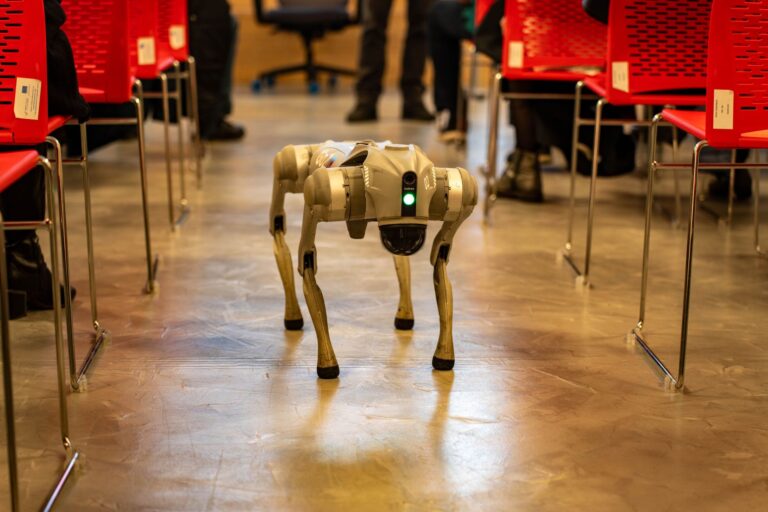
ANYbotics has started customer deliveries of ANYmal X, a four-legged walking robot built to inspect explosive atmospheres in oil, gas and chemical plants. The company announced the rollout in Zurich on Oct. 27, 2026.
In these plants, a small spark can ignite flammable gas in the air. ANYmal X is designed to walk routine inspection rounds where people would otherwise go on foot. ANYbotics said in its launch announcement that first shipments are going to industry operators including Equinor ASA and DSM-Firmenich AG.
Table of Contents
- How does it avoid causing a spark?
- Who tested it before delivery?
- What work does it take over?
- Where does the approval stop?
How does it avoid causing a spark?
The computer and sensors sit inside nitrogen-pressurized chambers. The sealed nitrogen keeps flammable gas away from electronics that could arc. All 12 leg actuators and the battery sit in flameproof casings.
The feet use conductive material to ground static charge. Together, these measures aim to remove heat, sparks and static as ignition sources. Bureau Veritas examined the design and issued an ATEX EU-type examination certificate for gas Zones 1 and 2, Gas Group IIB, temperature class T4, Category 2G, according to Silicon Report in its independent certification report. That certificate defines where the robot is approved to operate.
Who tested it before delivery?
ANYmal X comes from field testing since 2023 under an Early Access Program. ANYbotics said in its launch announcement that the program included BP, Equinor, Shell, PETRONAS, Petrobras, BASF and SLB. The trials covered hundreds of onshore and offshore missions.
Legged movement matters there because plants use stairs, pipes, gravel and narrow passages. Early users are now moving from trials to owned units. The first named recipients are oil, gas and chemical operators with large Ex-zone estates.
What work does it take over?
Certified autonomous inspection lets operators run routine rounds in Ex-zones without sending technicians on foot into high-risk areas. The robot can repeat the same route on every shift. It flags valve, compressor and equipment anomalies earlier, according to Silicon Report in its independent certification report.
Early warning gives planners time to act before a small leak or fault grows. For automation teams, the practical gain is coverage. Night rounds, remote platforms and repeat gauge checks become easier to staff.
Where does the approval stop?
The certificate does not cover every hazardous area. Base Reality Group explains in its certificate analysis that ANYmal X is not certified for Zone 0 continuous-gas areas, explosive dusts, or Group IIC gases including hydrogen and acetylene. Charging and nitrogen refills must happen outside the hazardous zone.
Plants need a safe dock area and a clear handover point at the Ex boundary. International IECEx certification has not yet issued. It will require an audit of the series production line after launch. Plant teams should take three practical checks before ordering routes:.
- Confirm each route stays inside gas Zones 1 or 2 with Group IIB gases or less severe.
- Keep Zone 0 pits, dusty solids handling and hydrogen areas on manual procedures.
- Place chargers and nitrogen refill points outside the Ex-zone with trained handover.