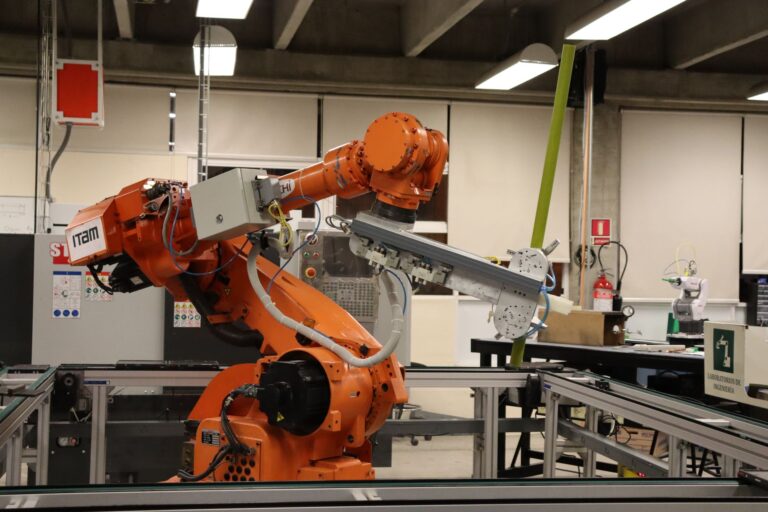
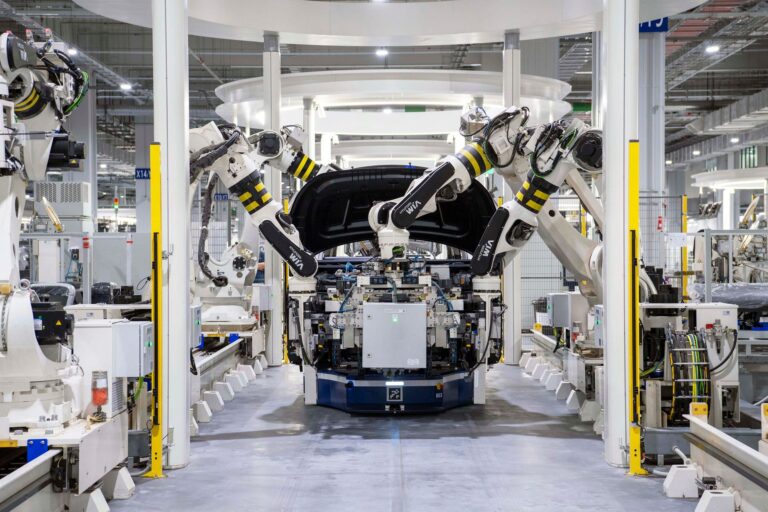
Construction robot safety on busy job sites means controlling movement, crushing zones, and dropped loads around programmed machines. A construction robot is a powered machine that lifts, builds, demolishes, drills, or hauls under programmed or supervised control. Busy sites raise exposure because many trades share space with moving machines. Clear barriers, sensing, and trained operators decide whether that sharing stays safe.
Table of Contents
- When does contact happen?
- How do workers get struck or trapped?
- Which standards shape a busy site?
- What keeps the work envelope safe?
When does contact happen?
Associated Builders and Contractors Rocky Mountain explains that OSHA has no robot-specific standard, so sites use existing machine-guarding, lockout/tagout, electrical, and PPE rules under Associated Builders and Contractors Rocky Mountain guidance. Most trouble starts during setup, programming, testing, and maintenance inside the work envelope, where workers stand close to motion. Sanders, Sener and Chen reviewed OSHA Severe Injury Reports from 2015 to 2022 and found 77 robot-related accidents in a Frontiers in Built Environment review. Fifty-four involved stationary robots.
Twenty-three involved mobile robots. Finger amputations plus head and torso fractures were common. Stationary arms threaten hands near tools. Mobile units threaten bodies in travel paths. Both demand separation during non-routine work.
How do workers get struck or trapped?
Occupational Health and Safety, summarizing OSHA's Technical Manual, lists four robot accident types. They are impact from unpredicted movement, crushing between arm and fixtures, mechanical-part failure, and slips near the cell. NIOSH, summarized by the Association for Advancing Automation, said in its Oct. 7, 2026 bulletin that robots can cut heavy lifting and demolition strain under Association for Advancing Automation summary.
They still create struck-by, caught-in/between, crushing, unexpected-movement, and dropped-load hazards for nearby crews. CDC NIOSH eNews warns that degraded sensors, communication failures, and limits in object recognition are construction-specific failure modes. Dust, vibration, and shifting workfaces blind or confuse machines built for fixed cells. Treat clear human-robot communication as a safety control, not an upgrade.
Which standards shape a busy site?
IBF Solutions reports ISO published ISO 10218-1:2025 and ISO 10218-2:2025 in February 2025. Part 1 covers robot design and Part 2 covers integration and cells. Most collaborative-robot rules from ISO/TS 15066 moved into the new parts. MarketScale, reporting an A3 announcement, says ANSI/A3 R15.08-3-2026 completes the U.S. mobile-robot series in a MarketScale report on the A3 announcement.
It places duties on operating sites for risk assessment, change management, training, inspections, and periodic review after deployment. The focus shifts from purchase to daily operation. Design rules help buyers pick capable machines. Site rules decide whether busy operation stays safe. Verify both before a robot joins a crowded floor.
What keeps the work envelope safe?
The same ABC Rocky Mountain guidance urges application-level control. Assess the full robot, tool, material, and surroundings as one system. Run site acceptance testing before production work.
Use interlocked barriers and presence sensing to stop motion on entry. A robot that passed factory tests can still fail on dust, slopes, or crowded paths. Accept it on your site, not on paper.
- Lock the cell during programming, testing, and maintenance; admit only demonstrably competent programmers, operators, and maintainers.
- Reassess after layout, tooling, software, or traffic changes; repeat testing and update training.
- Inspect sensors, interlocks, and emergency stops on schedule; pull faulty units from service.