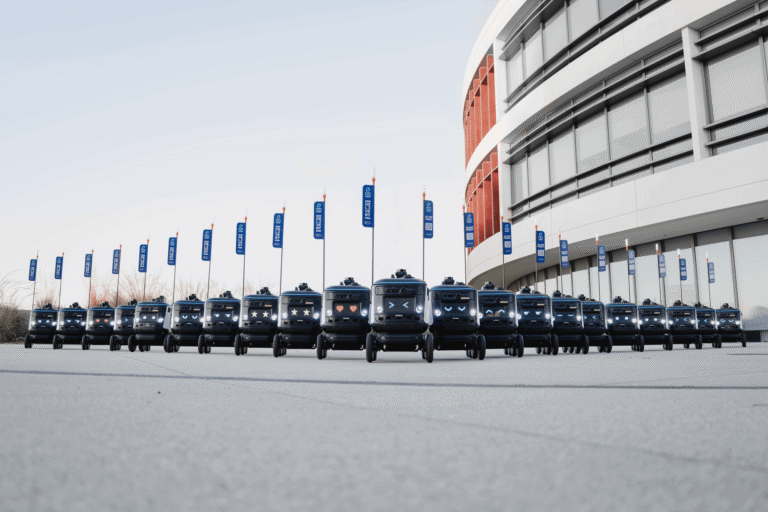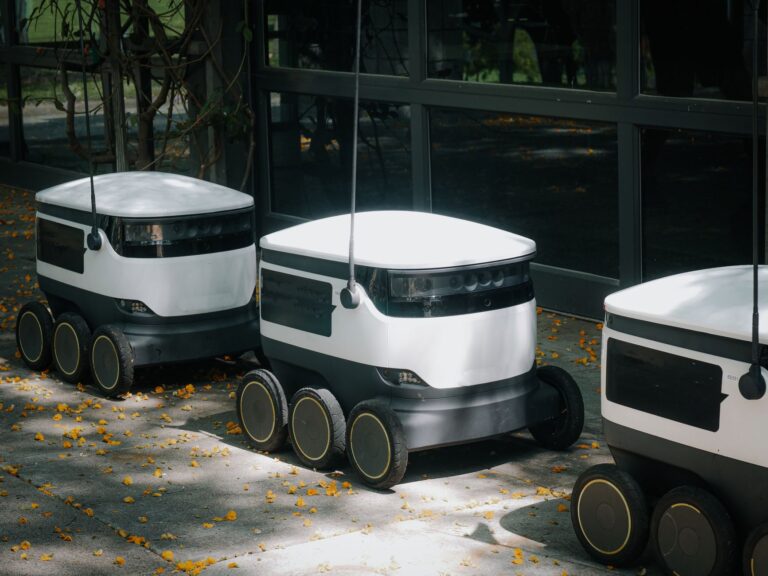

Guardforce AI (NASDAQ: GFAI) has positioned itself as an ambitious player in the autonomous security robotics market, though calling it “The Google of Autonomous Security” requires significant qualification. The Singapore-headquartered company operates more than 1,400 robotic systems across Asia-Pacific, offering everything from thermal imaging concierge robots to mobile sentry units through a Robot-as-a-Service (RaaS) model. While the company has built genuine operational scale in markets like China and Thailand since its founding in 1982, its current market capitalization of roughly $14-25 million and stock price hovering near all-time lows paint a picture of a company still fighting to prove its business model rather than dominating its sector.
The “Google of” comparison likely stems from Guardforce AI’s attempt to build a comprehensive, integrated platform for autonomous security rather than selling standalone products. Their Intelligent Cloud Platform connects deployed robots across supermarkets, hospitals, government facilities, and transportation hubs, creating a networked approach to security automation. However, investors should approach such characterizations skeptically given the company’s current financial struggles, including a net loss of $2.2 million in the first half of 2025 and ongoing Nasdaq compliance issues. This article examines what Guardforce AI actually offers, where the company stands financially, how its technology compares to competitors, and whether the ambitious comparisons to tech giants hold any merit for investors and industry observers.
Table of Contents
- What Makes GFAI a Contender in Autonomous Security Robotics?
- Guardforce AI’s Product Portfolio and RaaS Business Model
- Financial Reality: Stock Performance and Nasdaq Compliance
- Geographic Footprint and Expansion Strategy
- Technology Integration and the AI Agent Platform
- DeepVoyage Go: Diversification or Distraction?
- The Road Ahead for Autonomous Security
- Conclusion
What Makes GFAI a Contender in Autonomous Security Robotics?
Guardforce AI’s claim to significance rests on three pillars: legacy experience, deployed scale, and platform integration. The company traces its roots to 1982 Thailand, where it began as a traditional security and logistics provider. This four-decade history in physical security gives it operational knowledge that pure robotics startups lack. The company employs approximately 1,700 people and maintains established relationships with clients who already trust them for conventional security services. The deployed fleet of over 1,400 robotic systems represents meaningful real-world validation. These units operate in demanding environments including hospitals requiring disinfection protocols, outdoor facilities needing patrol capabilities, and high-traffic locations like transportation stations.
Unlike companies showcasing prototype demonstrations, Guardforce AI generates actual revenue from robots performing actual work. Their H1 2025 revenue of $18.2 million, while modest, came from genuine commercial operations rather than pilot programs. The platform approach through their Intelligent Cloud Platform attempts to create network effects similar to what made google dominant in search. By connecting robots through centralized intelligence, Guardforce AI can theoretically offer coordinated security responses, aggregated data insights, and simplified fleet management. Google Cloud itself has worked with Guardforce AI on implementation, lending some credibility to the technical architecture. However, network effects require scale that Guardforce AI has not yet achieved outside select Asian markets.

Guardforce AI’s Product Portfolio and RaaS Business Model
The Robot-as-a-Service model addresses a fundamental barrier in enterprise robotics adoption: upfront capital costs. Rather than selling robots outright for tens or hundreds of thousands of dollars, Guardforce AI offers subscription-based access to thermal imaging concierge robots, disinfection units, indoor and outdoor patrol robots, delivery systems, and mobile sentry platforms. This mirrors the shift from on-premise software to cloud subscriptions that transformed enterprise technology. For clients like hotels or educational institutions, RaaS eliminates the need for internal robotics expertise. Guardforce AI handles maintenance, software updates, and eventual hardware replacement. A hospital administrator can add disinfection robot capacity during disease outbreaks and scale back during normal operations without owning depreciating assets.
The model also provides Guardforce AI with recurring revenue streams rather than one-time sales. However, RaaS creates its own challenges. The company must finance robot production before generating subscription revenue, straining cash flow. Their $25 million cash position as of June 30, 2025 provides runway, but continued net losses will erode this buffer. Additionally, RaaS economics depend heavily on utilization rates. A robot sitting idle between client deployments generates no revenue while requiring storage and maintenance. Companies without sufficient client density in a geographic region may find RaaS margins difficult to achieve.
Financial Reality: Stock Performance and Nasdaq Compliance
The gap between Guardforce AI’s technological ambitions and financial performance demands honest assessment. The stock reached an all-time low of $0.5214 on January 21, 2026, triggering concern about the company’s viability as a public entity. On December 12, 2025, Nasdaq notified Guardforce AI of non-compliance with the $1.00 minimum bid price requirement, giving the company until June 10, 2026 to remedy the situation. First half 2025 results showed mixed signals. Revenue increased 3.6% year-over-year to $18.2 million, demonstrating continued operational activity. Gross profit of $3.0 million represented a 16.2% margin, thin but positive.
The $2.2 million net loss, while concerning, was not catastrophic relative to the company’s cash reserves. One analyst maintains a “Strong Buy” rating with a $4.50 price target, suggesting at least some professional observers see significant upside potential. The Nasdaq compliance situation creates specific risks. If the stock price remains below $1.00, Guardforce AI may need to execute a reverse stock split, which often signals distress to the market. Alternatively, the company could be delisted to over-the-counter markets, reducing liquidity and institutional investor access. Neither outcome is terminal, but both would complicate capital raising efforts and partnership negotiations.

Geographic Footprint and Expansion Strategy
Guardforce AI concentrates operations in China, Thailand, and other Asia-Pacific markets. This regional focus offers both advantages and limitations. Asia-Pacific represents the fastest-growing market for commercial robotics, with labor costs rising in traditional manufacturing hubs while technology adoption accelerates. The company’s Thai heritage and Singapore incorporation provide cultural and regulatory familiarity that Western competitors lack. Deployment locations span diverse environments: government facilities in Thailand, supermarket chains across the region, hotels serving international guests, and transportation stations handling millions of commuters.
This diversity tests the robotics platform across varied use cases, building operational knowledge that narrow-focused competitors cannot match. A robot successful in a climate-controlled hospital lobby learns different lessons than one patrolling outdoor parking facilities in tropical humidity. The November 2025 announcement of expanded RaaS operations in Thailand, integrating robots through the Intelligent Cloud Platform, suggests ongoing investment in home market infrastructure. For investors, concentrated geographic exposure means results depend heavily on Asia-Pacific economic conditions. A regional recession or political instability in key markets would disproportionately impact Guardforce AI compared to globally diversified competitors.
Technology Integration and the AI Agent Platform
Guardforce AI’s November 2025 announcement of an AI Agent platform represents the company’s attempt to differentiate through software intelligence rather than hardware alone. The concept involves autonomous decision-making systems that coordinate multiple robots, analyze security threats, and optimize patrol routes without constant human supervision. If successfully implemented, such capabilities would justify higher RaaS pricing and create switching costs for established clients. The Intelligent Cloud Platform already provides centralized monitoring and control, but the AI Agent layer aims to add predictive capabilities. Rather than simply dispatching a patrol robot when an alarm triggers, an AI Agent system could recognize patterns indicating potential security breaches and position resources proactively.
This represents meaningful advancement over current capabilities across the industry. Skepticism remains warranted until demonstrated at scale. AI Agent announcements proliferate across robotics companies, many delivering incremental improvements marketed as revolutionary advances. Guardforce AI’s actual implementation will depend on their data science capabilities, the quality of data collected from existing deployments, and their ability to avoid the false positive problems that plague predictive security systems. The gap between announcement and profitable deployment often spans years.
DeepVoyage Go: Diversification or Distraction?
The April 2025 beta launch of DeepVoyage Go, an AI-powered travel planning tool, raises questions about strategic focus. On one hand, diversification could provide revenue streams uncorrelated with security robotics cycles. On the other, entering the crowded AI travel planning market against well-funded competitors like Google, Expedia, and numerous startups seems disconnected from Guardforce AI’s core competencies.
The charitable interpretation suggests DeepVoyage Go leverages natural language processing capabilities developed for robot interaction systems, applying them to travel recommendations. Cross-pollination between business units could strengthen both. The concerned interpretation notes that a company losing money in its primary market while facing Nasdaq compliance deadlines should focus resources rather than launch consumer-facing beta products.
The Road Ahead for Autonomous Security
Autonomous security robotics will grow substantially regardless of Guardforce AI’s individual trajectory. Labor shortages, rising security costs, and advancing sensor and AI technologies create favorable conditions for the entire sector. The question for Guardforce AI specifically is whether they can achieve profitability and scale before their capital runway expires.
The June 2026 Nasdaq compliance deadline creates a concrete milestone. Either the stock recovers above $1.00 through improved fundamentals or market sentiment, the company executes a reverse split to regain compliance, or they accept delisting consequences. Each path leads to meaningfully different futures for shareholders and the company’s competitive position. Meanwhile, larger players continue investing in autonomous security, potentially outpacing Guardforce AI’s technology while the company manages financial distractions.
Conclusion
Guardforce AI occupies an interesting position in autonomous security robotics, with genuine operational scale, proven RaaS business mechanics, and four decades of security industry experience. The 1,400-plus deployed robots and established client relationships in Asia-Pacific represent real assets that differentiate the company from vaporware competitors. Their Intelligent Cloud Platform and emerging AI Agent capabilities address legitimate market needs. However, the “Google of Autonomous Security” label remains aspirational rather than descriptive.
Google dominates search with market share exceeding 90 percent and generates massive profits. Guardforce AI struggles to maintain Nasdaq listing requirements while losing money quarterly. For investors, the company represents a speculative bet on autonomous security sector growth combined with successful execution of a turnaround. For industry observers, Guardforce AI provides a case study in the challenges of scaling robotics businesses even with experienced management and proven technology.