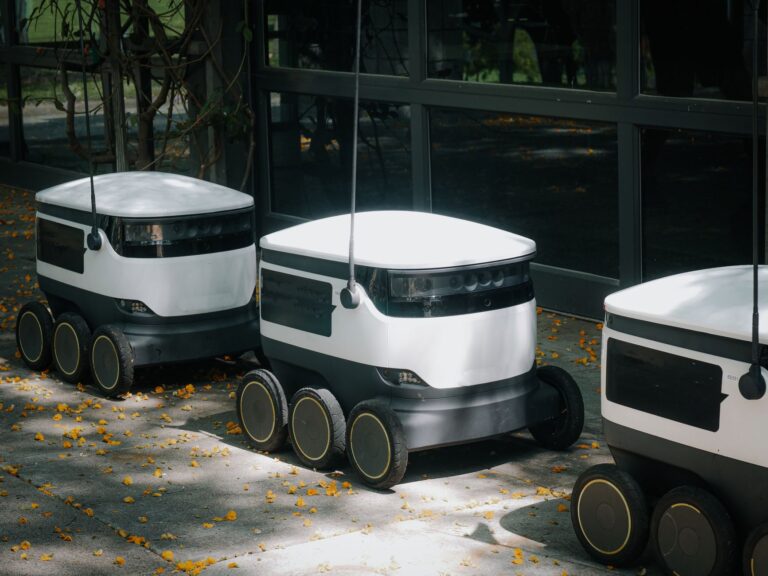

Corporate strategy determines success in the autonomous vehicle market because the AV sector demands simultaneous mastery of capital deployment, technological differentiation, and geographic expansion—no company can win on one dimension alone. The winners are emerging as those that align capital investment with clear technology choices, form partnerships that complement internal capabilities, and match their go-to-market strategy to regional conditions. Waymo’s dominance, Tesla’s contrarian approach, and Uber’s infrastructure plays all reflect radically different strategic bets, and they’re producing measurably different outcomes: Waymo completes over 450,000 paid rides weekly across six U.S. markets as of February 2026, while Tesla just began Cybercab production in April 2026 with management warning of a slow ramp and significant revenue unlikely before 2027.
The market stakes are enormous and rising fast. The autonomous vehicle market reached $220.58 billion in 2026, up from $177.20 billion in 2025, and is projected to hit $656.37 billion by 2031 at a compound annual growth rate of 24.37 percent. The robotaxi segment alone—focused on shared autonomous vehicles rather than personal ownership—is forecast by Goldman Sachs to become a $415 billion market globally by 2035, with the U.S. reaching $48 billion by that year. At this scale, a misaligned strategy doesn’t just underperform—it consumes billions in capital while stronger competitors consolidate market position.
Table of Contents
- How Strategic Partnerships Determine Market Entry Speed
- Vertical Integration as a Differentiation Strategy
- Geographic Strategy and Regional Market Leadership
- Pricing Strategy as a Reflection of Market Position
- Technology Investment and Patent Strategy
- Robotaxi vs. Personal Vehicle as Strategic Objective
- Safety Performance and Competitive Credibility
- Frequently Asked Questions
How Strategic Partnerships Determine Market Entry Speed
The most successful entrants have recognized that partnership is a force multiplier in autonomous vehicle development. Uber has committed up to $1.25 billion to Rivian for robotaxi deployment across 25 cities in the U.S., Canada, and Europe, with $300 million upfront and the remainder contingent on hitting performance benchmarks through 2031. This strategy trades Uber’s direct vehicle manufacturing risk for rapid fleet scale and access to Rivian’s custom LiDAR and autonomous stack. Waymo took a different partnership path, announcing a strategic collaboration with Toyota to accelerate full self-driving technology for personally owned vehicles, recognizing that consumer vehicle penetration requires OEM scale.
Sony and Honda launched their joint autonomous electric vehicle, the Afeela EV, in Japan and the U.S. by 2026, combining Sony’s sensor and AI expertise with Honda’s manufacturing heritage. Toyota and NTT signaled long-term commitment by investing 500 billion yen through 2030 to develop a Mobility AI Platform that integrates high-speed communication infrastructure with advanced autonomous driving AI. These partnerships reveal a strategic principle: companies without existing vehicle manufacturing, distribution, or OEM relationships accelerate their timeline by partnering with those who have them. The risk for partners is technology misalignment or capability dilution; Uber’s bet on Rivian, for example, depends on Rivian successfully scaling autonomous capability while managing its core R2 electric vehicle production.
Vertical Integration as a Differentiation Strategy
Some companies are rejecting the partnership model in favor of vertical integration, betting that controlling the entire stack—perception, computing, silicon—yields long-term advantage and margin. Rivian is manufacturing its own LiDAR sensors in the United States and developing custom silicon chips for autonomous driving, with LiDAR units beginning shipment in R2s by the end of 2026. This strategy absorbs capital and engineering complexity but insulates Rivian from supplier dependency and allows rapid iteration when supply chains or component architectures become bottlenecks. The tradeoff is clear: vertical integration is expensive and requires sustained investment even if external options become available.
The automotive LiDAR market has accumulated 41,939 active patents globally as of March 2026, with 6,502 filings in 2024 alone; three competing solid-state architectures are vying for mass production, and choosing wrong can mean significant manufacturing rework. Tesla has adopted a mixed strategy, pursuing in-house autonomous computing and vision-based perception while remaining dependent on external battery suppliers. This approach allows Tesla to move fast in areas it considers strategically critical—autonomous algorithms and vehicle integration—while outsourcing commodity components. The risk is that vision-based perception, which Tesla has prioritized, requires higher computational power and larger datasets than LiDAR-fusion systems. As of April 2026, Tesla began Cybercab production at its Texas Gigafactory but warned of slow ramp-up; whether this reflects production constraints, perception algorithm maturity, or validation delays will determine whether its strategy yields faster time-to-market or falls behind LiDAR-based competitors.
Geographic Strategy and Regional Market Leadership
North America commands 37 percent of the global autonomous vehicle market share in 2026, but Asia Pacific is growing at 25.05 percent CAGR during 2026-2031, signaling where long-term market dominance will be decided. Corporate strategy must account for these regional trajectories. Waymo has concentrated on North America, launching services in six U.S. markets including Miami in 2026 and planning expansions to Dallas and Nashville in 2026, maximizing ride volume and revenue per market before geographic diversification. Mercedes-Benz and BMW are pursuing different regional focuses: Mercedes logged 2 million miles on its Drive Pilot during 2024, focusing on highway automation in Europe, while BMW plans to deploy Highway Assistant in 2026, a different capability tier suited to different regulatory and consumer expectations.
Sony-Honda and Toyota-NTT’s emphasis on Japan and Asia reflects strategic recognition that Asia Pacific will be the faster-growing market. A company must choose whether to deepen presence in North America’s established regulatory environment and wealthy urban markets or invest heavily in Asia Pacific’s volume and growth. The Waymo approach—dominant in North America first, then expand—trades eventual market share in Asia for early cash flow and operational learning. The Sony-Honda and Toyota approaches—building from the ground up in Asia—trade slower initial revenue for potential leadership in the faster-growing region. Neither choice is universally correct; it depends on capital availability, technology maturity, and manufacturing partnerships.
Pricing Strategy as a Reflection of Market Position
Waymo charges $3.50 to $4.00 base fares and $2.25 to $2.85 per mile, positioning itself as a premium service for urban users who value safety and convenience over cost. Tesla prices Cybercab rides near $1 per mile, targeting cost-sensitive users and competing on volume and affordability. This price gap reflects fundamentally different corporate strategies: Waymo is maximizing revenue per ride and targeting high-value trips (city centers, airports), while Tesla is pursuing market share and density by undercutting premium competitors. Waymo’s approach allows higher margins per ride and attracts affluent users first, validating demand in the most profitable segment before expanding downmarket.
Tesla’s approach requires much higher volume to achieve profitability per ride, but if achieved, creates dominant market position and raises switching costs through network effects and brand entrenchment. Pricing also signals confidence in technology maturity. Companies charging premium prices implicitly claim their safety, reliability, and uptime justify the cost. Waymo’s 450,000 weekly paid rides demonstrate market acceptance of its pricing; Tesla’s warning of slow production ramp suggests its pricing, while low, may not yet be achievable at profitable volumes. The comparison reveals a strategic constraint: pricing cannot exceed what consumers perceive as justified by safety and reliability, and pricing cannot fall below cost structure without eroding margin or requiring extreme scale.
Technology Investment and Patent Strategy
The automotive LiDAR market is projected to reach $4.5 billion by 2028, reflecting sustained R&D investment by companies betting that LiDAR will remain a core autonomous perception technology. The 41,939 active LiDAR patents globally, with 6,502 filings in 2024 alone, signal that companies are building durable IP moats around their sensor technology. Waymo, Rivian, and others are investing heavily in LiDAR because they believe it reduces computational load compared to vision-only systems and provides redundancy in adverse weather.
However, the existence of three competing solid-state LiDAR architectures introduces risk: committing manufacturing to one architecture before industry standardization can leave a company stranded with expensive, incompatible supply chains if another architecture wins. Tesla’s bet on vision-based autonomous driving without LiDAR is a high-risk, high-reward strategy that sidesteps solid-state architecture risk but requires extraordinary progress in neural network perception and computational efficiency. The strategic choice between LiDAR and vision becomes irreversible once manufacturing scales and supply contracts lock in. Companies must balance the risk of choosing wrong against the cost of maintaining optionality by hedging technology bets; most major automakers and AV companies are diversifying, but Tesla’s concentrated bet reflects a different risk tolerance and belief in AI-only perception.
Robotaxi vs. Personal Vehicle as Strategic Objective
The autonomous vehicle market shows divergent corporate strategies on whether to pursue robotaxi (shared, autonomous fleets) or personal vehicle autonomy (autonomous cars sold to consumers). Passenger vehicles account for 69 percent of global revenue in 2024, but transportation applications (including robotaxis and autonomous trucks) represent 85.6 percent of market revenue, signaling that shared autonomous services, while smaller in unit volume, generate higher revenue per vehicle. Goldman Sachs forecasts the robotaxi market will reach $415 billion by 2035, with $48 billion from the U.S. alone.
Waymo, Uber-Rivian, and Tesla Cybercab are pursuing robotaxi strategies that generate recurring revenue and network effects but require solving shared vehicle durability, liability, and urban operational complexity. Waymo and Toyota’s partnership focuses on personal vehicle autonomy, allowing consumers to own autonomous vehicles and generating sale revenue rather than recurring service revenue. The strategic difference is not trivial: robotaxi revenue scales with utilization rate and geography; personal vehicle revenue scales with unit sales and resale value. Robotaxis tolerate higher upfront cost per vehicle because utilization justifies it; personal vehicles must hit consumer price points that allow profitable retail sale.
Safety Performance and Competitive Credibility
Waymo’s safety trajectory demonstrates how operational performance becomes strategic advantage. In 2022-2023, 46 percent of Waymo’s crashes involved parked or stopped vehicles; by 2024, that fraction increased to 65 percent, and by 2025, it reached 70 percent. This shift means fewer accidents involving moving vehicles and clearer separation between incidents caused by Waymo’s technology versus uncontrollable external factors.
Tesla’s warning of slow Cybercab ramp suggests ongoing validation challenges. Mercedes-Benz’s 2 million miles logged on Drive Pilot and BMW’s Highway Assistant deployment show regional OEMs building safety credibility in narrower domains before expanding autonomy scope. A company’s safety record becomes its most durable competitive asset in autonomous vehicles because liability, insurance, and regulatory approval all hinge on demonstrated safety performance. Waymo’s 450,000 weekly paid rides represent not just revenue but proof of reliable operation across diverse urban conditions; no competitor has yet matched that scale or publication of safety metrics.
Frequently Asked Questions
Why do some companies pursue partnerships while others invest in vertical integration?
Partnerships accelerate market entry but reduce margin and create dependency on partners; vertical integration preserves margin and control but requires sustained capital and expertise. Companies choose based on capital availability, existing capabilities, and risk tolerance. Uber bet on Rivian for fast scale; Rivian bet on internal LiDAR for strategic independence.
Why is Waymo’s pricing so much higher than Tesla’s?
Waymo targets premium urban users and maximizes revenue per ride; Tesla targets market share and density through cost competition. Waymo’s 450,000 weekly rides validate that users accept premium pricing for proven safety and reliability. Tesla’s approach requires enormous volume to achieve profitability at $1 per mile.
Which technology wins—LiDAR or vision-based perception?
Multiple solid-state LiDAR architectures are competing for dominance, and vision-only systems face computational and weather-robustness challenges. Most major competitors are hedging by combining both; Tesla’s vision-only bet is an outlier. Industry outcome remains uncertain.
How important is geographic strategy?
Critical. North America has 37% market share but Asia Pacific grows at 25% CAGR. A company must choose: dominate North America first and expand later, or build in Asia Pacific for the faster-growing market. Waymo chose North America dominance; Toyota-NTT and Sony-Honda chose Asia.
Why is the robotaxi market growing faster than personal vehicle autonomy?
Shared autonomous vehicles generate higher revenue per unit through utilization and recurring service revenue; personal vehicles generate sale revenue but require consumer price points. Goldman Sachs forecasts $415 billion in robotaxi revenue by 2035 despite lower unit volume.