
This FAQ gives source-checked answers to common questions about natural language processing robotics in October 2026. Natural language processing robotics means robots that take everyday language, camera images, and task context and turn them into physical plans and motor commands. Use it to decide what language-controlled robots can do now, how to instruct them clearly, and what safety, legal, and security limits apply. Each answer stays close to published models, studies, and rules.
Table of Contents
- How do robots turn language into action?
- How should you phrase robot instructions?
- What safety baseline covers industrial robots?
- What EU AI Act dates affect robot deployers?
- What security limit should you plan for?
How do robots turn language into action?
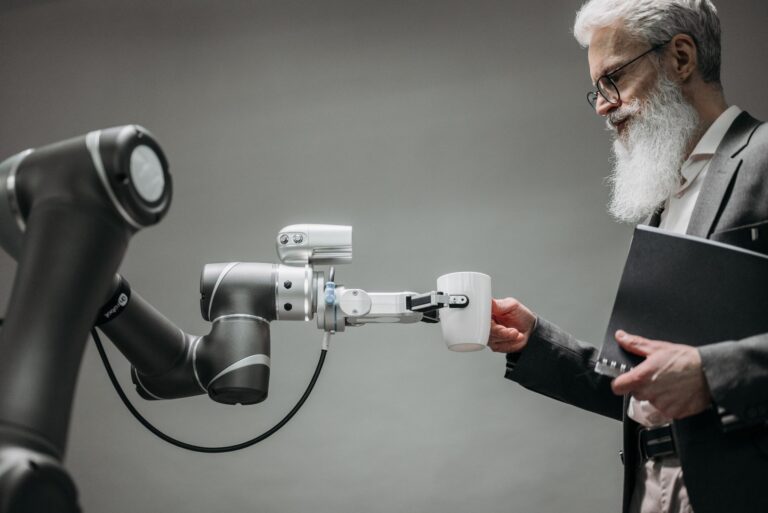
Google DeepMind describes two parts. Gemini Robotics 2 is a vision-language-action model that converts camera images and natural-language instructions directly into motor commands for full humanoids. Gemini Robotics-ER 2 handles spatial reasoning, task orchestration, and multi-robot collaboration for planning multi-step tasks, according to Google DeepMind in its model card for Gemini Robotics-ER 2.
NVIDIA News reports a similar split for research systems. Isaac GR00T N1.6 with Cosmos Reason acts as a robot brain that turns vague instructions into step-by-step plans using common sense and physics. In practice, give the planner the goal and limits, then let the action model handle grasp points and motion.
How should you phrase robot instructions?
Be specific about object, place, order, and stop rule. Say "pick the small metal bolt from the left bin and place it in tray A, then stop" rather than "tidy the parts." Wording changes behavior.
A 2026 Frontiers in Robotics and AI study found prompt framing measurably changes foundation-model action selection, so persona and relational wording act as interface parameters. MIT Computing reports that the neurosymbolic LILO method uses a language model to write, compress, and document code, and beat standalone language models and DreamCoder on commonsense coding and robotics abstractions.
- Name the target object and location
- State the sequence in numbered order
- State what not to touch and when to stop
What safety baseline covers industrial robots?
ISO 10218-1:2025 and 10218-2:2025, published in 2025, set the industrial-robot safety baseline. According to Automation Mag summarizing the ISO catalogue, they integrate cybersecurity and collaborative-application requirements into design and integration in its automation safety overview.
That matters for shared cells with people, quadrupeds, or humanoids. Treat risk assessment, fencing or speed and separation rules, and secure setup as part of install work, not add-ons. Ask the integrator which clause covers each hazard and keep that record.
What EU AI Act dates affect robot deployers?
EU AI Act transparency duties took effect Aug. 2, 2026, while high-risk obligations were pushed by Regulation 2026/1744 to Dec. 2, 2027 and Aug.
2, 2028, according to Goodwin in its alert on EU AI Act transparency duties. For deployers, that split means disclosure work comes first. Label AI-generated interaction where required, log system version and use case, and track whether your robot falls into a regulated high-risk use. Put the December 2027 and August 2028 dates in your compliance plan now.
What security limit should you plan for?
Researchers disclosed UniPwn in Sept. 2025, IEEE Spectrum reports.
It is a wormable Bluetooth exploit chain with hardcoded keys that enables decryption, authentication bypass, and root command injection across robot fleets. Do not deploy fleets with shared default keys and always-on discoverable Bluetooth. Segment robot wireless traffic, rotate credentials, patch Bluetooth stacks, and test one recovery path that works without wireless access.