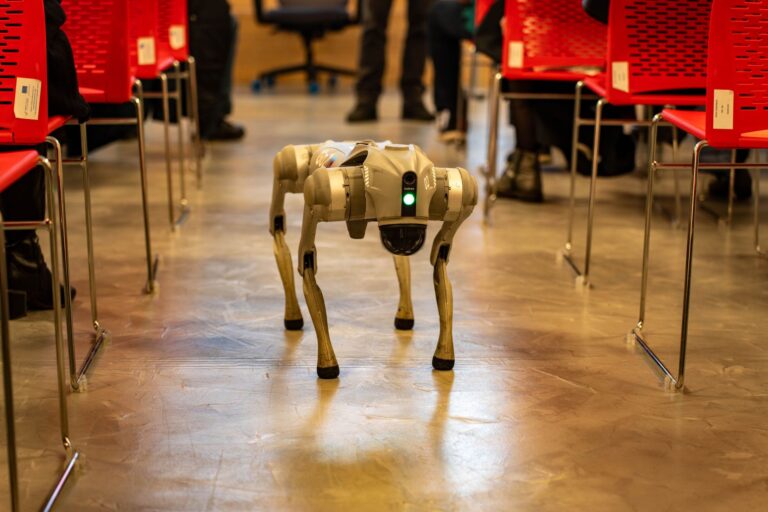

A quadruped patrol robot — a four-legged walking machine that carries cameras and sensors on set routes — pays off when it handles repeat rounds and frees staff for response and judgment. Productivity comes from steady coverage, staffing changes toward supervision and exceptions, and payback depends on frequent use at a suitable site. Legged design matters where stairs, curbs, gravel, or clutter block wheeled robots. The business case is therefore site-specific, not automatic, and rests on task fit and operating discipline.
Table of Contents
- What a patrol quadruped actually does
- Where productivity gains come from
- How does staffing change in practice?
- What drives payback?
What a patrol quadruped actually does
A patrol quadruped walks planned paths, pauses at checkpoints, and records video, sound, heat patterns, or gauge readings. Operators assign routes, watch alerts, and step in when something needs action. The robot does not reason like a guard.
It suits dull, regular work: perimeter checks, after-hours rounds, tank and pipe aisles, parking areas, and remote corners. It is less useful where crowds, intervention, or complex judgment dominate. Match the route list to sensing, not to appearance.
Where productivity gains come from
The main gain is repeatability. A robot follows the same path each time, visits low-priority points without delay, and logs every stop. That steadies inspection quality across shifts and seasons.
A second gain is reach. It can enter noisy, hot, dark, or isolated zones without pulling a two-person team away from other duties. People then spend more time on alarms, access control, customer contact, and repair decisions.
How does staffing change in practice?
Most teams keep headcount and change roles. Guards become robot handlers, reviewers, and responders. They launch missions, check images and sensor flags, charge or dock the unit, and attend incidents the robot finds.
Plan for new work as well. Someone must keep maps current, clear route obstacles, manage software updates, and review false alerts. Sites with clear ownership, simple escalation rules, and backup coverage for leave and faults adjust fastest.
What drives payback?
Payback comes from avoided effort and avoided loss, balanced against running cost. Value rises with patrol frequency, site size, night and weekend coverage needs, and hard-to-staff posts.
Cost includes the unit, connectivity, maintenance, training, and staff time for supervision. Use this check before committing: Walk the intended route with operations and safety staff before signing.
- repeat routes are mapped, walkable, and free of frequent changes
- alerts go to a person with authority to act
- winter weather, poor light, and poor signal are tested on site
- cleaning, charging, and storage have an owner and a place