
Simulation digital twins for robotics in 2026 are live virtual replicas that mirror physical robots and cells to design, train, and operate fleets. This guide explains current capabilities, safety rules, and deployment checks so buyers and integrators can ask sharper questions. A digital twin is a software model linked to a real robot, sensor set, or workcell. It updates with real data and lets teams test motion, perception, and layout changes before touching hardware.
Table of Contents
- What can robotics twins do in 2026?
- How do you deploy a twin that connects?
- Which safety rules now apply?
- Where do twins still fail?
What can robotics twins do in 2026?
Cloud hosting now removes the need for local workstations for heavy simulation. Reply demonstrated cloud-hosted NVIDIA Isaac Sim on G4 instances at NVIDIA GTC March 16-19, 2026 to build logistics twins and train robot fleets, as reported by Reply via Business Wire coverage. Component makers test before hardware exists.
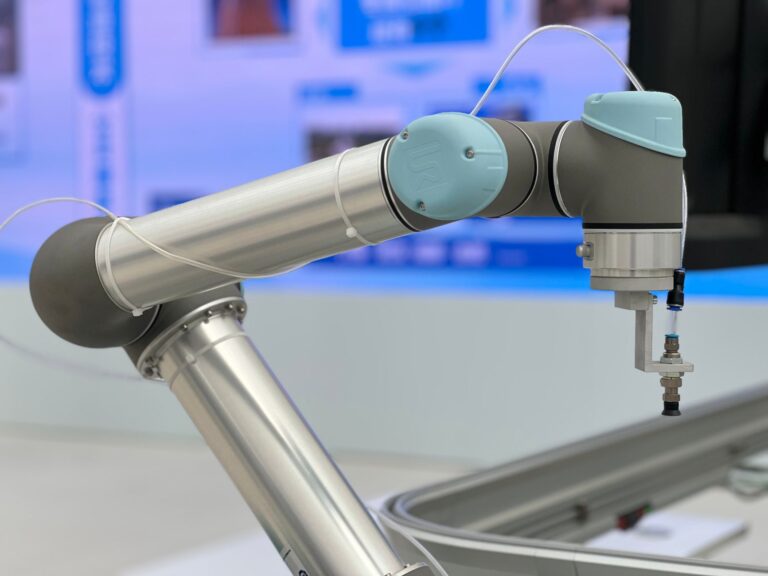
Infineon and NVIDIA are placing smart actuator and sensor twins in Isaac Sim and Isaac Lab for humanoid motion and perception tests, according to Robotics and Automation News. Machine builders link offline programming to live cells. FANUC America integrated NVIDIA Isaac Sim with FANUC ROBOGUIDE as a live twin for IMTS 2026, with changes synchronized to a physical CRX cobot handling hard drives, according to FANUC America via Newswire CA release. Use these cases to judge vendor claims by live sync, not video playback.
How do you deploy a twin that connects?
Deployment works when the twin observes the right elements and exchanges data cleanly. ISO 23247 defines the manufacturing twin framework around personnel, equipment, material, process, facility, environment, and product, with reference architecture and information-exchange networks, according to the ISO review in MDPI Sensors.
Ask vendors how each element enters the model and how often it refreshes. Confirm which systems own the master data and which interfaces carry alarms, positions, and task state.
- Observable scope: which people, machines, materials, and facility signals are modeled
- Sync rate and ownership: update interval, latency, and source of truth
- Interoperability: ISO 23247 alignment, open interfaces, and export paths
- Operations fit: cloud, on-site, or hybrid run mode and workstation needs
Which safety rules now apply?
ISO 10218-1/-2:2025 makes safety-function requirements explicit for robot systems. It drops the separate collaborative robot category and moves most ISO/TS 15066 collaboration rules into Part 2, according to IDEC USA summarizing ISO in its standards update. The change affects manufacturers and integrators more than robot labels. Risk assessment, safety functions, and complete application design carry greater weight than whether a model is called collaborative.
U.S. adoption ANSI/A3 R15.06-2025 revises the 2012 standard to clarify functional safety and consolidate collaborative-application guidance from ISO/TS 15066. It also adds end-effector and manual load and unload content, according to Engineering.com and A3. Request updated risk assessments that cite the 2025 documents.
Where do twins still fail?
Trust is a deployment issue, not only a modeling issue. NIST IR 8356 from February 2025 warns that twins raise trust concerns over defects, functional equivalence, and accuracy, according to NIST in the federal report. NIST recommends zero-trust authorization for instrumentation, data channels, and visualization.
Apply that control list during pilot acceptance and user access reviews. The sim-to-real gap persists because simulators simplify physics and miss sensor noise, contact dynamics, and environmental variability. An IRIS Publishers review from May 5, 2025 finds simulation-only policies often fail on transfer without real-world validation. Ask for validation evidence and pilot metrics on your parts, grippers, lighting, and floor conditions.
You Might Also Like
- Sensors and Perception Robotics 2026 Guide: capabilities, safety, and deployment; Key Facts and Questions to Ask
- Research Robotics 2026 Guide: capabilities, safety, and deployment; Key Facts and Questions to Ask
- Programming Robotics 2026 Guide: capabilities, safety, and deployment; Key Facts and Questions to Ask