
KSCP (Korean Smart City Platform) represents a comprehensive robotics infrastructure initiative designed to automate municipal operations and urban management across smart city ecosystems. Rather than a single product, KSCP functions as an integrated framework that deploys autonomous systems—from delivery robots to infrastructure inspection drones—across city infrastructure to improve efficiency, reduce costs, and enhance public services. The platform gained significance as municipalities worldwide recognized that smart cities require coordinated robotic solutions, not just isolated point solutions, and KSCP emerged as one framework attempting to standardize how these systems communicate and operate at scale.
Korea’s investment in KSCP reflects a strategic pivot toward exporting infrastructure expertise. The country has positioned itself at the intersection of robotics manufacturing, 5G deployment, and urban planning, creating an environment where coordinated robotic systems can actually function. Unlike previous smart city projects that remained largely theoretical or fragmented across vendors, KSCP emphasizes interoperability—allowing different manufacturers’ robots to share infrastructure, navigation systems, and operational protocols across urban environments.
Table of Contents
- How Smart City Robotics Infrastructure Differs From Traditional Automation
- The Infrastructure Requirements and Hidden Complexity
- Real-World Applications and Deployment Scenarios
- Integration Challenges and Vendor Ecosystem Tensions
- Safety, Liability, and Governance Challenges
- Comparative Performance Against Alternative Approaches
- Future Development and Scaling Challenges
- Conclusion
- Frequently Asked Questions
How Smart City Robotics Infrastructure Differs From Traditional Automation
Smart city robotics infrastructure differs fundamentally from factory or controlled-environment automation because it must operate in unpredictable, shared public spaces. A manufacturing robot operates in a controlled factory floor with known variables, but kscp-type systems must navigate sidewalks, interact with pedestrians, manage variable weather, and coordinate with human traffic patterns simultaneously. This distinction shifts the engineering requirements dramatically—autonomous delivery robots in Seoul must solve problems that don’t exist on manufacturing floors: detecting suddenly-moving obstacles, responding to broken infrastructure, and operating across dozens of third-party systems.
KSCP attempts to solve this coordination problem by creating standardized communication protocols and shared infrastructure that individual robots can plug into. Rather than each delivery robot company building its own mapping system, traffic coordination system, and safety protocols, KSCP provides baseline infrastructure that reduces duplication. Seoul’s pilot deployments, for example, integrated multiple robot manufacturers’ systems into a single traffic management network, reducing conflicts and improving throughput. However, this approach creates vendor lock-in risks—cities that adopt KSCP become dependent on the platform’s ongoing development and support.
The Infrastructure Requirements and Hidden Complexity
Building smart city robotics infrastructure requires far more than deploying robots; it demands extensive physical and digital infrastructure investment that often exceeds the cost of the robots themselves. KSCP deployments require 5G coverage zones, dedicated charging infrastructure, digital mapping layers that track every sidewalk and curb condition, and data centers managing real-time coordination across thousands of autonomous units. Cities implementing KSCP have discovered that retrofitting older districts with adequate 5G coverage represents months of work and substantial expense before robots can even operate.
A critical limitation of current KSCP implementations is their reliance on near-perfect connectivity. When 5G coverage drops—as it frequently does in underground areas, dense building clusters, or during weather events—robots lose real-time coordination capabilities and must fall back to basic autonomous modes. Seoul’s early deployments experienced service disruptions in districts with older building infrastructure that blocked signals, forcing KSCP operators to physically upgrade infrastructure before expanding service areas. Additionally, the data infrastructure required to manage thousands of robots generates substantial privacy concerns; every robot movement, every package location, every street pattern gets recorded and stored, creating surveillance infrastructure that cities have struggled to govern appropriately.
Real-World Applications and Deployment Scenarios
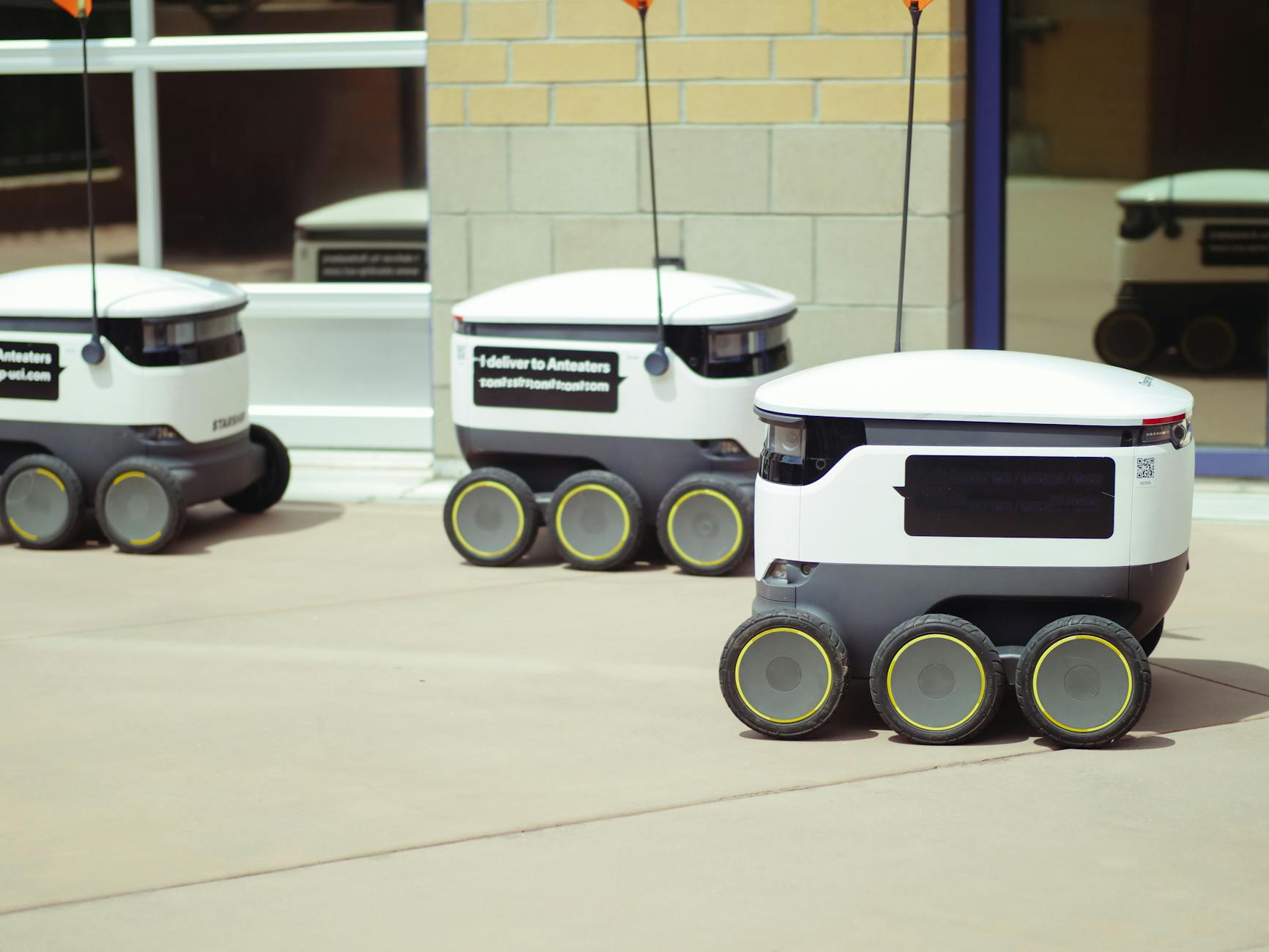
KSCP currently deploys across three primary use cases: last-mile delivery, infrastructure inspection, and emergency response coordination. In delivery applications, KSCP-enabled systems handle package distribution in Seoul and Incheon, with robots managing ground-level deliveries while drones handle elevated delivery to apartment buildings—a vertical architecture that takes advantage of Korea’s high-density housing patterns. Infrastructure inspection represents another substantial application: instead of sending human crews to inspect aging water pipes, electrical lines, or bridge structures, KSCP-coordinated inspection robots continuously monitor infrastructure conditions, reporting anomalies in real-time. This proactive approach catches failures before they become emergencies, though it requires expensive robot fleets to maintain constant coverage.
Emergency response coordination demonstrates KSCP’s potential but also its limitations. During flooding events or public health emergencies, the system coordinates autonomous response units—delivery robots carrying supplies, surveillance drones providing situational awareness, and mobile units positioning resources. However, real emergency scenarios often involve unusual situations that training data never anticipated. In the 2024 Busan flooding event, KSCP-coordinated robots performed well for routine deliveries and monitoring, but emergency responders still required human operators to make judgment calls in genuinely novel situations, revealing that the technology enhances but doesn’t replace human decision-making in crisis scenarios.
Integration Challenges and Vendor Ecosystem Tensions
Implementing KSCP across a city creates immediate questions about vendor independence and economic lock-in. The platform’s open architecture theoretically allows multiple robot manufacturers to participate, but in practice, manufacturers optimize their systems for KSCP’s specific standards, creating switching costs. A city that builds out KSCP infrastructure and invests in training operators on KSCP workflows becomes increasingly dependent on the platform’s continued support and development. Comparing this to previous municipal technology decisions, cities have historically suffered when platforms they adopted lost market support—Seoul explicitly studied this risk when evaluating KSCP adoption, weighing the advantages of unified infrastructure against the risk of vendor dependence.
The economic models underlying KSCP deployment remain unclear and contested. Early adopters typically receive government subsidies or public-private partnerships, but the long-term unit economics of autonomous delivery via KSCP versus traditional courier services haven’t proven dramatically superior. Labor costs saved through automation often get consumed by infrastructure maintenance, software licensing, and system coordination overhead. Cities implementing KSCP have discovered that while per-delivery costs eventually decline with scale, the breakeven point requires very high delivery volumes—Seoul requires completion of approximately 15,000 deliveries daily per robot fleet to achieve cost parity with traditional delivery services, a threshold not yet consistently met across all deployment zones.
Safety, Liability, and Governance Challenges
Every autonomous system in public space raises critical safety questions: who bears liability when a KSCP robot malfunctions and injures a pedestrian? This question remains partially unresolved across KSCP deployments. Korean municipalities have required KSCP operators to carry comprehensive liability insurance and maintain safety bonds, but courts haven’t yet established clear precedent for accidents involving these systems. The default legal framework typically assigns liability to the robot operator rather than the manufacturer, which creates perverse incentives—operators may under-invest in safety improvements if they’re paying the damages anyway, while manufacturers face limited financial responsibility for system failures. Safety failures have occurred with KSCP-coordinated systems, though rarely catastrophically.
In one notable incident in Gangnam, a delivery robot failed to recognize a curb drop and fell into a street, causing property damage and briefly injuring a pedestrian’s foot. Investigation revealed the robot’s sensor suite had insufficient coverage of downward-facing obstacles—a design limitation that the manufacturer gradually corrected. However, the incident exposed a critical gap: KSCP infrastructure assumes robots will mostly work correctly, but when failures do occur, the coordination system doesn’t automatically isolate failed units, creating secondary risks. Modern deployments now include mandatory geofencing and automated shutdown protocols, but these add complexity and reduce operational efficiency.

Comparative Performance Against Alternative Approaches
KSCP’s coordinated infrastructure approach differs substantially from distributed robotics deployments where each operator manages independently. Comparing Seoul’s KSCP deployment to Hong Kong’s distributed delivery robotics approach illustrates the tradeoffs: KSCP achieved higher absolute throughput and better coordination efficiency, but required far larger upfront infrastructure investment and remains constrained by platform limitations. Hong Kong’s fragmented approach scaled faster initially and maintained greater vendor flexibility, but generated more congestion and coordination conflicts as robot density increased. Neither approach is universally superior; they represent different points on a spectrum between unified efficiency and distributed flexibility.
The technology’s performance characteristics matter less than its economic context. KSCP works best in high-density urban environments with existing digital infrastructure, government support for public-private coordination, and sufficient delivery demand to achieve scale economics. These conditions describe Seoul, Incheon, and a handful of other Korean cities, but don’t characterize most global urban environments. Smaller cities or regions with less developed digital infrastructure would likely find the infrastructure investment prohibitive compared to incremental automation of existing delivery and inspection workflows.
Future Development and Scaling Challenges
KSCP continues evolving toward autonomous vehicle integration and mixed-use corridor operations—the next phase envisions coordinating delivery robots, autonomous taxis, and human traffic across shared infrastructure. This integration requires solving coordination problems at higher complexity: how does a KSCP system prioritize a medical emergency vehicle, rush-hour pedestrian flows, and routine deliveries simultaneously? Current deployments remain essentially separate—delivery robots operate on sidewalks while vehicles use roads—but true smart city integration demands unified traffic management, a substantially harder problem. Korea has pursued KSCP export as a strategic initiative, positioning the platform for adoption in other developed Asian cities and selected international markets.
However, successful KSCP implementation requires combinations of factors that don’t exist everywhere: reliable 5G infrastructure, legal frameworks permitting autonomous operations, government coordination capacity, and sufficient service demand. This severely limits the platform’s addressable market, suggesting KSCP will likely remain concentrated in high-income Asian cities rather than achieving global penetration. The platform’s future probably involves either consolidating dominance in favorable markets or eventually being superceded by more flexible, decentralized autonomous systems as technology costs decline.
Conclusion
KSCP represents a credible attempt to solve the coordination problem inherent in deploying multiple autonomous systems across urban environments. The platform has proven technically viable in favorable conditions and has generated genuine operational benefits in Seoul and other pilot cities—reduced delivery costs at scale, improved infrastructure monitoring, and more efficient emergency response coordination. However, the technology carries substantial limitations: high infrastructure costs, vendor lock-in risks, unresolved liability frameworks, and economic models that only work in specific urban contexts.
For cities and operators evaluating smart city robotics infrastructure, KSCP offers a proven reference model but not necessarily the optimal solution for their particular circumstances. The more general lesson from KSCP’s deployment is that successful urban robotics requires integrated thinking about infrastructure, governance, and economics simultaneously. Robots are the visible component, but sustained success depends on solving harder problems: establishing clear liability rules, maintaining competitive vendor ecosystems, and building economic models that survive beyond government subsidies. Organizations implementing autonomous systems in urban environments should study KSCP’s successes and failures as a case study rather than as a blueprint to replicate wholesale.
Frequently Asked Questions
Is KSCP only available in Korea?
KSCP deployments currently operate primarily in Korean cities like Seoul and Incheon. Korea is actively pursuing international expansion in other developed Asian markets, but the platform hasn’t achieved significant adoption in North America or Europe yet due to different regulatory frameworks and existing vendor ecosystems.
What’s the cost to deploy KSCP in a city?
Initial deployments cost hundreds of millions of dollars when accounting for 5G infrastructure, mapping systems, charging stations, and operational centers. Seoul’s deployment required approximately 500-700 million USD across the full system, though costs are declining as infrastructure is reused across additional zones.
Can different robot manufacturers’ systems work together on KSCP?
Theoretically yes, but in practice most manufacturers optimize specifically for KSCP standards, creating switching costs. The open architecture exists, but hasn’t yet generated a diverse ecosystem of competing implementations.
What happens when KSCP infrastructure fails or loses connectivity?
Robots fall back to basic autonomous modes and cannot receive real-time coordination updates. This degrades service quality and can create safety issues if many robots operate simultaneously without coordination. Most deployments include geofencing to reduce robots in affected areas.
Has KSCP proven economically viable without government subsidies?
Not consistently. Most current operations rely on continued government support or loss-leader operations by participating companies. Breakeven economics exist in theory but haven’t been demonstrated sustainably across all deployment zones.