
Teradyne’s acquisition of Universal Robots in 2015 for $285 million catapulted the Massachusetts-based semiconductor testing giant into the collaborative robotics arena with a decisive market position. Today, TER rivals NVIDIA in its transformative impact on the robotics industry—not through semiconductor design, but through a calculated strategy of intelligent automation that has turned collaborative robot arms into the backbone of modern manufacturing. With a 245% stock surge over 12 months and accelerating AI integration, Teradyne has positioned its robotics segment as a growth engine that commands investor attention alongside its legacy testing business.
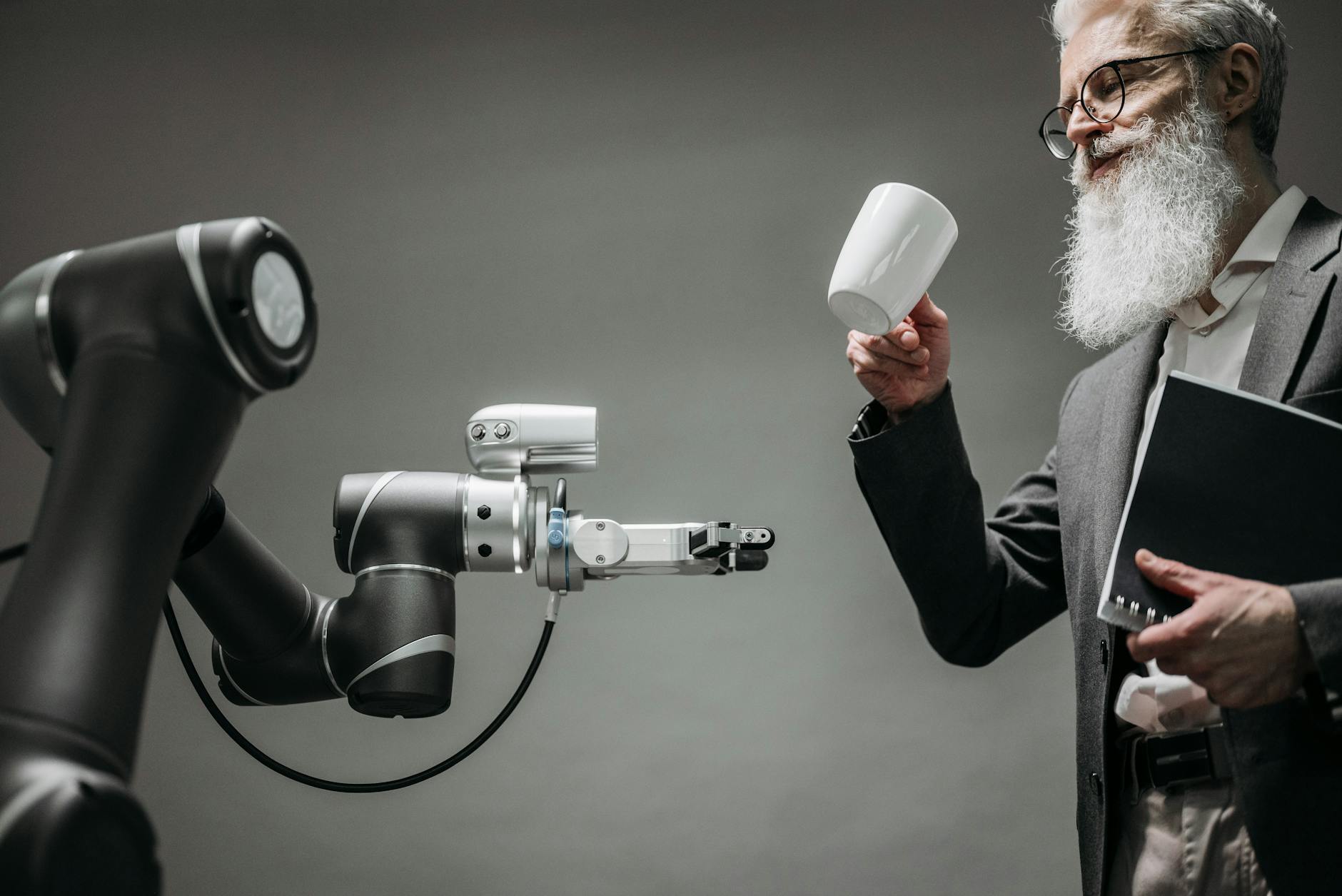
The “Nvidia of collaborative robotics” comparison holds because TER, through its Universal Robots subsidiary, has mastered the same competitive advantage NVIDIA wields in AI: control of a critical infrastructure layer. While NVIDIA supplies the processors that power artificial intelligence, Teradyne supplies the collaborative arms that execute AI-driven decisions in physical space. The integration of NVIDIA’s cuMotion path planning software into UR’s robot systems—delivering 50-80x faster motion planning than existing solutions—exemplifies this synergy. It’s a partnership that puts collaborative robotics at the intersection of software acceleration and hardware autonomy, redefining what’s possible in manufacturing automation.
Table of Contents
- How NVIDIA’s AI Partnership Accelerates Collaborative Robotics Innovation
- TER’s Dominance Through Strategic Market Consolidation
- Real-World Applications Transforming Manufacturing Operations
- Financial Performance and the Investor Confidence Surge
- U.S. Manufacturing Expansion and Workforce Investment
- Patent Protection and Competitive Market Defense
- AI Training Infrastructure and the Next Generation of Collaborative Robotics
- Conclusion
How NVIDIA’s AI Partnership Accelerates Collaborative Robotics Innovation
The collaboration between Teradyne robotics and NVIDIA represents one of the most consequential partnerships in manufacturing automation. Universal Robots integrated NVIDIA’s cuMotion path planning software, which fundamentally changed the speed and capability of robotic motion planning. The results are dramatic: a 50-80x improvement in path planning speed over conventional solutions. This isn’t a marginal efficiency gain—it’s a categorical leap that transforms how quickly robots can respond to dynamic manufacturing environments and adapt to real-time production changes. The heart of this acceleration is NVIDIA’s Jetson AGX Orin system-on-module, now embedded in UR’s PolyScope X platform through the AI Accelerator.
This architecture allows collaborative robots to run sophisticated AI models locally without dependence on cloud connectivity or external processing, a critical advantage in factory environments where latency can cost thousands of dollars per minute of downtime. The computational power available to individual robot cells has essentially doubled what was possible with previous generations, enabling more complex vision systems, predictive maintenance algorithms, and adaptive learning capabilities at the edge. However, there’s an important limitation: this technological leap doesn’t eliminate the need for domain expertise in robot programming and integration. The 50-80x improvement in path planning applies primarily to trajectory computation and collision avoidance—significant but not universal across all robotic tasks. Smaller manufacturers without software engineering resources may struggle to unlock the full potential of these AI-accelerated systems, potentially creating a two-tier market where technology leaders pull further ahead.
TER’s Dominance Through Strategic Market Consolidation
Teradyne’s 2015 acquisition of Universal Robots for $285 million was a watershed moment in robotics history, though its significance wasn’t immediately obvious to all observers. At the time, UR was already a leader in collaborative robots, but lacked the capital and distribution infrastructure to scale globally. The acquisition married UR’s innovative product lineups with Teradyne’s existing relationships across industrial manufacturing, creating a platform that could grow exponentially. The robotics segment now comprises two complementary brands: Universal Robots (collaborative arms) and Mobile Industrial Robots (MiR) (mobile manipulation). Together, they represent approximately 10% of Teradyne’s total revenue.
More importantly, they represent the company’s highest-growth segment and a direct answer to the semiconductor industry’s cyclicality. Robotics revenue is tied to capital investment in factory automation, a trend that has remained remarkably stable even through economic downturns, making it a strategic hedge for Teradyne’s exposure to volatile testing markets. The comparison to nvidia is apt because both companies control a fundamental technology platform that customers cannot easily switch away from. NVIDIA’s CUDA ecosystem locks in software developers; Universal Robots’ collaborative design, ease of programming, and extensive ecosystem of integrators creates equivalent switching costs. A factory that trains its workforce on UR robots and builds custom applications around PolyScope X isn’t simply going to rip and replace with a competitor’s system. This network effect, built over a decade of UR’s independent operation and reinforced through Teradyne’s consolidation, represents a durable competitive moat.
Real-World Applications Transforming Manufacturing Operations
The utility of Teradyne’s collaborative robotics platforms becomes tangible when examining actual deployments. amazon‘s Vulcan robotic system, which Amazon showcased as a significant advancement in warehouse automation, integrates Universal Robots’ collaborative limbs as core components. Vulcan’s ability to manipulate diverse packages and work alongside human associates in high-density fulfillment centers demonstrates how UR’s technology has transcended traditional manufacturing to enable entirely new workflows in logistics and e-commerce. Teradyne’s extended partnership with Flex, the global electronics manufacturing services provider, represents another powerful validation. This relationship extends a 20-year supplier arrangement into advanced robotics and automation.
Flex operates across smartphones, cloud infrastructure, and IoT devices—industries where production volumes are enormous and unit economics demand continuous automation improvement. The partnership’s expansion into robotics signals Flex’s confidence that Teradyne’s platforms will remain competitive and relevant as manufacturing continues its digital transformation. A critical caveat: successful robotic deployment requires more than hardware and software. Integration costs, including on-site engineering, custom vision systems, and safety certification, often exceed equipment costs for complex applications. Smaller suppliers without engineering depth may find that the true cost of ownership far exceeds initial equipment purchases, potentially limiting adoption among price-sensitive manufacturers despite the technology’s apparent advantages.

Financial Performance and the Investor Confidence Surge
Teradyne’s financial trajectory has been remarkable. In fiscal year 2025, the company reported total revenue of $3.19 billion, representing a 13% increase year-over-year. The stock market has responded with enthusiasm: the share price surged approximately 245% over a 12-month period, hitting an all-time high of $344.92 in February 2026. This performance reflects investor recognition that Teradyne’s robotics segment is transitioning from a portfolio diversifier to a genuine growth engine. The valuation multiple expansion is particularly revealing.
Investors are willing to pay premium prices for Teradyne shares because they see the robotics division as possessing the same category-defining characteristics that made NVIDIA valuable: exposure to a transformational technology trend (AI-driven automation) with limited direct competitors. The financial markets are essentially pricing in future growth acceleration as collaborative robotics adoption expands across industries beyond traditional automotive manufacturing. Yet investors should note a fundamental reality: robotics remains a capital-intensive business with longer sales cycles than software. Revenue growth, while accelerating, still depends on manufacturing customers’ willingness to invest in automation capex. An economic recession or significant downturn in industrial production could pressure both near-term revenue and near-term sentiment, despite the long-term structural tailwinds supporting the robotics industry.
U.S. Manufacturing Expansion and Workforce Investment
Teradyne is putting capital behind its robotics growth thesis through significant facility expansion. The company is opening a 67,000-square-foot manufacturing facility in Wixom, Michigan, located approximately 30 miles northwest of Detroit in the heart of the American automotive manufacturing corridor. This investment is expected to create more than 200 new jobs, representing a substantial commitment to U.S. production capacity. The Wixom location is strategically deliberate. Michigan remains the epicenter of North American automotive manufacturing, where tier-one and tier-two suppliers continuously seek automation solutions to improve productivity.
Locating advanced robotics manufacturing near the region’s customer base reduces lead times, improves service responsiveness, and creates a visible commitment to supporting American manufacturing renaissance. This facility also signals confidence that demand for collaborative robotics will justify expanded domestic production capacity, rather than relying solely on existing overseas manufacturing. The expansion does carry some execution risk. Ramping a new manufacturing facility while simultaneously scaling software platforms and service operations requires coordinated operational excellence. Teradyne has historically executed acquisitions well, but greenfield manufacturing expansion presents different challenges. Any delays in facility startup or production quality issues could constrain growth guidance, potentially disappointing investors who have built high growth expectations into the current stock valuation.
Patent Protection and Competitive Market Defense
Intellectual property protection has become increasingly critical in the robotics market. On April 20, 2026, the Regional Court of Hamburg issued a preliminary injunction against Elite Robots Germany, validating Teradyne’s copyright and patent positions in a competitive market. This legal victory isn’t merely symbolic—it demonstrates that Teradyne can successfully defend its core technologies against competitors attempting to replicate UR’s designs or functionality. Patent and copyright protection matters because collaborative robotics is increasingly attracting competitors from both established industrial equipment manufacturers and nimble startups. Chinese manufacturers in particular have aggressively pursued collaborative robot development, recognizing the market’s growth potential.
Legal victories like the Hamburg injunction establish precedent and deter competitors from pursuing direct imitation strategies. They also protect Teradyne’s ability to maintain pricing and margins—a company facing constant IP challenges must cut prices to maintain market share, which erodes profitability. However, patent protection has temporal limits. Teradyne’s key UR patents will eventually expire, and next-generation collaborative robots will be designed around existing patent claims. The company must therefore continuously innovate and add new proprietary technologies to maintain competitive advantages beyond legal protection. This requirement for constant innovation is both a strength (driving continued R&D investment) and a risk (innovation is inherently unpredictable).
AI Training Infrastructure and the Next Generation of Collaborative Robotics
The launch of UR AI Trainer at NVIDIA’s GTC 2026 conference represents a significant inflection point in how collaborative robots will be programmed and deployed. In partnership with Scale AI, UR AI Trainer enables direct training of AI models in laboratory environments that can then be deployed to factory robots without requiring years of traditional programming expertise. This democratization of robot programming could fundamentally expand the addressable market. Historically, deploying collaborative robots required systems integrators with deep programming expertise—a scarce and expensive resource. UR AI Trainer changes this equation by enabling manufacturing engineers with domain expertise (but not necessarily robotics programming skills) to train AI models that robots can execute directly.
This capability will likely accelerate adoption among mid-market manufacturers that previously found integration barriers too high. The competitive advantage isn’t merely in the hardware arms themselves but in the software and training infrastructure that enables non-specialists to deploy sophisticated automation. This represents the natural evolution of the NVIDIA comparison. Just as NVIDIA’s CUDA ecosystem enabled developers to easily harness GPU computing power, Teradyne’s AI training infrastructure enables manufacturers to easily deploy AI-driven automation. The company is building a comprehensive ecosystem—from hardware (UR arms with NVIDIA processors) through software (PolyScope X, cuMotion integration) to training and deployment tools (UR AI Trainer). This vertical integration from silicon to application is precisely what made NVIDIA dominant in its category.
Conclusion
Teradyne has earned the comparison to NVIDIA not through semiconductor innovation but through strategic control of a fundamental platform in modern manufacturing. By combining Universal Robots’ market leadership in collaborative arms with NVIDIA’s AI acceleration capabilities and building comprehensive software and training infrastructure, Teradyne has created a durable competitive advantage in a market poised for explosive growth. The 245% stock surge, $3.19 billion in revenue, and aggressive U.S.
manufacturing expansion all reflect investor and customer confidence in this vision. The path forward demands consistent execution: bringing the Wixom facility to full production, defending intellectual property against increasingly aggressive competitors, and continuously innovating in AI-driven automation capabilities. If Teradyne executes successfully, collaborative robotics could become as central to manufacturing as numerical control was in the 1980s or precision machining was in the 20th century—with Teradyne and its UR subsidiary positioned as the essential infrastructure provider enabling that transformation.