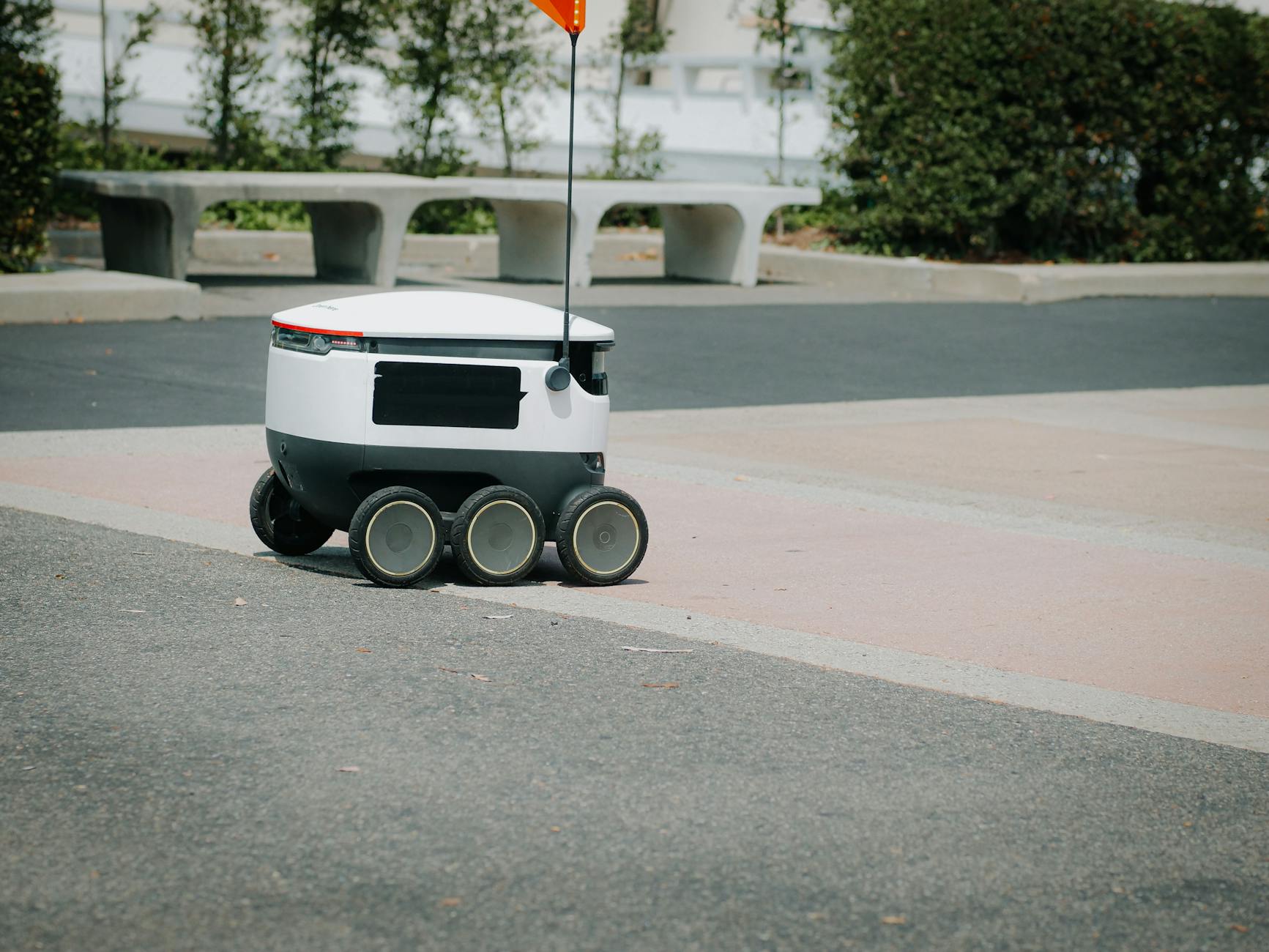

Serve Robotics (SERV) stands out as the most compelling under-the-radar robotics company with genuine Nvidia-level upside potential, having already captured 578% year-over-year revenue growth in Q1 2026. This autonomous sidewalk delivery robot maker has secured partnerships with household names like Uber Eats and 7-Eleven, positioning itself at the intersection of AI infrastructure demand and real-world commercial deployment—the exact formula that created Nvidia’s dominance in AI semiconductors. Wall Street analysts see at least 38% near-term upside, with some forecasting the stock could reach $26 per share, but the real story goes deeper: this is one of several robotics companies poised to benefit from accelerating AI adoption where Nvidia provides the silicon backbone.
The distinction between an under-the-radar robotics stock and a generational wealth creator comes down to execution, market timing, and defensibility of technology. Serve Robotics has already reached commercial scale with paying customers, while competitors like Knightscope (KSCP) and Arbe Robotics (ARBE) are earlier in their arcs but potentially exposed to even greater percentage gains. What ties them together is not just robotics, but the fact that each depends on the exact type of edge AI computing that Nvidia has engineered its way to dominate. Unlike social media plays or cloud generics, these companies are building the physical layer of AI—and that layer increasingly requires Nvidia’s processors.
Table of Contents
- Which Robotics Companies Actually Have Nvidia Upside Built In?
- The Real Opportunity—And the Real Risk
- Why Nvidia Upside Matters in Robotics
- Valuation and Risk-Adjusted Returns
- The Nvidia Cycle and Broader Market Dynamics
- Real-World Deployment and Defensibility
- The Next Five Years and What Investors Should Watch
- Conclusion
Which Robotics Companies Actually Have Nvidia Upside Built In?
The clearest example is Arbe Robotics, which in May 2026 announced the integration of nvidia‘s DRIVE AGX Orin platform directly into its autonomous vehicle perception stack. The announcement alone drove the stock up 20.8% in premarket trading, translating a $0.87 stock price into significant momentum. Arbe’s technology centers on an AI-based occupancy grid with LiDAR-comparable performance delivered via radar—a sensor that works in fog, rain, and snow where lidar fails. By baking Nvidia’s processor directly into their offering, Arbe has essentially tethered its growth to Nvidia’s AI compute roadmap. When Nvidia ships a faster or cheaper Orin variant, Arbe benefits. When autonomous vehicle OEMs adopt Orin as the standard, Arbe’s radar stack becomes more valuable.
That’s the Nvidia upside embedded in the business model. Serve Robotics follows a different but equally compelling pattern. Its delivery robots operate in dense urban environments—the exact use cases where compute density, real-time inference, and edge processing matter most. The 578% revenue growth represents not investor hype but paid deployments, meaning Serve is scaling a business model that requires continuous AI inference at the edge. As deployment numbers grow, compute costs per unit become critical, and the company will naturally gravitate toward Nvidia’s ecosystem because the performance-per-watt advantage compounds at volume. Teradyne (TER), meanwhile, occupies a less obvious but crucial position: it builds the advanced robotic testing equipment that semiconductor manufacturers use to validate chips. If Nvidia’s manufacturing accelerates (which it will, given AI demand), Teradyne’s revenues scale directly, and analysts are already forecasting 22.5% revenue growth for 2026.
The Real Opportunity—And the Real Risk
Here’s the limitation that separates real upside from speculation: these companies are not guaranteed winners, even if Nvidia continues its dominance. Serve Robotics must prove that sidewalk delivery can remain profitable as labor costs evolve and regulations tighten. Several cities have already placed restrictions on autonomous delivery robots, and if the regulatory environment tightens significantly, Serve’s addressable market shrinks overnight. The company’s 2026 analyst consensus projects $2.05 billion in revenue, but it’s currently burning cash with -$2.35 in EPS. That’s not uncommon for high-growth robotics companies, but it means Serve must reach profitability before capital dries up—something that could happen if the startup funding environment cools.
Arbe Robotics faces a different but no less real challenge: it operates in the autonomous vehicle space, which has become a graveyard of overhyped, underfunded ventures. The company had a stock price of $0.87 as of May 12, 2026, and its 2026 guidance projects only $4–6 million in revenue with $28–31 million in adjusted EBITDA losses. The Nvidia partnership is real and significant, but it doesn’t guarantee market adoption. Autonomous vehicle programs at tier-one auto suppliers and OEMs move slowly, require years of validation, and often shift their technology stack based on politics and supply chain relationships. Arbe’s radar-plus-AI approach is technically sound, but the market for that specific solution is unproven at scale. Knightscope’s autonomous security robot offering is the most conservative bet—security is a durable business category—but the company must defend against competition from larger players who could replicate the hardware quickly if demand proves real.
Why Nvidia Upside Matters in Robotics
Nvidia’s dominance in AI semiconductors is not accidental; it comes from a decade of architecture choices that made GPU computing the default for machine learning. When robotics companies build their systems, they inherit that choice. Serve Robotics’ sidewalk robots process video feeds and navigate complex urban environments in real time—tasks that require the kind of parallel compute that Nvidia GPUs excel at. Arbe’s occupancy grid inference, Knightscope’s computer vision for security threat detection, and Teradyne’s testing algorithms all rely on the same GPU ecosystems that Nvidia controls. This isn’t brand loyalty; it’s physics and economics.
The upside mechanism is straightforward: as these robotics companies scale from hundreds to thousands to hundreds of thousands of units deployed, the Nvidia chips inside each unit represent a growing revenue stream for Nvidia while simultaneously proving the business case for edge AI generally. Wall Street analysts covering Serve Robotics project the company will deploy tens of thousands of robots within the next three years. If accurate, that means millions of dollars in recurring Nvidia processor shipments embedded in robots that are earning revenue for their operators. Unlike a software company that might port to ARM or build custom silicon, a robotics company’s hardware stack is locked in for the lifespan of the product—often 5–10 years. That creates a structural moat around Nvidia’s opportunity.
Valuation and Risk-Adjusted Returns
The risk-adjusted return profile differs sharply across these companies. Knightscope offers the most conservative entry point: a $16.50 analyst price target against a current stock price of $10.98 represents 50% upside with a mature business model (security robots are simpler than autonomous delivery or vehicles). Lake Street Capital’s “Moderate Buy” rating suggests institutional confidence without exuberance. For a robotics investor uncomfortable with binary outcomes, Knightscope is the 50/50 trade—meaningful upside with downside protection. Serve Robotics, by contrast, is a 38% base case with significantly higher ceiling and floor risk.
If the company achieves its guidance and hits profitability milestones, the $19.50 consensus price target could prove conservative. Alternatively, if a single major city bans delivery robots or Serve’s unit economics deteriorate, the stock could cut in half. Arbe Robotics is the highest-risk, highest-reward play: a $0.87 stock is already pricing in substantial failure, which means even modest success could drive meaningful percentage gains. But “modest success” in autonomous vehicles is deceptively hard to achieve. Teradyne sits at the other end of the spectrum—it’s a $133 price target against current levels (using a 13% upside estimate from UBS), which reflects a mature, profitable business with predictable Nvidia tailwinds rather than a pure robotics bet. For investors who want Nvidia exposure without robotics-specific risk, Teradyne offers that trade.
The Nvidia Cycle and Broader Market Dynamics
Here’s a warning often missed by robotics investors: the Nvidia upside in robotics companies is real, but it’s not independent of Nvidia stock itself. If Nvidia’s growth slows, if margin pressures emerge in chip manufacturing, or if a competitor (AMD, Intel) makes unexpected progress on edge AI processors, the leverage effect works in reverse. Robotics stocks would face a double pressure: slowdown in Nvidia-driven AI infrastructure adoption plus the loss of a first-mover advantage in embedding Nvidia technology. Serve Robotics’ stock could fall not because autonomous delivery is a bad business, but because investors repriced their expectations for AI compute growth generally. The second dynamic to watch is capital deployment.
Robotics companies are capital-intensive businesses. Serve Robotics’ 578% revenue growth is impressive, but building robots at scale requires manufacturing facilities, supply chain relationships, and working capital. If interest rates rise or venture capital becomes scarce, the growth trajectory could slow even if demand is strong. Arbe Robotics’ $28–31 million EBITDA loss guidance assumes successful fundraising and continued investor patience. If either assumption breaks, the stock could move significantly before the underlying technology problem is solved.

Real-World Deployment and Defensibility
Serve Robotics’ partnership with Uber Eats provides a concrete example of deployment defensibility. Unlike a pure R&D company waiting for a breakthrough, Serve is already operating hundreds of robots in multiple cities, generating real revenue from known customers. This provides several advantages: it generates cash flow that can fund further R&D, it creates switching costs (Uber Eats benefits from Serve’s technology improving), and it provides a moat against new entrants who must prove their robots can operate in the same urban environments.
A competitor starting today would need years to replicate Serve’s operational experience and customer relationships. Arbe’s CES 2026 NVIDIA DRIVE AGX Orin launch announcement follows the same logic: by publicly committing to Nvidia’s platform at a major trade show, Arbe signals to tier-one OEMs that it has chosen the industry-standard compute platform. This reduces adoption risk for OEMs and builds credibility. Knightscope’s security robot business operates in a similarly defensible space—municipalities and private security firms prefer established vendors with track records over experimental platforms.
The Next Five Years and What Investors Should Watch
The inflection point for these robotics companies comes between 2026 and 2029, when first-generation commercial deployments mature and either expand dramatically or plateau. For Serve Robotics, this means watching whether delivery robot density in major cities continues to grow or hits regulatory/economic friction. For Arbe Robotics, it means watching whether tier-one OEMs actually integrate the Nvidia DRIVE AGX Orin platform into production vehicles and at what scale. For Knightscope, it means whether security robot adoption spreads beyond niche use cases into mainstream enterprise and government procurement.
The Nvidia upside thesis holds if and only if these robotics companies succeed in making robotics economically viable at scale. If they do, the demand for Nvidia’s edge AI processors will compound for a decade, and these companies’ stocks could deliver multiples of their current value. If they don’t, Nvidia still wins (because enterprise AI demand remains strong), but these specific robotics companies become cautionary tales. The risk is binary; the opportunity set is continuous. That’s the distinction between an under-the-radar stock with Nvidia upside and a lottery ticket.
Conclusion
Serve Robotics stands out as the most tangible under-the-radar robotics company with legitimate Nvidia upside, given its rapid revenue growth, established customer relationships, and clean positioning on the Nvidia AI compute stack. Arbe Robotics and Knightscope offer different risk-return profiles, with Arbe representing higher-ceiling upside in exchange for binary execution risk and Knightscope providing more moderate, downside-protected gains. The common thread is simple: each company’s success depends on making edge AI robotics economically viable, and Nvidia’s dominance in AI semiconductors becomes more entrenched if they succeed. For investors considering these names, the key is matching time horizon to risk tolerance.
Knightscope suits conservative portfolios with a 2-3 year outlook. Serve Robotics requires willingness to hold through inflection points and regulatory headwinds. Arbe Robotics is for investors who can stomach a penny-stock journey and have conviction that autonomous vehicle perception will ultimately shift toward radar-plus-AI architectures. Across all three, watching quarterly deployment numbers, gross margins, and path to profitability matters more than listening to conference call guidance. The Nvidia upside is real, but it exists only if these robotics companies execute.