
Richtech Robotics (NASDAQ: RR) is being positioned as a potential Nvidia-level force in restaurant robotics, but the comparison has built-in qualifications. The company’s ADAM robot—a dual-armed AI-powered beverage service bot powered by NVIDIA’s Jetson Thor processor—deployed its first unit in Times Square in April 2026, where it served its first coffee to Shaquille O’Neal at the tm:rw location. That’s the kind of high-visibility proof point that draws investor comparisons to Nvidia’s foundational role in AI infrastructure. The parallel isn’t that RR will become a chip manufacturer, but that it could become the dominant platform provider for an emerging robotics category—the way Nvidia became essential infrastructure for AI companies regardless of their specific mission.
The financial case rests on scale potential rather than current dominance. RR’s stock trades at $2.25 as of June 2026, with a market cap of $513.15M and annual revenue of just $5.05M in FY 2025. Wall Street sentiment is cautiously skeptical: three analysts surveyed by financial platforms show one Buy, zero Holds, and one Sell, with a median price target of $4.00. Yet the 2026 forecast average sits at $8.27—a +176.57% upside from current price—suggesting that if RR executes on restaurant and service robotics adoption, the growth curve could justify the Nvidia comparison. The question isn’t whether RR equals Nvidia today; it’s whether the restaurant robotics market will consolidate around RR’s platform the way enterprise AI consolidated around Nvidia’s GPUs.
Table of Contents
- Is RR Becoming the Essential Platform for Service Robotics?
- The ADAM Robot—Proven Capability and Hidden Limitations
- The DEX Humanoid Robot as Market Expansion
- Why NVIDIA Partnership Matters More Than Stock Price
- The Stock Price Versus Reality Gap
- Real Deployment Challenges and Market Adoption
- The Real Test: National Restaurant Association Show and Beyond
Is RR Becoming the Essential Platform for Service Robotics?
Richtech’s product lineup hints at platform ambition. Beyond ADAM, the company offers the Matradee Plus autonomous delivery robot, the Scorpion dual-arm beverage preparation bot, and the Titan heavy-duty autonomous mobile base. Each targets a different service vertical—cocktails, coffee, delivery, parts handling—but they share a common architecture: autonomous mobility plus AI-guided task execution. The Jetson Thor processors powering these systems aren’t proprietary to RR; they’re nvidia parts. But RR’s value sits in the software stack, the task-specific training, and the deployment model that makes these robots plug-and-play for restaurant operators.
The microsoft partnership, announced in April 2026, signals that RR aims for infrastructure status. Products are now available through the Microsoft Marketplace, which means enterprise restaurant groups and hospitality chains can request RR systems through existing Microsoft relationships and procurement channels. That’s the ecosystem play—not selling individual robots to individual venues, but becoming the default robotics vendor in Microsoft’s enterprise automation stack. Nvidia achieved that position in AI because every major AI vendor needed Nvidia chips. RR is betting that every major hospitality vendor will need RR robots because they’re the proven, integrated, safe option for high-volume environments.
The ADAM Robot—Proven Capability and Hidden Limitations
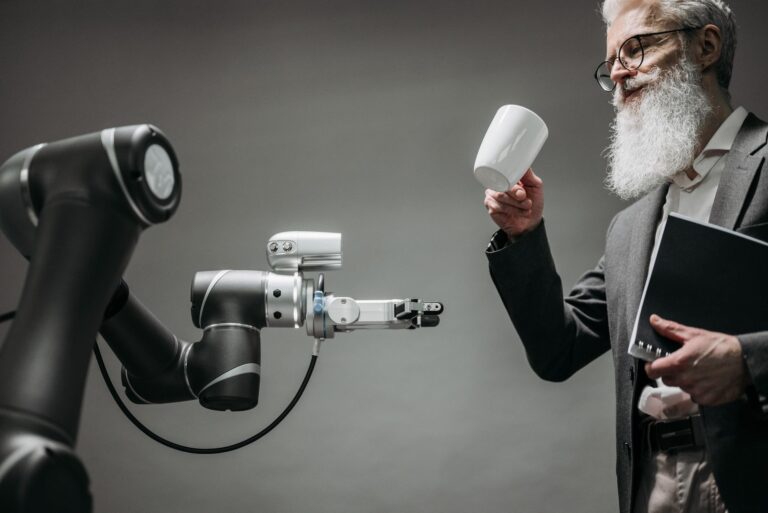
ADAM’s capabilities are genuine. The robot can craft cocktails, brew barista-quality coffee, and create bubble tea using dual arms guided by machine learning models trained on thousands of service-industry tasks. It’s NSF certified, meaning it meets health and safety standards for food-contact environments—a non-trivial certification that separates consumer robotics from commercial deployment. The Times Square installation matters not just for branding but as proof that ADAM can operate in one of the world’s highest-traffic, highest-visibility venues without major incidents.
But operational reality includes friction that the promotional material downplays. ADAM requires approximately 20 minutes of daily maintenance—calibration, cleaning, checking for wear on end-effectors, firmware updates. For a 24/7 venue, that means scheduling downtime or running multiple units. The robot also operates in constrained physical spaces with carefully mapped workflow paths; a busy bartender during evening rush still outpaces ADAM in flexibility and speed, though ADAM provides consistency and never takes breaks. The upcoming live demonstration of noodle-making at the National Restaurant Association Show (May 16-19, 2026) will show new use cases, but each new task requires retraining, new end-effector attachments, and operational validation—not instantaneous scaling.
The DEX Humanoid Robot as Market Expansion
RR debuted the DEX humanoid platform at CES 2026, signaling ambitions beyond the service bar. DEX combines the Titan autonomous mobile base with the precision dual-arm system from ADAM, wrapped in a humanoid frame. Key specs: 4-hour battery runtime on a single charge with ability to operate continuously from a charging dock, 360-degree environmental awareness via four cameras, and modular end-effectors for rapid tool swaps. The platform is simulated and trained using NVIDIA’s Isaac Sim and Isaac Lab, indicating deep integration with NVIDIA’s robotics software ecosystem.
DEX targets industrial use cases that weren’t part of ADAM’s restaurant focus—parts handling, quality inspection, packaging operations in manufacturing and logistics. If DEX scales adoption in factories and warehouses the way ADAM is being tested in hospitality, RR becomes a two-market player rather than a single-vertical specialist. But humanoid robotics at scale remains unproven; every major robotics and AI company from Boston Dynamics to Figure AI to tesla has humanoid prototypes that work in controlled demos. Translating a working prototype into reliable, cost-effective production units across thousands of operations is a different engineering and business problem entirely.
Why NVIDIA Partnership Matters More Than Stock Price
Richtech’s reliance on NVIDIA’s Jetson Thor processors isn’t a weakness—it’s leverage. Jetson Thor is NVIDIA’s latest edge AI accelerator, designed for autonomous machines that need high compute density in low-power form factors. By standardizing on Jetson Thor, RR gets access to NVIDIA’s continuous optimization work; every improvement to the chip or its software stack benefits RR’s robots without additional engineering investment. More strategically, NVIDIA has incentive to see RR succeed because every ADAM and DEX robot deployed is a Jetson Thor sold. This creates a symbiotic relationship similar to how Nvidia benefits when every AI startup uses its GPUs.
The SoundHound AI partnership announced for the May 2026 National Restaurant Association Show adds another layer. SoundHound specializes in voice-command AI interfaces. Integration means customers can order cocktails or coffee from ADAM using natural language rather than touchscreen menus. Voice-enabled service robots are more intuitive for casual users in high-traffic venues. But this also means RR’s competitive advantage becomes harder to replicate if other robotics companies can license SoundHound (or build similar voice AI) and integrate it onto their own hardware. The partnership is powerful for RR’s current market position but isn’t a permanent moat unless RR locks in exclusive integration or becomes SoundHound’s dominant customer.
The Stock Price Versus Reality Gap
RR’s stock has traded between $1.71 and $7.43 in the past 52 weeks—a range indicating high volatility and speculative positioning. At $2.25 current price against $5.05M annual revenue, the company is valued at more than 100 times its annual sales, a multiple normally reserved for high-growth SaaS or biotech companies. The implicit assumption baked into that valuation is massive revenue acceleration—moving from millions to hundreds of millions or billions annually—within a few years. The analyst consensus reflects this risk.
A single “Sell” rating in the dataset suggests meaningful skepticism about near-term growth or execution. The price targets ranging from $2.00 to $6.00 show disagreement on fair value. Wall Street’s median target of $4.00 implies roughly 78% upside from current price, which is substantial but also suggests the stock is already priced for moderately positive outcomes; any major deployment delays, competition, or execution problems will collapse that premium. The comparison to Nvidia glosses over the fact that Nvidia is a $3.5+ trillion company with decades of dominance and unmatched manufacturing scale. RR is a $513M startup in a robotics category that has yet to achieve meaningful volume.
Real Deployment Challenges and Market Adoption
The Times Square ADAM installation proves the technology works in one high-visibility location. It doesn’t yet prove that hundreds of restaurant chains will deploy thousands of units. Restaurant operators care about labor cost savings, yes, but also about customer experience, liability, warranty support, and integration with existing point-of-sale and kitchen systems. A venue in Times Square—a high-capacity tourist destination with staff specifically trained on new technology—operates under different constraints than a suburban location relying on typical restaurant labor.
Scaling from one flagship installation to mainstream adoption requires solving logistics, support, financing, and operator training on a massive scale. Competitor robotics companies including Boston Dynamics (which has teased hospitality applications) and emerging Chinese manufacturers are developing similar systems. The key differentiator for RR remains first-mover credibility and partnership leverage with Microsoft and NVIDIA. But first-mover advantage in robotics doesn’t guarantee market dominance; the history of commercial robotics shows that manufacturing scale, supply chain efficiency, and service reliability often matter more than technical capability.
The Real Test: National Restaurant Association Show and Beyond
RR’s May 2026 National Restaurant Association Show demonstration (Booth #6857) will showcase the live noodle-making capability of ADAM, potentially expanding the use case beyond cocktails and coffee. If noodle preparation proves reliable in demo conditions, it signals that ADAM can handle more complex, multi-step food preparation—a significant expansion of addressable market. But demonstrations in controlled environments with trained staff differ from 24/7 operation in a busy restaurant kitchen where equipment degrades, modifications happen on the fly, and downtime costs money.
The path from $513M valuation to Nvidia-like market dominance requires RR to solve the adoption curve. That means reducing unit cost (current pricing isn’t public, but custom robotics systems typically run $150K-$500K per unit), improving the maintenance and support story beyond the current 20-minute daily requirement, expanding the task library to dozens or hundreds of restaurant operations, and maintaining competitive distance from larger robotics companies that are now entering the market. The 2026 forecast of $8.27 assumes that scaling happens. The reality will emerge from how many restaurants actually deploy ADAM by year-end and whether those deployments drive revenue growth or encounter friction that slows adoption.