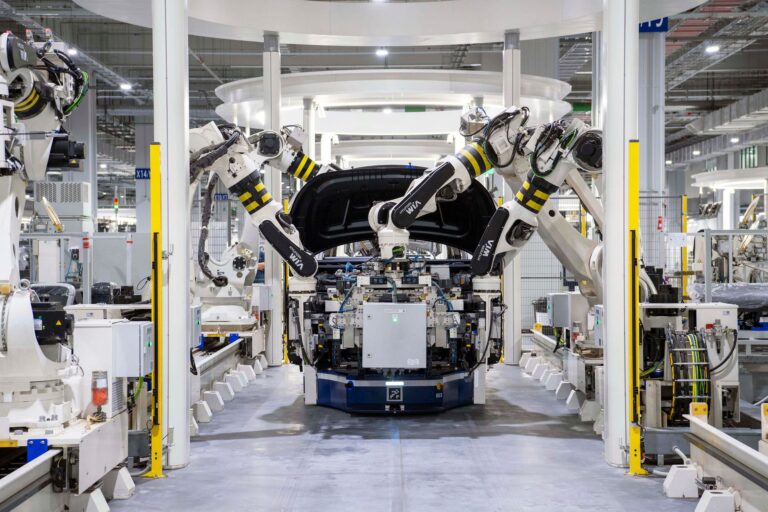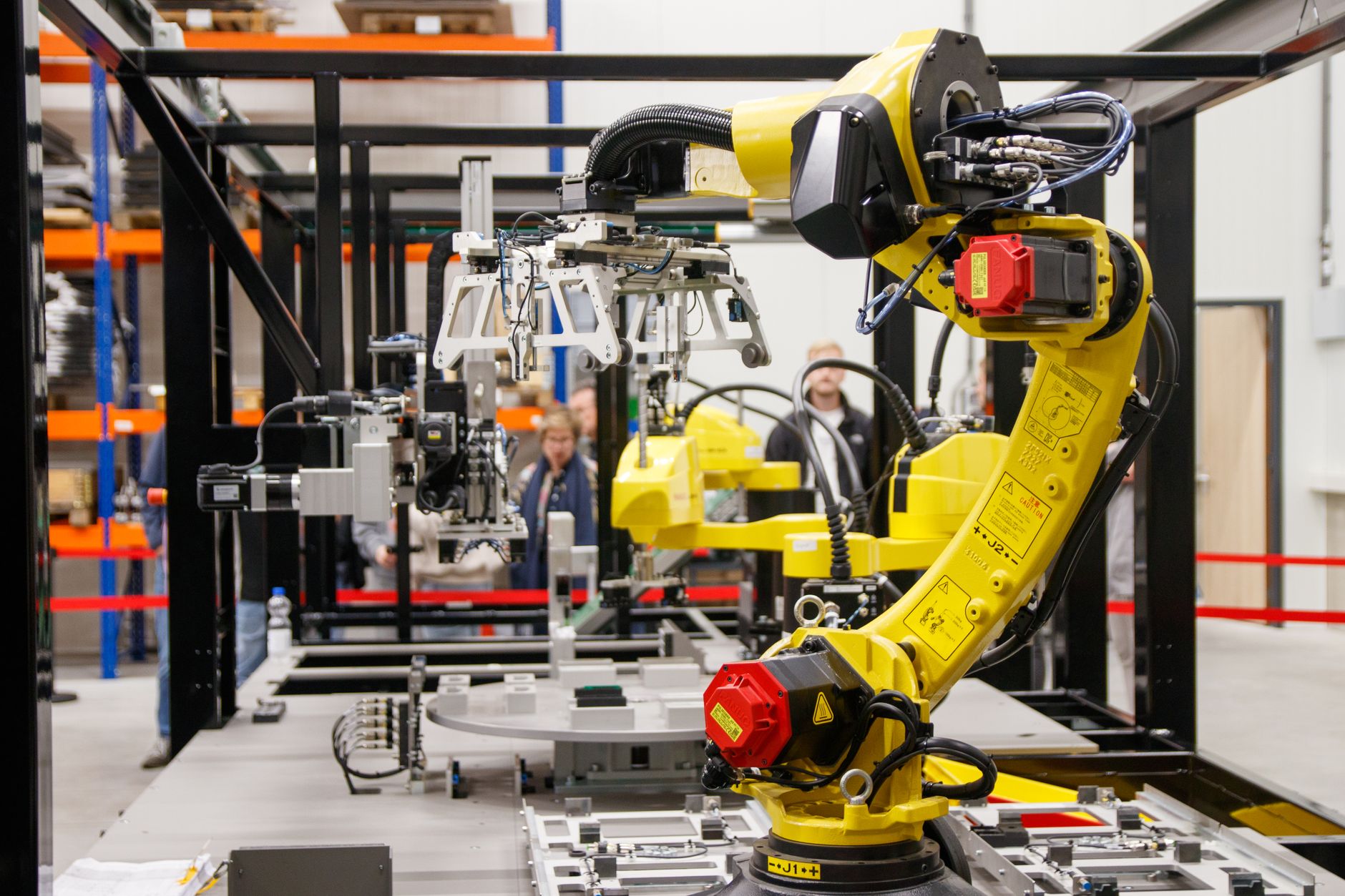

The bull case for GE stock rests fundamentally on a decades-long competitive advantage that is finally accelerating: the company’s deep integration of industrial automation and robotics into its manufacturing operations and product platforms. When GE Vernova announced its acquisition of Robotech Automation on May 21, 2026, it wasn’t a defensive move to catch up—it was a statement of intent to own the automation supply chain. Robotech, a Montreal-based systems integrator with 35 employees, brings hands-on expertise in customized robotics and control systems, and is already embedded in active projects at GE Vernova’s factories in Schenectady, New York and Charleroi, Pennsylvania. This isn’t theory. It’s operational reality.
GE’s financial position amplifies why automation integration matters: the company generated $45.85 billion in annual revenue in 2025 with a net profit of $8.70 billion, the highest in its industry. The aerospace division alone—powered by orders-driven contracts and a $190 billion backlog—posted 21% revenue growth and 38% EPS growth in 2025. When CEO H. Lawrence Culp Jr. reported Q1 2026 results showing orders up 87% and revenue up 29%, those numbers reflect an industrial base that is investing heavily in automation, capacity, and modernization. The bull case isn’t speculative; it’s backed by executed deals, deployed capital, and strong cash generation.
Table of Contents
- How Robotics and Automation Unlock Industrial Margin Expansion
- GE Vernova’s Strategic Robotech Acquisition and Its Competitive Signal
- GridBeats™ APS and the Automation Platform Evolution
- Financial Fundamentals and the Valuation Case for GE Stock
- Execution Risk and the Challenge of Integrated Industrial Systems
- The Aerospace Backlog as a Structural Tailwind
- Analyst Consensus and Margin Expansion Potential in Industrial Automation
How Robotics and Automation Unlock Industrial Margin Expansion
Industrial automation is no longer a cost-cutting tactic—it’s a margin multiplier. When a manufacturer integrates robotic systems into production lines, throughput increases, defect rates fall, and the workforce shifts from repetitive manual work to skilled technical roles. GE Vernova’s integration strategy targets exactly this outcome. By acquiring Robotech, GE gains direct control over how automation systems are designed, deployed, and optimized within its own facilities and customer projects. Rather than relying on third-party integrators who owe loyalty to multiple OEMs, GE can now customize solutions around its specific products and operational constraints. The practical advantage is speed and coherence. When GE Vernova launches GridBeats™ APS—announced on February 3, 2026, as an automation and protection system for electrical substations—the company can bundle not just the software and hardware, but the integration expertise to deploy it.
Utilities facing aging grid infrastructure, capacity expansion, and cybersecurity challenges are not buying a box; they’re buying a proven deployment model. That’s a significantly higher-margin offering than selling a generic control platform. A critical limitation, however, is execution complexity. Robotech employs only 35 people. GE Vernova’s U.S. factory footprint is far larger, and customer automation projects across diverse industries run from food processing to aerospace manufacturing. The acquisition solves for core expertise, but scaling Robotech’s methods across GE’s entire automation business is a multi-year integration challenge. If GE stumbles on the cultural or operational integration, the investment’s value erodes quickly.
GE Vernova’s Strategic Robotech Acquisition and Its Competitive Signal
The Robotech acquisition is modest in announced scale—financial terms were not disclosed, suggesting a relatively small headline number—but large in strategic signal. By moving into on-the-ground automation integration, GE Vernova is signaling that it no longer views robotics as a commodity input. Instead, GE wants to control the engineering judgment calls: where to place a robot, how to sequence work, what redundancy to build in, and how to train customers’ technical teams to operate the system long-term. This contrasts sharply with the traditional industrial playbook, where an equipment maker (turbine, generator, control system) ships the product, and a separate integrator handles the installation and troubleshooting. The overlapping responsibility created finger-pointing when things went wrong. By owning both the product and the integration team, GE takes end-to-end accountability.
Customers pay for that certainty. The Robotech teams are already working on live projects in Schenectady and Charlerton—GE’s own manufacturing footprint—which means GE is also validating the acquisition’s value in-house before scaling externally. That’s prudent. A hidden risk, however, is that Robotech’s Montreal-based culture and small-team dynamics may not survive integration into a $45.85 billion industrial conglomerate. Small integrators thrive on agility and direct customer contact. Formal procurement processes, approval hierarchies, and corporate compliance frameworks can smother that advantage. GE will need to deliberately preserve Robotech’s operational independence while plugging it into GE Vernova’s broader sales and delivery machinery.
GridBeats™ APS and the Automation Platform Evolution
GridBeats™ APS represents a second pillar of GE’s automation integration strategy. Launched in early 2026, the system addresses three acute pain points in grid modernization: aging substation infrastructure, capacity expansion to handle load growth, and cybersecurity resilience. These aren’t niche concerns—they’re existential for utilities operating 50+ year-old electrical systems that weren’t designed for distributed renewable energy, electric vehicle charging networks, or real-time cyberattacks. GE’s automation and controls platform includes four integrated layers: computing and control hardware, operator interface (HMI), future-proof architecture that can evolve as standards change, and real-time operational intelligence that feeds live data back to grid operators. A utility deploying GridBeats™ on a critical substation gains visibility and control that legacy systems cannot provide. This is not a retrofit add-on; it’s a fundamental modernization. The competitive advantage lies in integration at the system level, not the component level.
A competitor selling a control processor or SCADA software has to hope the customer’s integration team can knit it all together. GE Vernova, with Robotech’s expertise embedded in the organization, can promise the utility a fully validated, tested, and supported system architecture. That promise has significant pricing power. However, grid modernization cycles are long and regulated. A utility can’t simply rip out a substation’s controls overnight; it must coordinate with grid operators, secure regulatory approval, and sequence the work around maintenance windows. A promising technology that fails to navigate these institutional constraints generates minimal revenue. GE’s historical success in energy infrastructure suggests it understands these dynamics, but GridBeats™ is still early, and execution risk is real.
Financial Fundamentals and the Valuation Case for GE Stock
Wall Street’s consensus on GE reflects confidence in the automation and integration thesis. Twelve analysts cover GE with a “Buy” consensus and an average price target of $350.75, suggesting 17.33% upside potential from current levels. The price target range spans $290 to $425, indicating some debate about how much value integration and automation growth will create, but the direction is aligned. GE’s 2025 financial results provide the foundation for this optimism. Free cash flow conversion exceeded 100%, meaning the company generated more cash from operations than net income. That capital strength allows GE to fund acquisitions like Robotech, invest in GridBeats™ development, and return cash to shareholders simultaneously.
For a company in cyclical industrial businesses, that kind of cash generation is rare and valuable. The aerospace backlog of $190 billion is particularly significant; it’s a multi-year revenue stream that is largely immune to near-term economic cycles. The valuation case, however, hinges on sustained execution in automation and controls. If GE Aerospace continues its 20%+ growth trajectory while the Vernova automation platform (Robotech + GridBeats™ + controls software) accelerates adoption, the bull case justifies $350–$425 per share. If integration stumbles, if GridBeats™ adoption lags utilities’ upgrade cycles, or if margin expansion fails to materialize, the $290 price target becomes relevant. Investors are essentially betting on GE’s ability to execute a complex, multi-platform automation strategy while managing traditional industrial operational risks.
Execution Risk and the Challenge of Integrated Industrial Systems
The largest hidden risk in the GE automation bull case is execution at scale. Integration companies succeed by understanding specific customer industries deeply—their regulatory requirements, their technical constraints, their risk tolerance, and their capital approval processes. A utility grid integration looks entirely different from a food-processing plant, which looks different from an aerospace assembly line. Robotech, with 35 employees and roots in Montreal, has likely built expertise in specific verticals or geographies. Scaling that across GE’s global footprint while maintaining the deep domain knowledge that drives value is devilishly hard. GE has experience managing large integrations (Alstom, Baker Hughes), but those were primarily about consolidating products and sales teams. Robotech is about embedding an integration mentality into GE’s own operations and customer delivery.
That cultural integration is slower and messier than product consolidation. If GE forces Robotech into standard corporate procurement, engineering approval gates, or sales processes, it risks eroding the very thing it acquired: the ability to move quickly and customize solutions for complex customer problems. A second execution risk is technological obsolescence. Automation systems and grid controls are becoming increasingly digital and software-defined. A controls platform that is optimized for hardware in 2026 may be architecturally constrainedby 2030 if the industry shifts dramatically toward cloud-based operational intelligence or AI-driven optimization. GE must invest continuously in Robotech’s technical capabilities and architecture to stay ahead of point-solution competitors who can specialize narrowly on software. This is not a one-time acquisition; it’s a multi-year commitment to in-house integration talent and R&D.
The Aerospace Backlog as a Structural Tailwind
GE Aerospace’s $190 billion backlog is not just a number—it’s a structural tailwind for the entire GE Vernova strategy. That backlog reflects long-term orders from airlines, aerospace OEMs, and governments for engines, avionics, and propulsion systems. As those contracts execute over the next 7–10 years, GE’s manufacturing footprint must scale capacity. Scaling capacity efficiently means automation.
The Schenectady and Charleroi factories aren’t just testing grounds for Robotech; they’re the proof of concept for how GE intends to handle the backlog surge. Airlines and aircraft makers are also investing heavily in automated production and digital supply chains. A customer ordering 500 engines over five years wants visibility into production schedules, quality metrics, and delivery dates. GE’s automation platform can provide that visibility in real-time, strengthening customer relationships and enabling higher throughput. The backlog isn’t passive revenue; it’s active demand for exactly the kinds of integrated automation and control systems that GE Vernova is now building out.
Analyst Consensus and Margin Expansion Potential in Industrial Automation
The analyst consensus—with 33% “Strong Buy,” 58% “Buy,” 8% “Hold,” and 0% “Sell” ratings across GE’s coverage—reflects broad belief in the industrial automation thesis. Importantly, three out of four analysts with opinions think GE’s stock is undervalued relative to its automation and controls growth potential. That consensus doesn’t guarantee returns, but it suggests that the market is not yet fully pricing in the value of GE’s integrated automation strategy. The margin expansion opportunity is real but not guaranteed.
If GE Vernova can increase automation system sales (GridBeats™, custom integrations, controls software) alongside its traditional power and renewable energy offerings, gross margins in the Vernova segment could expand 200–400 basis points over the next 3–5 years. That’s the bull case’s core thesis. However, margin expansion is only realized if customers actually adopt the new systems, if integration timelines meet expectations, and if competitive pressure doesn’t force pricing concessions. Q1 2026 results showed orders up 87% and revenue up 29%, but order backlog growth does not automatically convert to margin growth—it depends on the mix of products, the complexity of deployments, and the intensity of competition for each deal.
- —