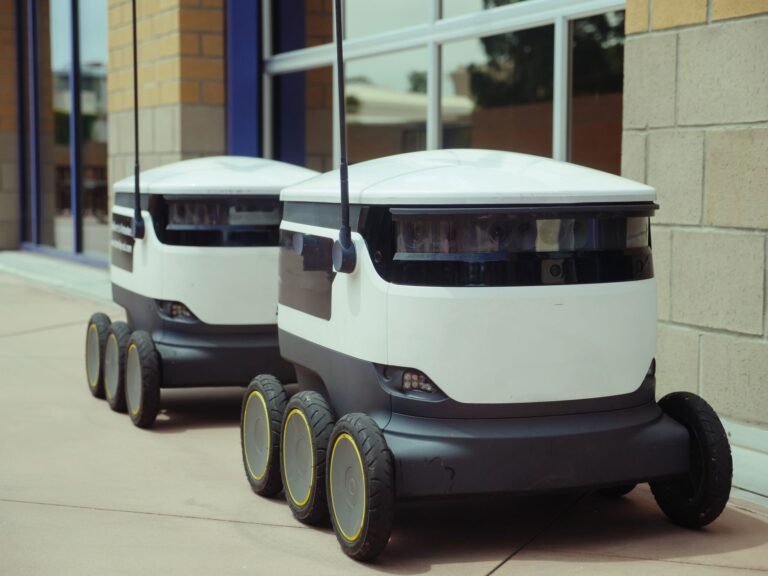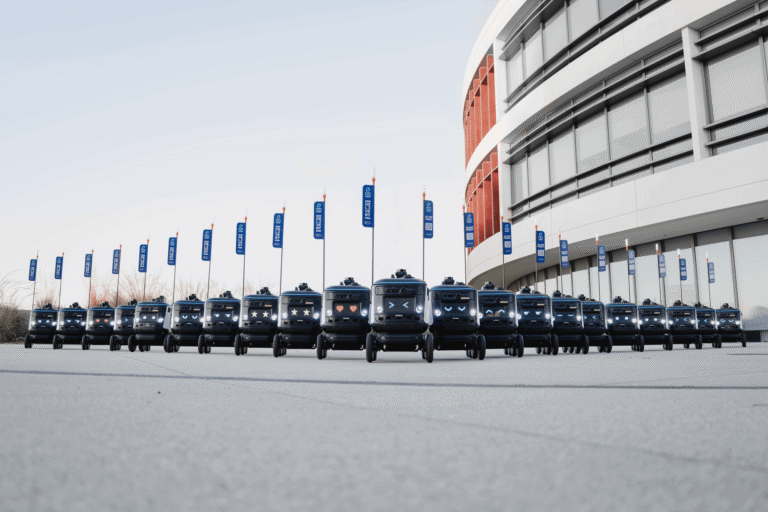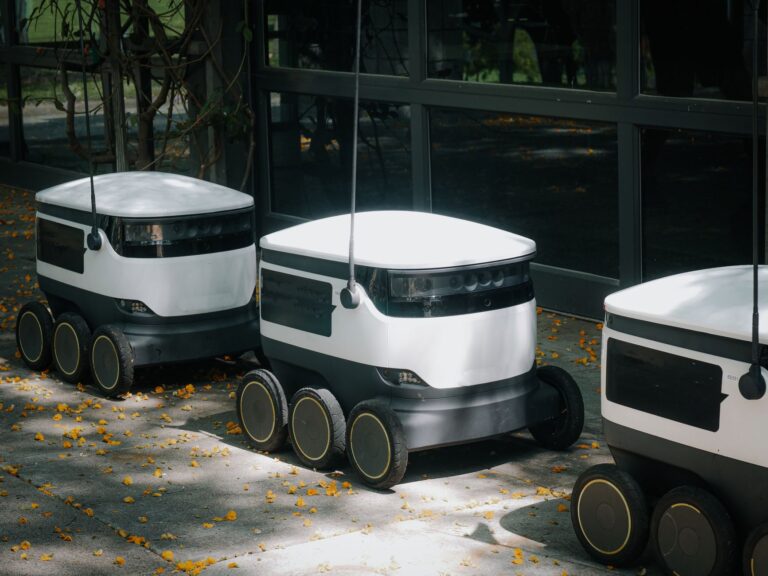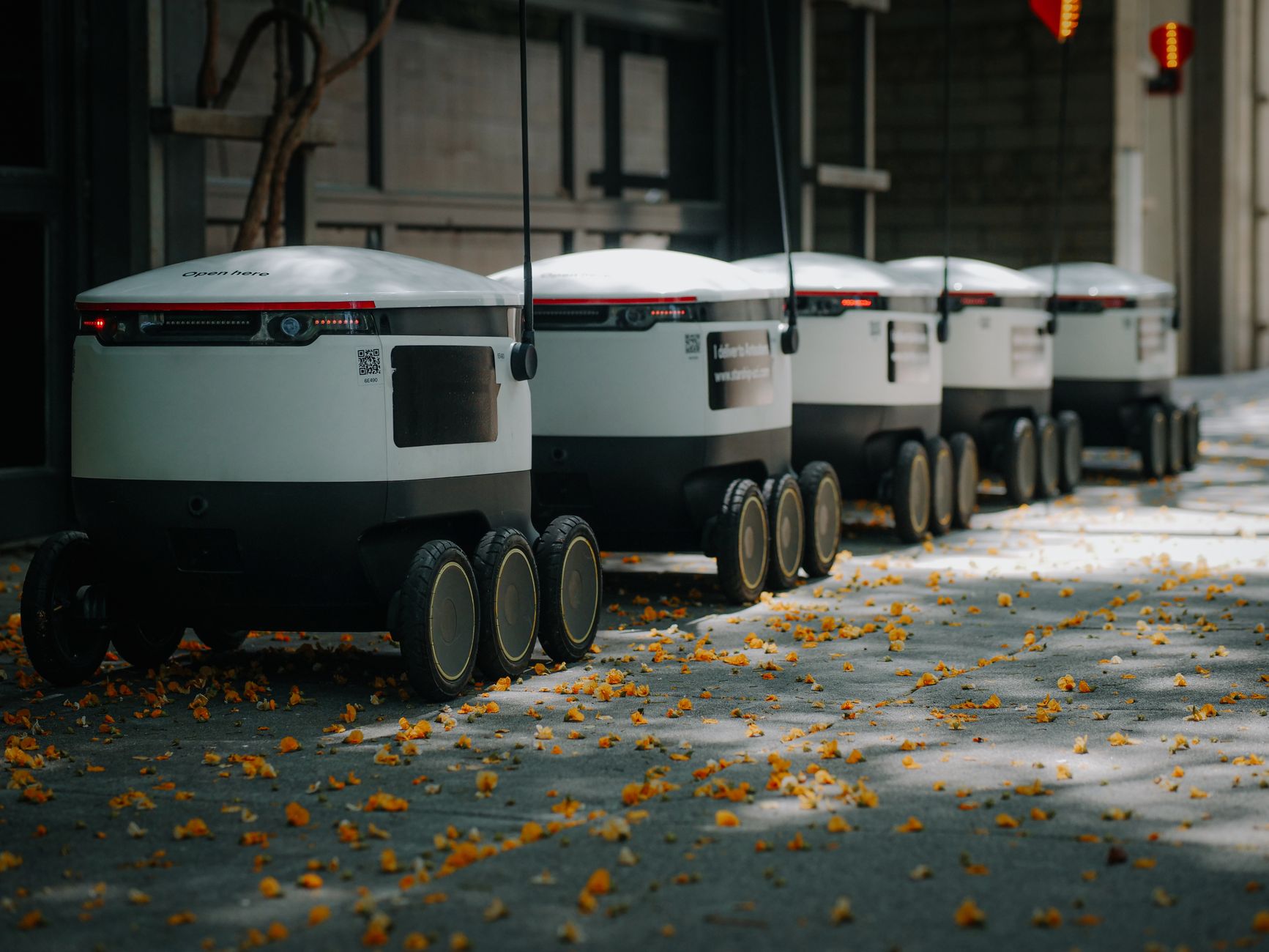

Autonomous delivery robots navigating city sidewalks are creating conflicts that cities were not designed to manage. From San Francisco to London, these wheeled devices—ranging from small autonomous bins to larger multi-compartment units—are blocking pedestrian pathways, creating accessibility problems for people with disabilities, and triggering collisions with pedestrians and street infrastructure. The disruption is not hypothetical: cities like Pittsburgh, Madison, and Washington, D.C.
have all restricted or temporarily suspended robot operations after recurring incidents and public complaints about blocked curb cuts, congested sidewalks, and unpredictable vehicle behavior. These conflicts expose a fundamental mismatch between robotic deployment and urban design. Sidewalks were built for pedestrians, and adding autonomous vehicles to that space requires coordination that regulators, delivery companies, and infrastructure planners have yet to fully establish. Unlike traditional delivery trucks that use roads and loading zones, robots claim continuous access to public sidewalks, creating a new class of urban congestion that has few established rules or accountability mechanisms.
Table of Contents
- Why Delivery Robots Create Sidewalk Congestion
- Accessibility and Pedestrian Safety Concerns
- Infrastructure and Urban Design Mismatches
- How Cities Are Regulating Autonomous Delivery
- Navigation Limitations and Weather Sensitivity
- Adoption Patterns and Geographic Inequality
- The Labor and Economic Reality of Sidewalk Automation
Why Delivery Robots Create Sidewalk Congestion
The core issue is one of spatial allocation. A delivery robot occupies the same finite sidewalk space as pedestrians, wheelchair users, strollers, street vendors, and utility infrastructure—yet operates on its own schedule with limited coordination with human traffic patterns. Studies from the University of Washington found that robots moving at roughly 3-4 miles per hour can create bottlenecks during peak pedestrian hours, forcing foot traffic around them or waiting for the device to pass. This is particularly acute in neighborhoods where sidewalks are already narrow or where pedestrian volume is high.
The problem intensifies during weather events or when robots malfunction. In rainy conditions or snow, robots sometimes stop unexpectedly, blocking paths and requiring manual intervention. Unlike a delivery driver who can park in a loading zone and deliver multiple packages at once, robots typically make single deliveries, meaning a single block might see five or six robots over an hour, each claiming temporary sidewalk space. The cumulative friction adds up in ways that a delivery truck—which at least moves off the sidewalk after unloading—does not replicate.
Accessibility and Pedestrian Safety Concerns
Delivery robots present a hazard specifically to people with visual impairments and wheelchair users. Sidewalks typically have designated curb cuts at corners and ramps that serve as predictable navigation points. When a robot stops on or near a curb cut, it eliminates the accessible crossing point. Disability advocacy groups in multiple cities have documented cases where robot traffic forced individuals to navigate into roadways or significantly detoured around their intended routes.
The risk is not just inconvenience—it’s safety. Pedestrian collisions with robots have been documented in several cities, typically involving children, elderly pedestrians, or distracted walkers who fail to notice the device. While robots are generally slower than vehicles and designed with soft bumpers, the collision hazard increases when pedestrians don’t anticipate the bot’s movement or when multiple robots create unpredictable traffic patterns. San Francisco’s early experience with robot deliveries included reports of pedestrians tripping over devices left on sidewalks, and Madison, Wisconsin documented several incidents where robots rolled into children before the city implemented stricter regulations. The liability question—who is responsible for injuries involving autonomous devices on public property—remains legally murky in most jurisdictions.
Infrastructure and Urban Design Mismatches
Delivery robots operate in cities that were not designed for autonomous foot traffic. Cobblestone neighborhoods, steep hills, potholed streets, and sidewalks with utility vents all present navigation challenges that robots either navigate poorly or avoid entirely. In Seattle, delivery robot operators have restricted service to specific flat, well-maintained neighborhoods, which means residents in older commercial districts or hillier areas either get no service or get service that is spotty and unreliable. This creates a two-tiered delivery system where infrastructure quality directly determines service availability.
The robots also interact unpredictably with existing street features. Bike lanes, parking meter installations, and newspaper vending boxes all represent obstacles that robot navigation systems must avoid or navigate around, sometimes pushing the device into the pedestrian pathway instead. Winter maintenance compounds the problem: salted roads corrode electronics, and snow forces robots into alternative routes. Cities like Minneapolis that experience heavy snow have found that robot delivery becomes impractical for roughly four months of the year, meaning the infrastructure built to support these devices sits largely unused during peak winter months.
How Cities Are Regulating Autonomous Delivery
Municipalities have begun implementing rules in response to sidewalk conflicts, though approaches vary widely. San Francisco limits robot operations to specific hours and zones, requires them to yield to pedestrians and emergency vehicles, and restricts deployment in neighborhoods that have not explicitly opted in. Pittsburgh implemented a cap of 100 active robots per company and banned them from rush-hour pedestrian zones. Washington, D.C.
temporarily halted new robot approvals after pressure from disability advocates and community members who reported repeated conflicts. The comparison to bike-sharing offers a useful parallel: cities initially allowed bike services to deploy with minimal regulation, then faced congestion and accessibility issues that required retrofitting rules around parking, geofencing, and user behavior. Delivery robots are following the same arc. Some cities are building designated robot lanes or parking corrals—specific zones where robots can operate or wait—though this requires street redesign that many older urban areas cannot easily accommodate. The tradeoff is stark: either cities dedicate scarce public sidewalk and curb space to robot operations and restrict other uses, or they constrain robot deployment and accept that autonomous delivery reaches fewer addresses.
Navigation Limitations and Weather Sensitivity
Delivery robots struggle with conditions that human drivers navigate automatically. Heavy rain causes sensors to malfunction, snow accumulation blocks wheels and cameras, and extreme cold degrades battery performance. A robot that works flawlessly on a clear Seattle afternoon in June may fail repeatedly during winter months or during summer rainstorms. This means that during periods of high delivery demand—holiday seasons, winter weather emergencies when people order more goods—robots are least likely to function, forcing companies to fall back on human drivers and negating the labor efficiency argument for automation.
The navigation systems also have consistent failure modes. Many robots cannot reliably navigate stairs, curbs higher than a few inches, or steep grades, which eliminates them from large portions of cities built on hills or older neighborhoods with significant elevation changes. Wifi and GPS signal degradation in dense urban canyons with tall buildings causes robots to lose their bearings, forcing them to stop and wait for signal recovery. This creates static obstacles in pedestrian zones—robots stuck waiting for a signal, blocking traffic and creating hazards for people trying to navigate around them.
Adoption Patterns and Geographic Inequality
Delivery robot deployment is heavily concentrated in affluent, flat neighborhoods with good infrastructure. San Francisco’s robots operate primarily in downtown and Marina District areas, bypassing the outer neighborhoods where many lower-income residents live. Pittsburgh’s deployment focuses on the central business district and a few surrounding tech neighborhoods. This creates a geographic inequality: residents in well-maintained areas get faster delivery and companies reap labor savings, while residents in older or poorer neighborhoods are served by traditional methods, if at all.
The robots are not solving the delivery problem for everyone; they are solving it for a profitable subset of the market and displacing the problem elsewhere. The economics reinforce this pattern. Companies only deploy robots where density and payment capacity support profitability. Neighborhoods with older, narrower infrastructure see fewer robots because the operational challenges outweigh the labor savings. Over time, this means that robot delivery infrastructure development follows the same path as traditional infrastructure investment: toward already-privileged areas.
The Labor and Economic Reality of Sidewalk Automation
Delivery companies promote autonomous robots as a labor-saving technology, but the actual impact is more complex. A single robot makes roughly five to eight deliveries per hour in ideal conditions, compared to fifteen to twenty for a human delivery worker. The per-delivery cost saving—typically 50 to 70 percent less than human delivery—looks significant until the company must pay for the robot, maintain it, repair weather damage, manage liability when things go wrong, and maintain a human fleet for deliveries that robots cannot make.
Several robot delivery pilot programs have been quietly scaled back or suspended after initial deployment proved far costlier than projected, particularly once sidewalk conflicts required corporate staff to manage complaints, reroute robots around congested areas, and negotiate with cities for permits and regulations. The most concrete reality is that robot delivery remains geographically and economically limited to specific scenarios: short distances, flat terrain, affluent neighborhoods, and predictable conditions. Outside those parameters, human delivery remains faster, cheaper, and more flexible. For cities and residents, this means the infrastructure disruption caused by robots is often happening not because robots are clearly superior, but because venture-funded companies are subsidizing deployments to capture market share and demonstrate viability to investors, with the costs of coordination, regulation, and pedestrian accommodation passed to the public.