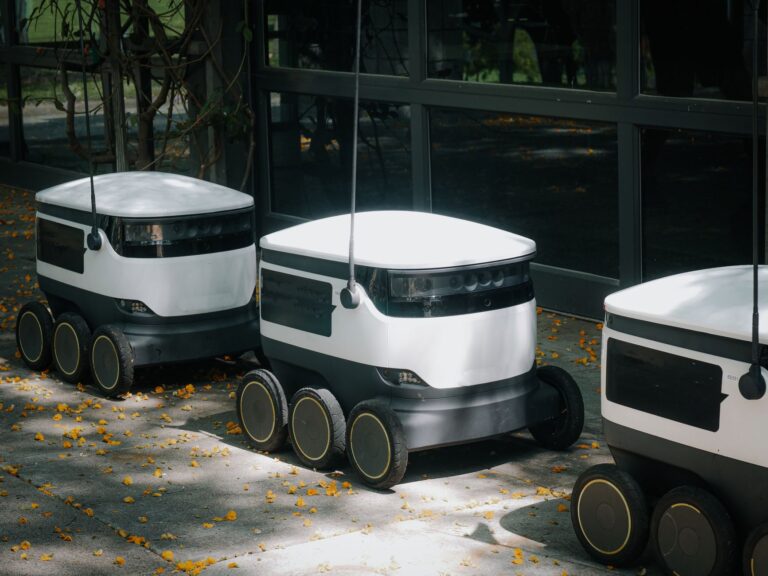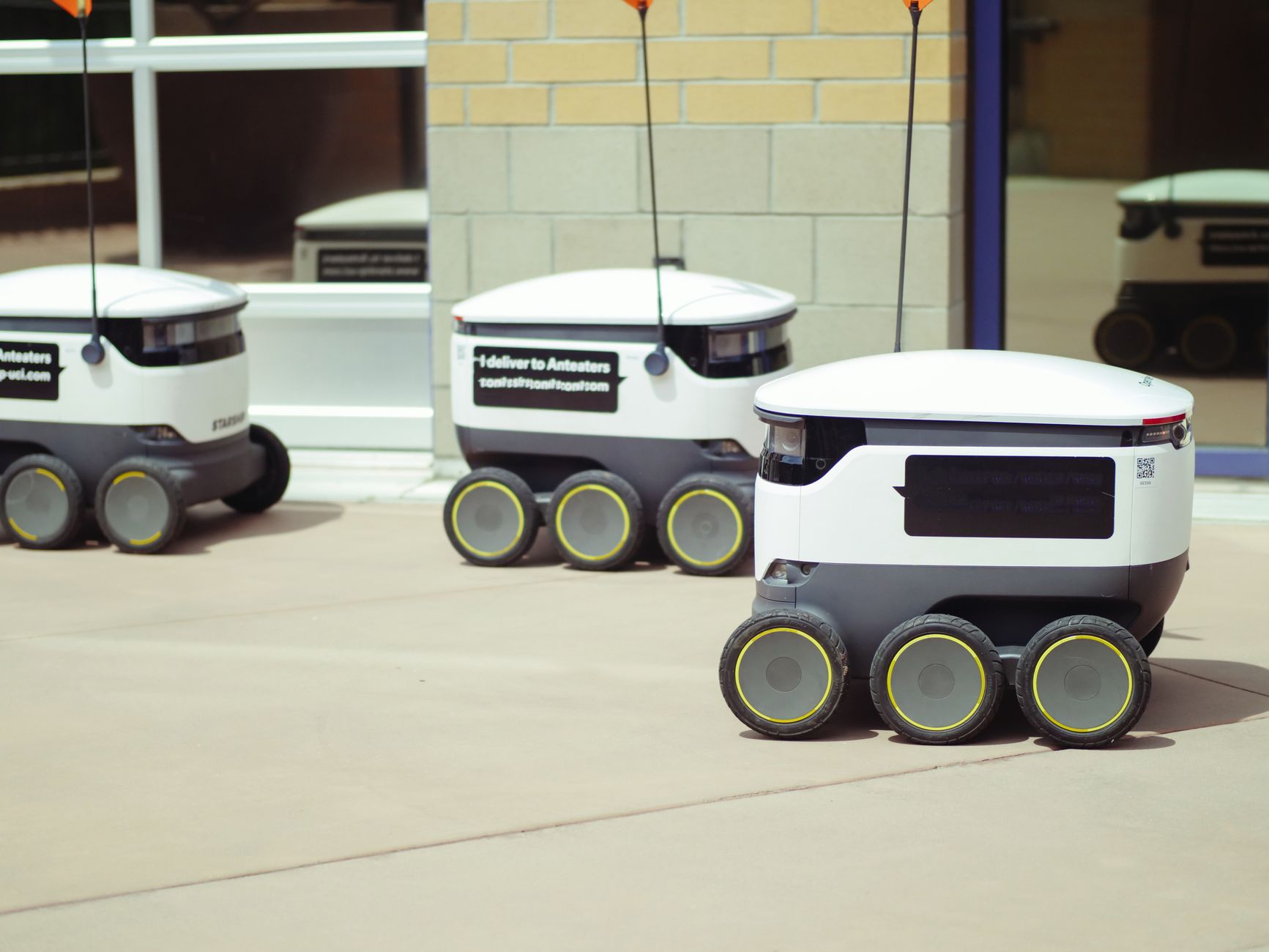

The autonomous delivery robot market is projected to reach between $818 million and $939.4 million in 2026, according to multiple independent research firms tracking the sector. This growth—accelerating at compound annual rates between 26.8% and 37.24% depending on technology maturity and geographic scope—represents a fundamental shift in how packages and goods move through cities and suburbs. The broader autonomous last-mile delivery market is even larger, with estimates ranging from $1.6 billion to $49.23 billion depending on whether analysts include drones, trucks, mixed fleets, or focus narrowly on ground robots. Consider a typical scenario: a restaurant in downtown Seattle deploys a small autonomous cart to deliver a lunch order to a nearby office building, eliminating the cost and emissions of a human driver making a single trip.
That transaction would not have been economically viable five years ago; in 2026, it is becoming routine. The variation in market size estimates—sometimes spanning orders of magnitude—reflects real disagreements among analysts about what counts as “autonomous delivery.” Some define it strictly as fully driverless ground robots operating on pedestrian paths. Others include mixed human-robot logistics systems, autonomous shuttles, delivery drones, and autonomous trucks working in dedicated corridors or at night. This ambiguity matters because it shapes investment decisions and technology choices. A company building a small sidewalk robot operates in a different market than one engineering autonomous semi-trucks for highway deliveries, yet both may be counted in the same forecast.
Table of Contents
- How Fast Is the Autonomous Delivery Market Really Growing?
- Why Geographic Differences Matter More Than You Think
- Ground Vehicles Dominate, But at What Cost?
- Short-Range Delivery Is Where the Real Action Is
- Regulatory Approval Is Advancing Faster Than Expected—But Implementation Lags
- Healthcare and Food Delivery Are Leading the Charge
- Labor Economics Remain the Fundamental Driver
- Frequently Asked Questions
How Fast Is the Autonomous Delivery Market Really Growing?
The compound annual growth rates cited across research bodies reveal both momentum and uncertainty. Coherent Market Insights projects autonomous delivery robots will grow at 26.8% CAGR from 2026 to 2033, reaching $4.867 billion by 2033. 360iResearch reports a more aggressive 37.24% CAGR to 2032, arriving at $5.558 billion. Mordor Intelligence takes a more conservative 19.74% CAGR through 2031, stopping at $3.27 billion. These projections diverge because they use different base assumptions about deployment rates, technology maturity, and what constitutes a paid autonomous delivery transaction versus a trial or pilot program. A 37% CAGR assumes rapid scaling; a 19% CAGR assumes adoption hits friction points—regulatory delays, safety incidents, or labor pushback—that slow expansion.
The broader last-mile delivery market, which encompasses autonomous ground vehicles, drones, autonomous trucks, and hybrid systems, shows similarly varied momentum. Grand View Research forecasts 24.5% CAGR through 2035, reaching $11.5 billion. Coherent Market Insights projects 29.3% CAGR to reach $137.7 billion by 2030. Fortune Business Insights estimates 26.80% CAGR through 2034, landing at $212.46 billion. The three-fold spread here is not a research error; it reflects genuine ambiguity about market boundaries. If you include all vehicle types and all logistics use cases, the market is vastly larger than if you count only small sidewalk robots delivering single packages.
Why Geographic Differences Matter More Than You Think
North America is projected to hold 47.8% of the global autonomous delivery market share in 2026, according to Spherical Insights, making it the dominant region by far. The United States and Canada have developed regulatory pathways, deployed pilots in major cities, and created a venture capital ecosystem that accelerates commercialization. Yet this dominance masks a critical limitation: Asia-Pacific is projected to have the highest growth rate in the forecast period. China, South Korea, and Southeast Asia are deploying autonomous delivery robots at scale with less regulatory friction and lower labor costs than North America.
The implication is that while North America leads in absolute market size today, Asia-Pacific will eventually become the larger market if growth rates hold. A delivery company optimizing for 2026 revenue will focus on North America; a company building for 2035 market leadership should prioritize Asia-Pacific expansion and talent. The geographic concentration in North America also reflects existing logistics infrastructure and consumer expectations. Urban areas with established last-mile delivery demand, existing retail e-commerce networks, and higher labor costs create the economic conditions where autonomous delivery makes financial sense. Rural areas and developing regions, despite potential long-term benefits, remain less attractive near-term markets because they lack the density and existing delivery volume to justify deployment.
Ground Vehicles Dominate, But at What Cost?
Autonomous ground vehicles—wheeled robots ranging from six inches to four feet tall—dominate the market due to their adaptability and compatibility with existing infrastructure. They can operate on sidewalks, parking lots, and mixed pedestrian areas without requiring new dedicated corridors or flight control systems. Grand View Research identifies this vehicle type as the dominant segment, and the reasons are practical: ground vehicles are cheaper to manufacture than drones, require less regulatory pre-approval than autonomous trucks, and can reach customers at their door without requiring rooftop landing zones or elevation infrastructure. Yet ground vehicle dominance comes with a tradeoff: they are slow, restricted to sidewalks and low-speed paths, and dependent on fine-grained navigation through crowds.
A ground robot delivering a package to an apartment building in a dense neighborhood may take 30 minutes to travel two miles, during which it requires wireless connectivity, real-time obstacle detection, and coordination with pedestrians who may not understand how to interact with it. Drones, by contrast, cross that distance in five minutes and avoid street-level obstacles entirely. The tradeoff is that drones require infrastructure changes, regulatory approval, and noise mitigation. Autonomous trucks offer throughput for bulk deliveries but require new traffic management systems. Ground vehicles win not because they are optimal but because they require the fewest systemic changes to existing cities.
Short-Range Delivery Is Where the Real Action Is
Short-range delivery—typically defined as trips under three miles—represents 74.21% of revenue share in the autonomous last-mile delivery market in 2026, according to Grand View Research. This concentration reflects the economics of urban retail: most parcels travel short distances, most orders are same-day or next-day, and most customers are clustered in high-density zones. A convenience store restocking shelves from a nearby warehouse, a restaurant filling a catering order at an office building two blocks away, or a pharmacy delivering a prescription across town are all short-range scenarios where autonomous robots make financial sense today.
Long-range autonomous delivery—beyond five miles—remains economically marginal because it competes directly with established carriers (UPS, FedEx) that have optimized highway logistics for decades and can absorb losses on low-density routes. Autonomous technology can eventually displace these carriers on specific routes, but not until autonomy cost per mile falls well below current human driver wages. Short-range is where autonomous ventures have immediate revenue traction because they serve a market—hyperlocal, same-day delivery—that conventional logistics ignores. This concentration also means that urban areas with high delivery density see autonomous technology adoption first, while suburban and rural deployment lags.
Regulatory Approval Is Advancing Faster Than Expected—But Implementation Lags
One of the drivers cited across all market research is “increasing regulatory approvals for autonomous operations.” Cities including San Francisco, Phoenix, and several European capitals have issued permits for autonomous delivery robot pilots. But regulatory approval and regulatory infrastructure are different things. A permit allows a company to test 50 robots on specific routes during limited hours; infrastructure changes allow autonomous robots to operate as a standard service, like human delivery drivers, at any time. Most current approvals are still in the pilot phase, requiring human oversight, restricted geographies, and time limits.
A critical limitation is that municipalities and states have not yet aligned on standards for autonomous vehicle operation, insurance requirements, or liability frameworks. A company operating robots in California, Arizona, and Nevada faces three different regulatory regimes. This fragmentation slows scaling because each new geographic market requires legal negotiation and compliance work. Larger delivery companies can absorb these costs; smaller autonomous startups often cannot, leading to geographic clustering around permissive early-adopter cities and slower expansion elsewhere.
Healthcare and Food Delivery Are Leading the Charge
Autonomous delivery robots are finding immediate traction in healthcare and food delivery—verticals where contactless delivery has become an explicit customer demand, often for safety or hygiene reasons. Hospitals use autonomous robots to deliver medication, lab samples, and meals through corridors, reducing staff exposure and enabling 24/7 logistics. Some food delivery platforms are testing autonomous robots for restaurant-to-customer delivery, particularly for orders placed by older adults or immunocompromised individuals who prefer minimal contact.
These use cases drive revenue today because they solve a specific problem—contactless delivery—rather than waiting for general autonomous vehicle adoption. The healthcare sector, in particular, is expanding autonomous delivery automation beyond ground robots. Some hospitals have deployed autonomous shuttles and conveyor systems for internal logistics. This creates a pipeline of organizations with experience managing autonomous systems, which then become customers for broader autonomous logistics platforms.
Labor Economics Remain the Fundamental Driver
Advances in AI navigation, sensor technology, and autonomy systems receive credit in most market forecasts, and those advances are real. However, the underlying driver of autonomous delivery adoption is labor cost reduction and operational efficiency. In developed economies, human delivery drivers command wages between $15 and $25 per hour plus benefits. Autonomous robots have capital costs but lower per-delivery costs if utilization is high. Where delivery density is high—urban retail, restaurant delivery, healthcare—autonomous robots achieve cost parity with human drivers within 2-4 years of deployment, depending on robot cost, maintenance expenses, and route density.
This economic logic also explains geographic variation. North America has high labor costs and high regulatory barriers to entry, so autonomous technology must be capital-efficient to justify deployment. Asia-Pacific has lower labor costs but faces equally high regulatory friction in many cities, so the business case depends more on operational efficiency gains and investment incentives from governments pursuing smart-city initiatives. Neither region is running out of humans willing to deliver packages; rather, both regions face labor availability constraints (workers prefer other jobs) and growing demand for delivery services that would require massive workforce expansion. Autonomous delivery solves a supply constraint, not a labor shortage.
Frequently Asked Questions
Why do market estimates vary so widely—sometimes by 30 times or more?
Different research firms define “autonomous delivery” differently. Some count only small sidewalk robots, others include trucks, drones, and mixed systems. A narrow definition produces smaller market totals; a broad definition includes all autonomous last-mile technology, inflating projections significantly.
Which region should I focus on if I’m building autonomous delivery technology?
North America dominates current revenue (47.8% share) but Asia-Pacific has the highest growth rate. Geographic choice depends on your time horizon: enter North America first for established demand and customers, but plan Asia-Pacific expansion for long-term market leadership.
Is short-range delivery really 74% of the market?
Yes, in 2026. Most autonomous delivery robots are built for trips under three miles—convenience stores, restaurants, last-mile apartments. Long-range delivery (beyond five miles) remains economically marginal because it competes with established carriers on routes where automation has not yet achieved cost advantage.
Why is regulatory approval not moving faster?
Regulatory approval for pilots has advanced rapidly, but operational infrastructure—standardized insurance, liability frameworks, and consistent rules across regions—has not. This gap means most current approvals are limited-scope pilots, not unrestricted deployment.
Which industries are adopting autonomous delivery first?
Healthcare and food delivery, driven by demand for contactless logistics and high delivery density. Hospitals deploy robots for medication and sample transport; restaurants and food delivery platforms deploy for customer delivery, particularly to high-risk populations.
Should I expect autonomous trucks or sidewalk robots to dominate?
Ground vehicles (sidewalk robots) dominate the 2026 market due to lower regulatory barriers and existing infrastructure compatibility. Autonomous trucks will grow later as they solve long-haul economics and require highway infrastructure investment that is just beginning.