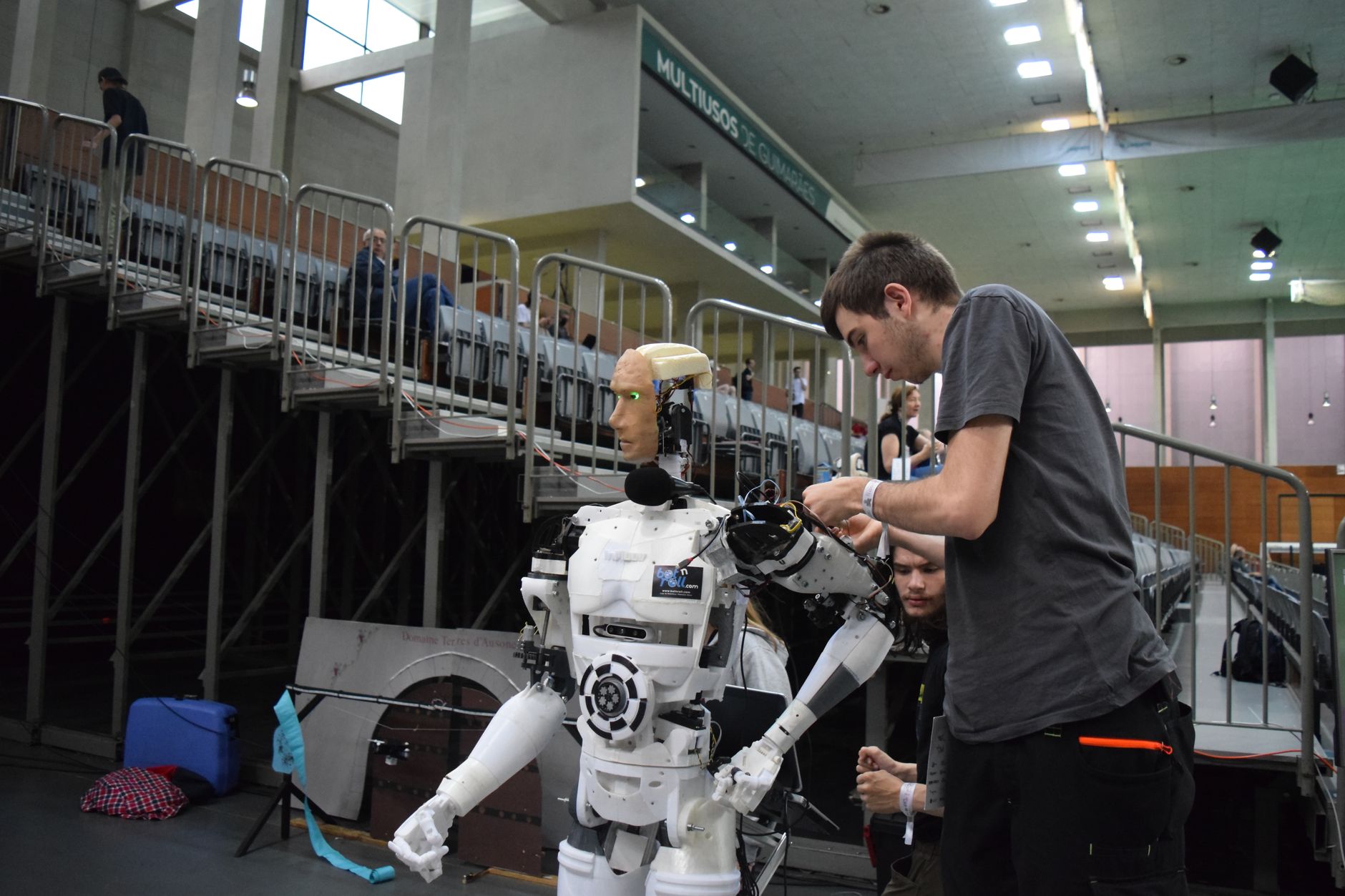

Humanoid engineering—the design of robots with a humanlike body plan—depends on matched sensors, layered control, and fault-tolerant hardware. Start with the required task and failure limits, then choose components that make the robot's state observable and controllable. A walking robot must estimate its posture, manage changing ground contact, and react before small errors become falls. Reliability therefore comes from the complete system, not from any single sensor, actuator, or algorithm.
Table of Contents
- Match sensors to the decisions they support
- Turn measurements into a trustworthy robot state
- Build control as a layered system
- Engineer for faults, heat, and physical wear
- Validate from components to full-body tasks
Match sensors to the decisions they support
Every sensor should answer a control or safety question. Joint encoders report limb position, inertial measurement units estimate body motion, and foot sensors help determine where the ground supports the robot. Cameras, depth sensors, and tactile arrays describe the surrounding environment and physical contact. Common sensor roles include: Choose sensors by accuracy, update rate, latency, range, durability, and failure behavior.
A precise sensor that arrives late can destabilize a fast control loop. Actuator current can provide a useful torque estimate, but gearbox friction, temperature, and calibration errors limit its accuracy. Redundancy matters most when a failure could cause a fall or hazardous motion. Two identical sensors can share the same weakness, so useful redundancy often combines different measurement methods. An encoder and an inertial sensor, for example, fail differently and can cross-check parts of the same motion estimate.
- Joint position: absolute or relative encoders measure link configuration.
- Joint effort: torque sensors or actuator-current estimates reveal loading and collisions.
- Body motion: accelerometers and gyroscopes track orientation and angular velocity.
- Ground contact: force sensors or pressure arrays locate support under each foot.
- Perception: cameras and depth sensors identify terrain, objects, and people.
Turn measurements into a trustworthy robot state
Controllers cannot act directly on noisy, delayed, or incomplete measurements. A state estimator combines sensor data into estimates of joint motion, body pose, velocity, ground contact, and sometimes external forces. Sensor fusion is the process of forming that combined estimate. Accurate timestamps are essential. A camera frame, encoder sample, and inertial reading may describe different moments even when software receives them together. Synchronization errors can look like physical motion and send the controller in the wrong direction.
Calibration also belongs in normal operation, not only initial assembly. Camera mounts shift, joint offsets drift, and force sensors develop bias. The system should detect implausible readings, report confidence, and degrade safely when an input becomes unreliable. Contact deserves special attention because it changes the robot's dynamics. A foot that is touching, slipping, or leaving the floor requires a different model. Estimators should compare expected contact with force, motion, and commanded behavior instead of trusting one threshold.
Build control as a layered system
A practical humanoid controller separates fast stabilization from slower decision-making. Inner loops regulate actuator position, velocity, or torque. Higher layers coordinate the whole body, plan contact changes, and select task actions. A typical control path is: Whole-body control helps manage coupled motion.
Moving an arm changes the forces needed at the feet, while bending the knees changes reach and balance. The controller must prioritize critical constraints, such as stable contact and joint limits, over less important goals such as exact hand orientation. Complex methods are not automatically better. Predictive control can account for future motion and constraints, but it depends on usable models and predictable computation time. A simpler controller with bounded latency and clear fallback behavior may be safer for an early prototype.
- The task layer requests an action, such as reaching for a box.
- A planner produces body, hand, and foot targets.
- A whole-body controller resolves competing goals and physical constraints.
- Joint controllers convert those targets into actuator commands.
- Safety monitors limit or stop commands that violate defined boundaries.
Engineer for faults, heat, and physical wear
Reliability means the robot performs its required function for a defined time and enters an acceptable state when it cannot. That definition should cover sensors, computing, communication, power, actuators, cables, connectors, and mechanical structures. Humanoid robots face repeated impacts, changing loads, cable movement, and actuator heating. Designs should include thermal monitoring, current limits, strain relief, protected connectors, mechanical stops, and replaceable wear parts.
Software should derate performance before temperatures or loads cross hardware limits. Plan explicit responses for predictable faults: An emergency stop does not guarantee a harmless outcome. Removing torque from a standing humanoid may cause it to collapse, while applying brakes suddenly can create large loads. The safe response depends on posture, stored energy, nearby people, and available backup power.
- Reject isolated sensor spikes instead of commanding abrupt corrections.
- Limit motion when state confidence falls below a defined threshold.
- Contain communication failures so one missing device does not freeze every bus.
- Preserve braking or controlled support when computing or power degrades.
- Record the events before and after a fault for diagnosis.
Validate from components to full-body tasks
Testing should progress from low-energy experiments to realistic operation. Begin with sensor calibration and actuator characterization, then test individual limbs, supported full-body motion, controlled contact, and finally untethered tasks. Use physical restraints and exclusion zones where a fall or unexpected movement could cause harm. Simulation can expose planning and control errors, but it cannot reproduce every friction change, cable interaction, impact, or sensor artifact. Hardware-in-the-loop testing adds real controllers or actuators to a simulated environment, helping uncover timing and interface problems before unrestricted trials.
Define success in measurable terms for each task. For a robot carrying a tote, requirements might cover permitted payload range, floor conditions, grasp loss detection, stopping distance, component temperature, and recovery after a blocked step. Repeat tests across battery state, warm hardware, worn surfaces, sensor dropouts, and deliberately delayed messages. Keep synchronized logs of commands, estimates, raw measurements, limit events, temperatures, and software versions. After any fall or unexplained stop, reproduce the triggering conditions at lower energy before returning the robot to full-body operation.