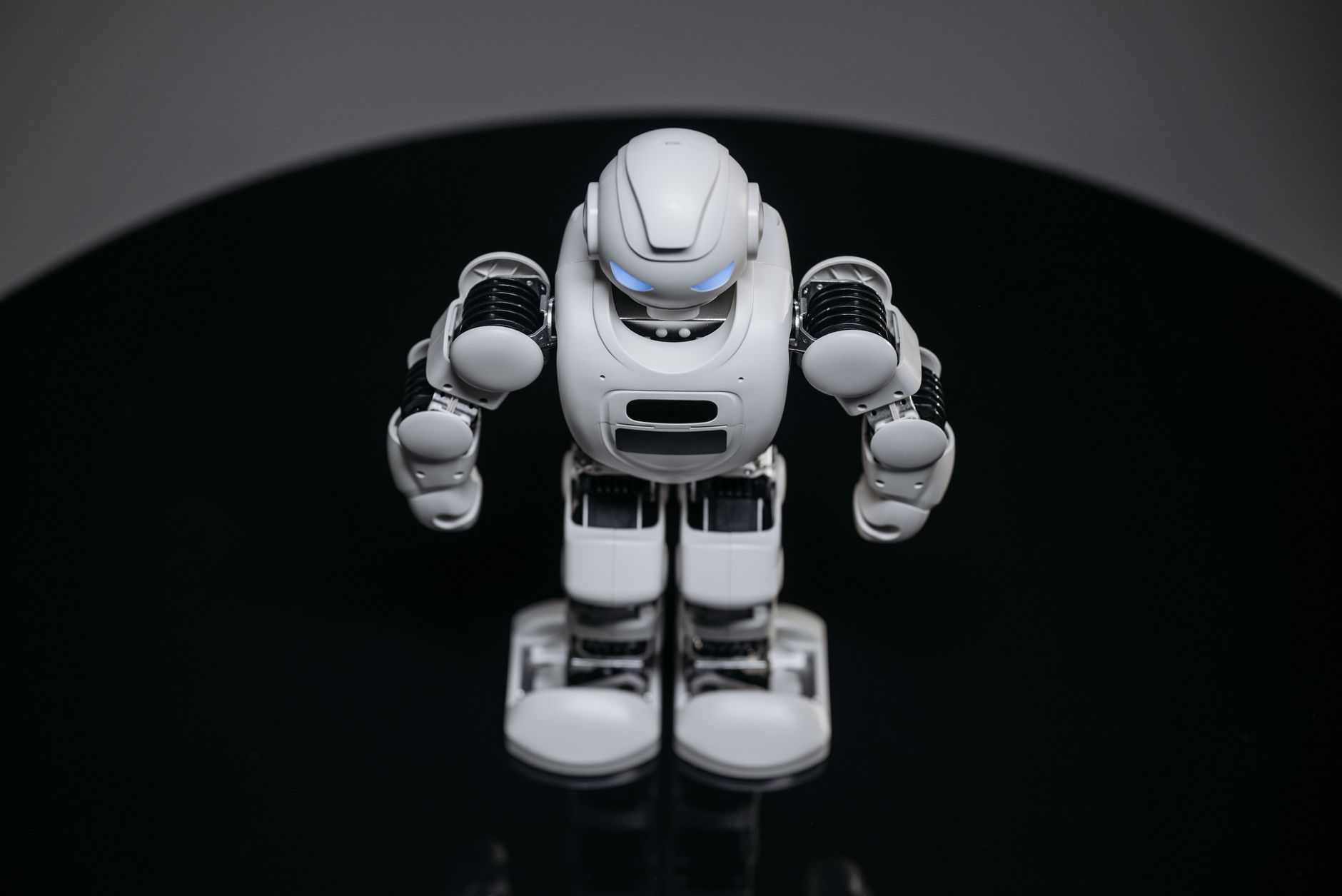

Humanoid robots—machines with a humanlike body plan—can perform selected tasks in manufacturing, logistics, and daily life. They are best suited to repetitive work in spaces designed for people, while home applications remain more limited and closely supervised. Their main advantage is compatibility: legs, arms, and grippers can use existing aisles, stairs, shelves, tools, and workstations. Their main weakness is complexity, which can make a specialized robot faster, safer, and cheaper for a fixed task.
Table of Contents
- Which tasks fit a humanoid robot?
- Manufacturing applications
- Logistics and warehouse work
- Daily-life and service applications
- How to evaluate a deployment
Which tasks fit a humanoid robot?
The strongest applications combine predictable surroundings with work that benefits from human reach and mobility. Examples include moving containers, loading machines, placing parts, inspecting equipment, and carrying supplies between stations.
A promising task usually has these traits: Irregular objects, crowded rooms, delicate handling, and constant improvisation make deployment harder. A robot may demonstrate a task successfully yet still lack the reliability, speed, or recovery behavior needed for routine operation.
- Repetitive motions and clearly defined start and end points
- Objects that stay within a manageable range of sizes and weights
- A workspace that would be expensive to redesign for fixed automation
- Enough task volume to justify integration, maintenance, and supervision
- A safe fallback when the robot stops or encounters something unfamiliar
Manufacturing applications
In factories, humanoid robots can support machine tending, parts delivery, inspection, kitting, and basic assembly. Humanlike proportions let them approach workbenches and controls that were originally positioned for employees. They may be especially useful in mixed production, where product designs or workflows change often. A programmable mobile worker can potentially move between stations instead of requiring separate automation for every step.
However, manufacturers should compare humanoids with conventional alternatives. A fixed robotic arm usually offers better precision and throughput at a stable workstation, while an automated guided vehicle can move standard loads with less mechanical complexity. Safety also extends beyond collision avoidance. The deployment must control dropped objects, unexpected movements, tool use, battery hazards, and restart behavior after a fault.
Logistics and warehouse work
Warehouses offer practical roles such as transferring parcels, picking cases, unloading containers, replenishing shelves, and moving items between conveyors. Humanoid arms can reach racks at different heights, while legs may help in facilities with thresholds, stairs, or uneven floors. The business case depends on the exact workflow. Wheeled robots remain a better fit for long, smooth travel, and conveyor systems excel when goods follow a fixed route.
Humanoid mobility matters most when the facility cannot easily be rebuilt around those systems. Picking remains challenging when products are reflective, soft, damaged, tightly packed, or unfamiliar. A useful system must detect failed grasps, recover without creating a jam, and hand uncertain cases to a person. Traffic management is equally important. Operators need rules for pedestrian right of way, charging, blocked aisles, emergency stops, and safe interaction with forklifts and other mobile machines.
Daily-life and service applications
In homes and public settings, humanoid robots could carry objects, fetch supplies, open compatible doors, operate appliances, and support simple cleaning or monitoring routines. The same body shape may also help in hotels, hospitals, laboratories, and offices built around human movement. Daily life is less structured than a factory. Pets, children, clutter, spills, narrow spaces, and fragile possessions create situations that are difficult to predict and test comprehensively.
Personal assistance also raises privacy and responsibility questions. A robot may process images, room layouts, voices, or routines, so buyers should understand where that data goes and how long it remains stored. Caregiving requires particular caution. A robot can support reminders, deliveries, or communication, but it should not silently replace human judgment in medical emergencies, mobility assistance, or decisions involving a vulnerable person.
How to evaluate a deployment
Start with one measurable task rather than a broad goal such as "automate the warehouse." Record cycle time, intervention frequency, error types, downtime, and any changes needed to the surrounding workplace. A useful pilot should answer these questions: Test under ordinary operating conditions, not only in a cleared demonstration area. Before expanding, document the failure cases that require human help and assign a trained person to each response.
- Can the robot complete the full workflow, including recovery from common failures?
- Does it meet the required pace without creating delays elsewhere?
- Can employees stop, move, or bypass it safely?
- Who handles maintenance, software updates, and remote support?
- What happens to operations if the robot is unavailable?