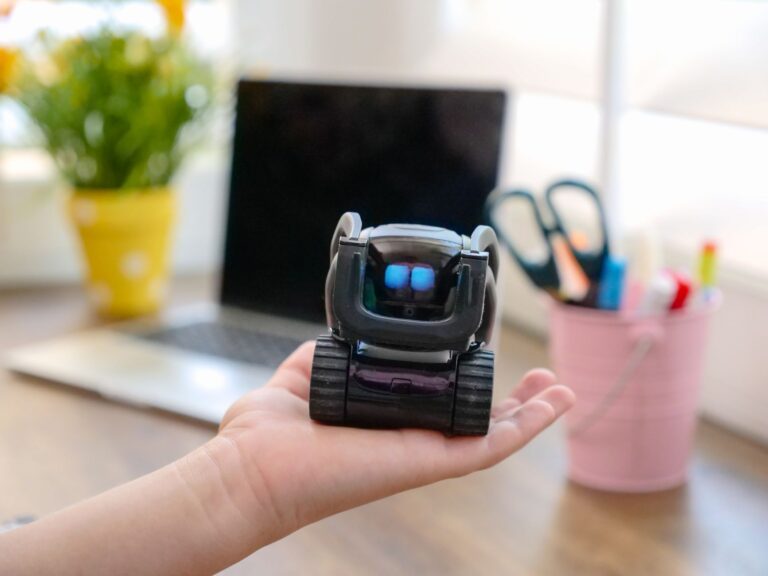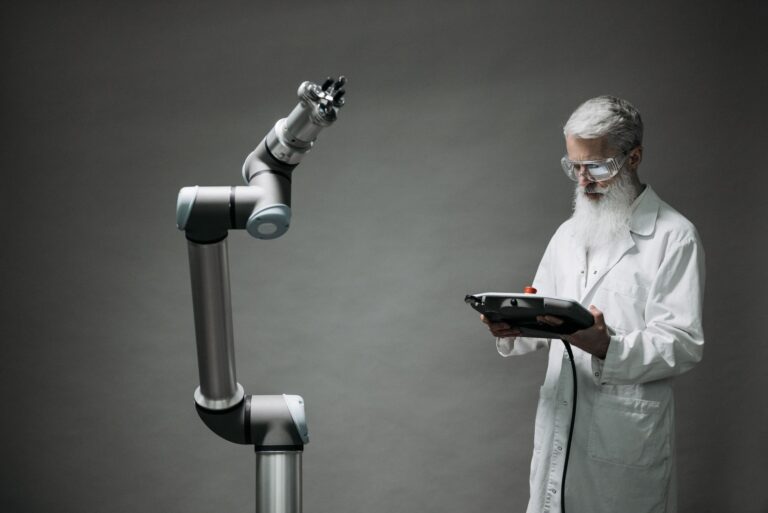

Computer vision robotics in 2026 means robots that use cameras and AI to see a scene, understand a task, and move arms or bases. This guide summarizes proven capabilities, current safety duties, and practical deployment checks for buyers and integrators. A vision-language-action model links vision, language understanding, and action planning in one system. According to Google DeepMind in its Gemini Robotics announcement, such a system can interpret a scene, take a natural-language instruction, and drive arms or humanoids without task-specific scripting.
Table of Contents
- What can one vision system do now?
- Where do vision models fail?
- What safety rules apply in 2026?
- How do you buy and deploy with confidence?
What can one vision system do now?
A single camera-driven policy can sort parcels, pick mixed parts, open doors, and guide a humanoid arm. The operator states the goal in plain language instead of scripting each motion. That shift suits warehouses, hospitals, and small-batch factories with frequent changeovers. Training data no longer depends only on manual collection.
According to TechTimes reporting on NVIDIA's pipeline in its report on synthetic robot training, GR00T foundation models with Cosmos world models can generate photorealistic synthetic video and trajectories, with 780,000 trajectories in about 11 hours. Buyers can therefore pilot warehouse and humanoid tasks faster and at lower data cost. The gain is breadth, not perfection. Synthetic scenes still miss rare clutter, reflections, and worn packaging. Treat early pilots as proof of range, then measure grasp success, cycle time, and recovery behavior on site.
Where do vision models fail?
General vision-language models often perform poorly outside their training distribution. A 2026 safety paper discussed by Ground Truth found that added guard layers help, including action validation, monitoring, intervention, and training-free failure recovery. The lesson is direct: do not trust a lab demo. Test with novelty before acceptance.
Use unfamiliar objects, changed lighting, moved bins, occluded labels, and human interruptions. Record whether the robot stops, asks, retries safely, or makes an unsafe move. Ask vendors how failures are detected and logged. Require a clear stop state, a resume procedure, and evidence from repeated trials. A system without visible monitoring and intervention is not ready for shared space.
What safety rules apply in 2026?
Application-level risk assessment is now the core duty. According to A3 via Business Wire in its 2025 robot safety standard notice, ISO 10218-1:2025 and 10218-2:2025 replace the 2011 edition, fold in ISO/TS 15066, and drop the term collaborative robot for collaborative application. They require body-region force and pressure limits plus cybersecurity planning. The U.S. standard ANSI/A3 R15.06-2025 adopts ISO 10218 Parts 1-2.
Robotics and Automation News reports that new Part 3 released in January 2026 adds user duties for operating robot cells. It covers continued safe operation after changes to equipment, tasks, or environment. OSHA has no robot-specific standard and enforces hazards through general machine-guarding duties and ANSI/RIA references, as described by Conversion Technology and OSHA citation records. U.S. employers therefore remain liable and must require compliant integration, safeguarding devices, and training in contracts. NIOSH's Center for Occupational Robotics Research, established in 2017 and described by CDC/NIOSH, studies incident surveillance and workplace interventions for industrial, collaborative, mobile, and wearable robots.
How do you buy and deploy with confidence?
Use objective tests before signing. NIST, with DHS and ASTM, publishes more than 50 standard robot test methods in its performance assessment framework, covering mobility, manipulation, sensing, endurance, communications, and safety. Procurement teams can demand scores, scenario libraries, and sensor logs from vendors.
Put those results in the purchase contract. Name the cell layout, task, speed, payload, safeguarding devices, software version, training data scope, maintenance duties, and retraining triggers after any change. Require the same evidence after deployment changes, because Part 3 duties continue during operation. Keep incident logs, near-miss reports, and sensor data for review with integrators and safety staff.
- Show NIST-style scores for sensing, grasping, navigation, endurance, and safety stops.
- Demonstrate novel objects, low light, glare, dust, and interruption recovery.
- Document risk assessment, force and pressure checks, cybersecurity measures, and operator training.
- Commit to revalidation after layout, product, lighting, or software changes.
You Might Also Like
- Simulation Digital Twins Robotics 2026 Guide: capabilities, safety, and deployment; Key Facts and Questions to Ask
- Sensors and Perception Robotics 2026 Guide: capabilities, safety, and deployment; Key Facts and Questions to Ask
- Research Robotics 2026 Guide: capabilities, safety, and deployment; Key Facts and Questions to Ask