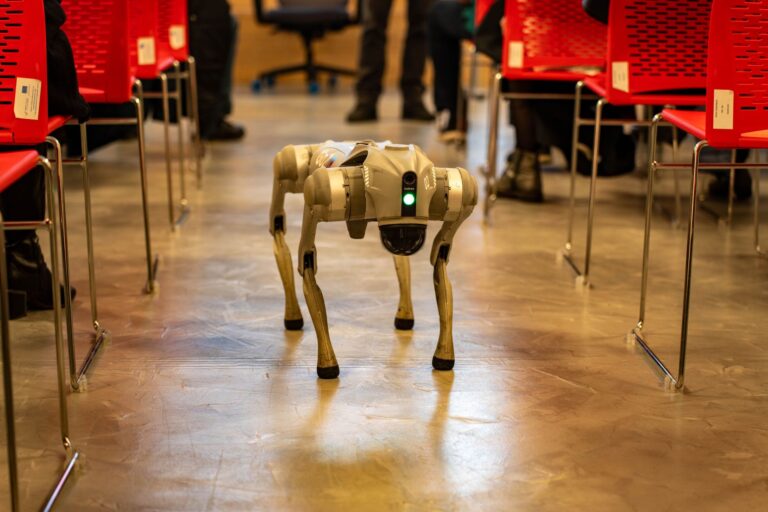

Iris, Evri's two-legged delivery robot, rolls along pavements on wheeled legs and steps over obstacles to reach doorsteps. It runs autonomously with remote monitoring for last-mile delivery.
Evri describes Iris as Europe's first two-legged autonomous delivery robot in its launch announcement. Evri and Japan-based Refined Robotics are trialling Iris on residential streets in Barnsley. The trial tests real doorstep delivery, not a closed course.
Table of Contents
- What makes the legs different?
- How does a street delivery work?
- Why test in Barnsley?
- What changes for couriers and residents?
What makes the legs different?
Iris stands about 4ft/1.2m tall on two articulated legs ending in wheels. The BBC reports that it rolls on pavements, then steps around branches and wheelie bins in its trial report. That mix suits narrow, cluttered residential paths.
According to Evri, the same design climbs stairs, crosses uneven ground and kerbs, and hops in and out of delivery vans. The robot does not need a flat warehouse floor. It moves between van, kerb, path, and door in one trip.
How does a street delivery work?
Driverless.news, summarising Evri, reports that Iris can operate autonomously or under remote monitoring in its trial summary. It can complete attended and unattended drops, including evening delivery and delivery when customers are out.
A typical run follows a short sequence: According to Evri, Iris carries up to 15kg, with BBC reporting about 20kg, at up to 6km/h. The early focus is fashion parcels, which often fit that weight and size.
- roll along the pavement toward the delivery street
- step around bins, branches, kerbs, or uneven patches
- climb steps to the door and release the parcel
- return to the van or continue to the next stop
Why test in Barnsley?
Barnsley combines homes, pavements, kerbs, steps, and parked cars in a compact area. The BBC links the choice to Barnsley's status as the UK's first government-backed Tech Town for AI in services. Evri also has a large parcel hub there.
That setup lets engineers watch pavement behaviour near live operations. Residents meet the robot during normal delivery hours. Couriers work alongside it during loading and handover.
What changes for couriers and residents?
According to Evri, robots support rather than replace couriers. Couriers load parcels and remain central to delivery.
Residents do not need to carry the parcel from a distant collection point. Practical use depends on reliable handover and handling blocked routes. A courier still loads each parcel, keeping handover simple when paths block or customers are out.