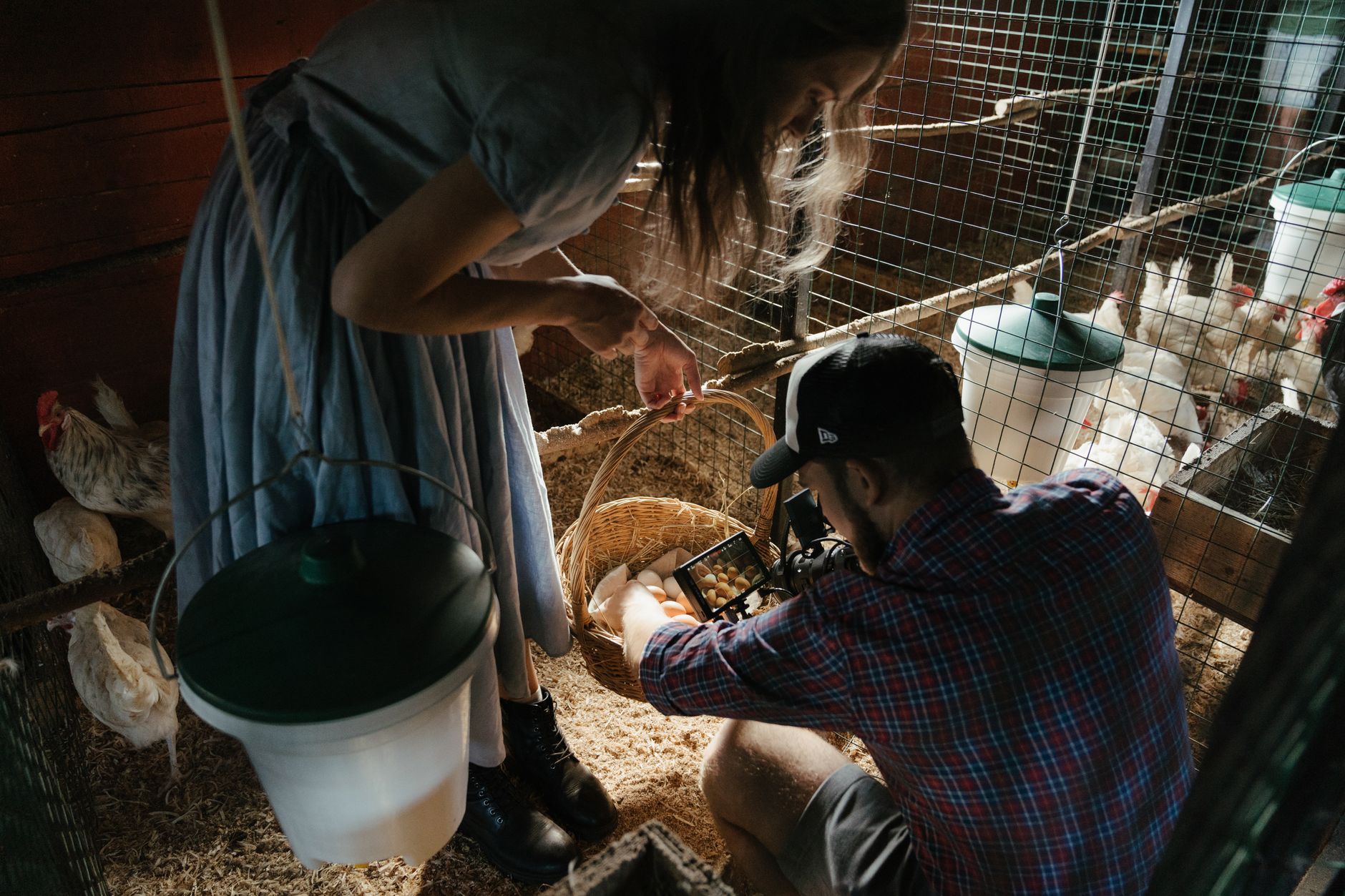

The egg-collecting humanoid sees cage-free barns through AI computer vision paired with depth sensing and LiDAR for mapping and grasping. Howl, NC State's roughly 4-foot humanoid for recovering floor eggs, uses that view to reach eggs and lift them with padded fingers.
Floor eggs are eggs laid outside nests on litter or barn floors. They account for 2% to 15% of production, or about 2,000 to 15,000 eggs daily in a 100,000-bird house, according to NC Field & Family. Collection means stooped manual work, and delays hurt quality amid labor shortages.
Table of Contents
- What cameras give Howl its view?
- How does vision become a pickup?
- Why do fixed barn cameras help?
- Where does barn vision still struggle?
What cameras give Howl its view?
According to Unitree Robotics, the G1 base supplies multimodal perception through a rotatable binocular camera and chest wide-angle camera, described in the G1 platform details. Depth cameras and LiDAR add spatial awareness for navigation and close manipulation.
The wide views cover the barn scene while depth sensing judges distance to floors, obstacles, and eggs. That split matters because Howl must cross a busy barn and then guide padded fingers to a small, fragile target. NC State's AIR Lab, led by Ramesh Bist, is building Howl on that G1 base for detection and pickup.
How does vision become a pickup?
Tech360.tv reports that Howl spots eggs with computer vision and AI perception, navigates to them, and lifts them without cracking shells, as covered in Tech360.tv's report. Vision locates the egg, navigation brings the body into reach, and perception guides finger placement.
Graduate students demonstrate motions with VR controllers and headsets. Imitation learning plus reinforcement learning then helps Howl repeat the grip autonomously, first in simulation before barn use.
Why do fixed barn cameras help?
The same AIR Lab installs fixed 2D and 3D barn cameras with AI models, according to NC Field & Family. Those models score flock health signals from above.
Fixed cameras watch the flock over time, while Howl watches the floor up close. A producer can use the overhead scores to catch stress or illness early and use the robot to recover floor eggs before quality drops.
- feather condition
- plumage density
- body weight for early stress or illness
Where does barn vision still struggle?
Howl was still finishing detection-and-retrieval simulations in late 2026 and targets the full barn task by early 2027, according to Interesting Engineering reporting in the robot's development update. Litter-colored eggs and hens moving around the robot limit progress.
A peer cage-free vision study shows both promise and difficulty. Its YOLOv8m system with a 360-degree panoramic depth camera reached 90.59% precision, according to MDPI AgriEngineering, and found floor eggs in dim areas below feeders and corners.
- eggs matching litter color
- dim corners and space below feeders
- hens walking through the camera view