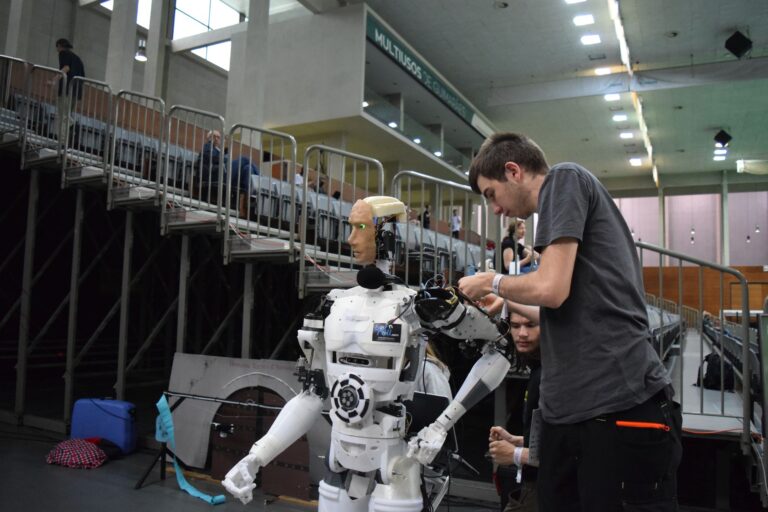

Humanoid machines could indeed replace human workers in hazardous professions, according to automation industry discussions and emerging robotics capabilities. The logic is straightforward: tasks that expose workers to immediate physical danger—extreme heat, toxic chemicals, radiation, high-altitude falls, or underground collapse risks—are precisely the kinds of repetitive, structured work that machines can potentially handle without the biological vulnerabilities that make these jobs lethal or chronically damaging to human health. A nuclear technician decontaminating a reactor facility, for example, absorbs radiation that causes long-term illness; a humanoid robot performing the same work experiences no biological harm.
The realistic timeline, however, differs sharply from the marketing narrative. Current humanoid robots lack the dexterity, environmental adaptation, and autonomous problem-solving to handle genuinely unpredictable or complex hazardous work. But the incremental path is clear: first deployment in the most structured and repetitive hazardous tasks, then expansion into less-controlled environments as hardware and software mature. The question is not whether replacement is possible, but when and at what cost.
Table of Contents
- What makes humanoid machines suited for hazardous work environments?
- The current state of humanoid robotics and its limitations
- Real-world hazardous professions where humanoid machines could make an immediate impact
- Economic viability and the deployment challenge
- The human impact and the transition problem
- Technical barriers that still block widespread deployment
- Nearest-term realistic applications
What makes humanoid machines suited for hazardous work environments?
Humanoid form factor is valuable for hazardous work because it allows machines to use the same tools, spaces, and procedural frameworks that humans designed. A construction site, mining shaft, or chemical plant has stairways, doorways, ladders, and equipment-access points sized for human bodies. A humanoid robot can navigate these spaces without requiring complete environmental redesign, unlike wheeled or specialized robotic systems. This retrofitting advantage saves deployers the cost of infrastructure overhaul.
The real safety advantage is simpler: a robot does not need air to breathe, does not suffer organ damage from chemical exposure, does not fatigue or make mistakes from exhaustion, and has no family to leave behind. A machine can remain in a confined space with methane gas, asbestos dust, or low-level radiation for as long as its power supply holds. The economic case becomes compelling when you calculate the lifetime healthcare cost of a worker with silicosis, mesothelioma, or radiation-induced cancer against the one-time capital cost of a durable robot. This is a hard calculation that companies already make in hazardous industries.
The current state of humanoid robotics and its limitations
Today’s humanoid robots are capable but fragile. They can walk, grasp objects, and perform simple repetitive tasks in controlled laboratory conditions. In unpredictable or degraded environments—a collapsed mine, a building damaged by explosion, a chemical spill with unstable footing—they struggle. Their balance systems are sophisticated but far inferior to how humans instinctively adjust their weight and step placement. Their sensors cannot “see” through dust, steam, or smoke the way a human can push through and feel the ground.
Battery life remains a critical constraint. Most humanoid prototypes operate for 4 to 8 hours on a charge, and swapping batteries in a hazardous environment creates its own safety complications. A human worker can work a shift, eat, and return; a robot’s operating window is tightly bounded. For truly remote hazardous sites—deep offshore drilling, Antarctic research stations, mines hundreds of meters underground—logistics of powering and maintaining humanoid machines remain unsolved. The machine must also be retrievable if it becomes trapped or damaged, which requires either a separate rescue robot or human intervention, negating some of the safety advantage.
Real-world hazardous professions where humanoid machines could make an immediate impact
Mining operations represent the clearest near-term case. Underground coal and mineral mining kills or injures workers through collapses, gas explosions, equipment failures, and cumulative dust inhalation. The tasks are structured: drilling, load-bearing, equipment operation, and evacuation of extracted material. A humanoid robot could do much of this work in sealed, measured environments. The cost of a roboticized mine is high, but the cost of medevacing an injured miner or paying settlements for occupational disease is higher.
Several mining companies have already piloted autonomous and semi-autonomous systems in lower-risk phases of extraction. Chemical and petrochemical plants expose workers to toxic vapors, caustic substances, and temperatures that damage skin and lungs. A refinery technician checking a leaking valve, repairing a corroded pipe, or inspecting a tank interior accepts cumulative chemical exposure that is not accidental—it is embedded in the job. These tasks are repetitive enough that a humanoid machine, guided by remote operation or pre-programmed sequences, could perform them reliably. The constraint is that many real-world refinery tasks involve troubleshooting unexpected problems, which current robots cannot yet handle autonomously. A partially or fully remote-operated humanoid worker is feasible now; a fully autonomous one is years away.
Economic viability and the deployment challenge
A functional humanoid robot capable of industrial work costs hundreds of thousands to millions of dollars depending on capability level. The human worker doing hazardous work costs 50,000 to 150,000 dollars per year with benefits, plus healthcare, workers’ compensation insurance, and compliance overhead. The payback period on a robot is typically 5 to 10 years in hazardous industries where human labor is expensive and turnover is high due to injury or burnout. In lower-wage regions, the math shifts unfavorably for robotics; a low-cost human worker remains cheaper even accounting for injury and replacement costs.
The practical deployment hurdle is not capital cost alone, but the integration cost. A company must retrofit its hazardous facilities, rewrite safety protocols to account for machine operation, train supervisors to manage remote-operated robots, and redesign workflows to split work between human and machine. A mining company that already employs 200 workers cannot simply swap them for 50 robots; it must manage a decade-long transition, maintain workforce stability, navigate union negotiations, and avoid the reputational damage of a workforce reduction that happens too abruptly. Realistic deployment happens incrementally: replacing the most dangerous single task first, then expanding.
The human impact and the transition problem
Hazardous work is often the employment of last resort for workers with limited education or geographic mobility. A coal miner or chemical plant operator may have no nearby alternative employment. Wholesale replacement of these workers by machines without retraining programs, wage support, or geographic relocation assistance would create economically devastated communities. This is not a technical problem but a social one, and it cannot be solved by engineering alone.
The warning embedded in these transitions is that companies deploying humanoid robots in hazardous work face increasing regulatory pressure to prove that displaced workers receive support and retraining. Several jurisdictions have begun debating taxes on automation or mandatory transition funds. A company that saves money by replacing workers but does not invest in community stability may face legal challenges, labor organizing, or political backlash that erodes the cost advantage. The fully economic calculation includes not just the robot’s price but also the cost of managing the transition responsibly.
Technical barriers that still block widespread deployment
Current humanoid robots lack true dexterity for complex manual tasks. They cannot yet reliably handle objects of varying size, weight, and fragility the way a human hand can. A robot could operate a pre-positioned tool reliably, but adapting grip strength, angle, or pressure based on unexpected resistance remains difficult. In hazardous work, many tasks require exactly this kind of adaptive problem-solving. A human repairing a corroded pipe senses when the wrench is about to slip, adjusts torque, and avoids dropping heavy components; a robot without equivalent tactile and proprioceptive feedback would damage equipment or hurt someone nearby.
Environmental sensing is another unresolved challenge. Hazardous environments are often degraded—low visibility, extreme temperatures, presence of combustible gases, radioactive contamination, or corrosive atmospheres. Sensors that work in a lab deteriorate rapidly in these conditions. A camera lens coated with chemical residue cannot see; a thermal sensor in extreme heat loses accuracy; a radiation detector requires frequent recalibration. Humanoid robots designed for hazardous work need to survive in these environments longer than current generations can, which requires materials science and sensor engineering advances that are still in development.
Nearest-term realistic applications
The most realistic near-term deployment of humanoid machines in hazardous work involves remote operation, not full autonomy. A human operator controlling a humanoid robot from a safe location, using live video and telepresence, can handle tasks like inspection, sample collection, equipment testing, and simple repairs. This model is already deployed in limited form in nuclear facilities and contaminated disaster zones. It does not fully eliminate human hazard exposure—the operator’s attention and fatigue remain, and emergency response to robot failure may still require on-site presence—but it reduces direct exposure significantly.
Inspection and monitoring is another near-term win. A humanoid robot can carry sensors into an environment, collect data, and return without human presence in the hazard zone. Mining companies are already using robotic systems to survey collapse risk and gas composition before sending human workers underground. As humanoid platforms become more ruggedized and affordable, this use case will expand. A company can deploy a humanoid machine to a hazardous site weekly or daily to collect data, run tests, and alert humans to problems, reducing the frequency and duration of human exposure on that site.