
Traditional robotic arms outperform collaborative robots on raw speed and payload for high-volume beverage bottling, while collaborative robots (cobots) win on flexibility, safety around people, and lower integration cost for smaller or mixed-format lines. The right choice depends on bottling speed, product variety, and how much floor space and safety infrastructure a plant can dedicate to automation. Both machine types perform the same basic jobs on a bottling line—picking, placing, palletizing, capping, labeling—but they're built on different assumptions about speed, safety, and how closely they work alongside people. Understanding those assumptions is the fastest way to match the robot to the line rather than the other way around.
Table of Contents
- What Separates a Robotic Arm from a Collaborative Robot
- Throughput and Line Speed: Where Robotic Arms Win
- Flexibility and Changeovers: Where Cobots Win
- Matching the Robot to the Task on a Bottling Line
- Cost and Safety Considerations Beyond the Robot Itself
- Frequently Asked Questions
What Separates a Robotic Arm from a Collaborative Robot
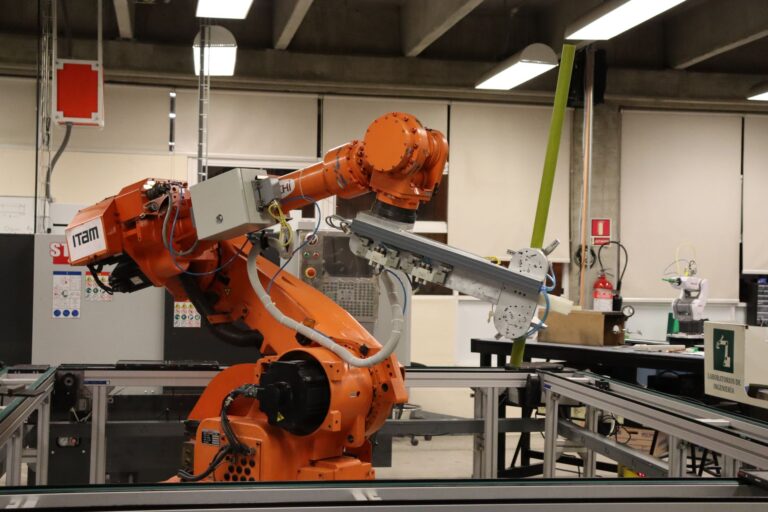
A traditional industrial robotic arm is designed for maximum speed and payload within a fenced,人-free work cell. It typically runs on a fixed program, repeats the same motion thousands of times per shift, and relies on light curtains, cages, or interlocked gates to keep workers at a safe distance while it operates. A collaborative robot, or cobot, is built around force and torque sensors that let it detect contact and stop or slow down before causing injury.
This sensing is what allows a cobot to work in the same space as a person without a cage, under safety standards such as ISO/TS 15066, which governs power- and force-limited collaborative operation. That safety architecture is also the main performance trade-off. The same sensors and lighter-duty motors that let a cobot stop safely on contact also cap its speed and payload compared with a caged industrial arm. On a bottling line, this translates directly into throughput: a fenced arm can move faster because it never has to anticipate a human hand entering its path.
Throughput and Line Speed: Where Robotic Arms Win
High-volume beverage bottling—soft drinks, water, beer, and mass-market spirits—runs on lines designed to move hundreds or thousands of containers per minute. At that pace, cycle time matters more than almost anything else, and caged industrial arms are built for exactly this kind of repetitive, high-speed motion. Industrial arms also carry heavier payloads without a speed penalty, which matters for case packing, palletizing full pallets of filled bottles, and handling glass containers that weigh more than plastic.
Because they don't need to sense and react to nearby people, their controllers can run motion profiles optimized purely for cycle time. The trade-off is flexibility and setup cost. A caged arm needs a dedicated safety perimeter, light curtains or interlocked fencing, and often a larger footprint than a cobot performing the same task. Changing the arm's job—say, from capping one bottle size to another—usually means reprogramming and sometimes retooling the end-of-arm gripper, work that a line typically schedules during a changeover window rather than on the fly.
Flexibility and Changeovers: Where Cobots Win
Craft breweries, specialty bottlers, and co-packers that run many small batches of different bottle shapes and sizes face a different problem: frequent changeovers, not raw speed. Cobots are generally easier and faster to reprogram for a new task, since many models support hand-guided teaching, where an operator physically moves the arm through a motion and the controller records it. Because cobots don't require a full safety cage, they can often be installed on an existing line with a smaller footprint and less construction disruption. This matters for plants retrofitting automation into a line that already has fixed conveyors, fillers, and labeling equipment in place, where cutting in a caged cell may not be physically possible.
Cobots also make sense for tasks that still benefit from a person working nearby—quality inspection, manual case assembly, or handling irregular products that a vision system occasionally misreads. A worker can intervene at the station without shutting down a fenced cell or triggering a safety stop that halts the whole line. The trade-off is speed and payload ceiling. A cobot handling a line running at bottling-industry volumes will typically become the bottleneck before a comparably priced caged arm would, which is why most plants do not deploy cobots on their fastest primary filling lines.
Matching the Robot to the Task on a Bottling Line
Different stations on a single bottling line can call for different robot types, and many bottlers mix both rather than standardizing on one. A practical way to decide is to map each station's required cycle time and payload against both robot classes' rated specifications before purchasing, since manufacturers publish these figures per model and they vary widely even within the "cobot" category.
- High-speed filling, capping, and primary packaging: typically a caged industrial arm, where line speed and repeatability dominate.
- Secondary packaging, case erecting, and palletizing at lower speeds: either type, depending on payload and available floor space.
- Final quality checks, label verification, or handling damaged/irregular containers: often a cobot, because a person may need to work alongside it.
- Low-volume or frequently changing SKUs (seasonal flavors, limited runs, co-packing for multiple brands): usually a cobot, for faster reprogramming between batches.
- New installations in older facilities with tight floor space: usually a cobot, to avoid the footprint of a full safety cage.
Cost and Safety Considerations Beyond the Robot Itself
Purchase price comparisons between cobots and industrial arms are misleading on their own, because the total installed cost includes safety infrastructure, integration, and programming support that differs sharply between the two. A caged industrial arm's total cost typically includes fencing, interlocks, light curtains, and sometimes a dedicated safety PLC, on top of the arm and controller.
A cobot's lower up-front safety cost can be offset by a lower top speed, meaning a plant may need more cobots, or a hybrid cobot-plus-fence setup, to match the output of one fast industrial arm—power- and force-limiting only removes the need for a cage when the robot is operating within its collaborative speed and force limits; running a cobot at reduced safety limits still requires a risk assessment under ISO/TS 15066, and some cobot applications are caged anyway when end-of-arm tooling or payload introduces hazards the robot's own sensors can't detect. Any deployment, cobot or caged arm, requires a documented risk assessment specific to the task, tooling, and product being handled—glass bottles, carbonated containers, and heavier case packs each introduce different pinch points, projectile risks, or crush hazards that a generic robot safety rating doesn't account for on its own.
Frequently Asked Questions
Can a cobot run at full industrial-arm speed if no one is nearby?
Some cobots support a reduced-safety "high-speed mode" when sensors confirm no person is in range, but this requires its own risk assessment and typically still falls short of a caged arm's top cycle speed.
Do cobots eliminate the need for safety fencing entirely?
Not always. A cobot's end-of-arm tooling, payload, or the product itself (glass, sharp caps, heavy cases) can introduce hazards the robot's force sensors don't cover, so some cobot stations are still partially guarded.
Is a mixed cobot-and-industrial-arm line a common setup?
Yes. Many bottling and packaging lines use caged arms for high-speed filling and palletizing while placing cobots at inspection, packaging, or changeover-heavy stations.