
The next dominant player in robotics could indeed emerge from factory automation, but not necessarily as a challenger to Nvidia. Instead, the more likely scenario is that Nvidia itself will consolidate its leadership by dominating the infrastructure layer that powers industrial robotics across manufacturing facilities worldwide. Nvidia CEO Jensen Huang made this vision explicit at GTC 2026, declaring that “every industrial company will become a robotics company,” signaling the convergence of physical AI and factory automation.
The company has already positioned itself at the center of this transformation through strategic partnerships with virtually every major industrial robotics manufacturer, including FANUC, ABB Robotics, KUKA, Yaskawa, Figure, Agility, and Universal Robots, while integrating its Isaac Sim platform with industrial simulation software that these companies depend on. However, the more nuanced answer is that factory automation may produce the next category leader—not necessarily in AI chips, but in robotics software, industrial digital twins, and application-specific automation solutions. While Nvidia provides the computational backbone, companies focused on the specific needs of manufacturing environments—from supply chain coordination to predictive maintenance—have the potential to become household names in the way that Nvidia has become synonymous with AI infrastructure. The capital flooding into robotics startups suggests investors believe there’s more than one billion-dollar opportunity emerging from this sector.
Table of Contents
- Why Factory Automation is the Proving Ground for Robotics Innovation
- The Challenge of Competing Against an Entrenched Nvidia
- Capital Influx Signals Market Maturation and Competition
- Real-World Manufacturing Applications Driving the Transition
- Technical Barriers and the Challenge of Scaling AI in Manufacturing
- Investment Opportunities Beyond Chip Manufacturers
- The Path Forward for Factory Automation and Robotics Innovation
- Conclusion
Why Factory Automation is the Proving Ground for Robotics Innovation
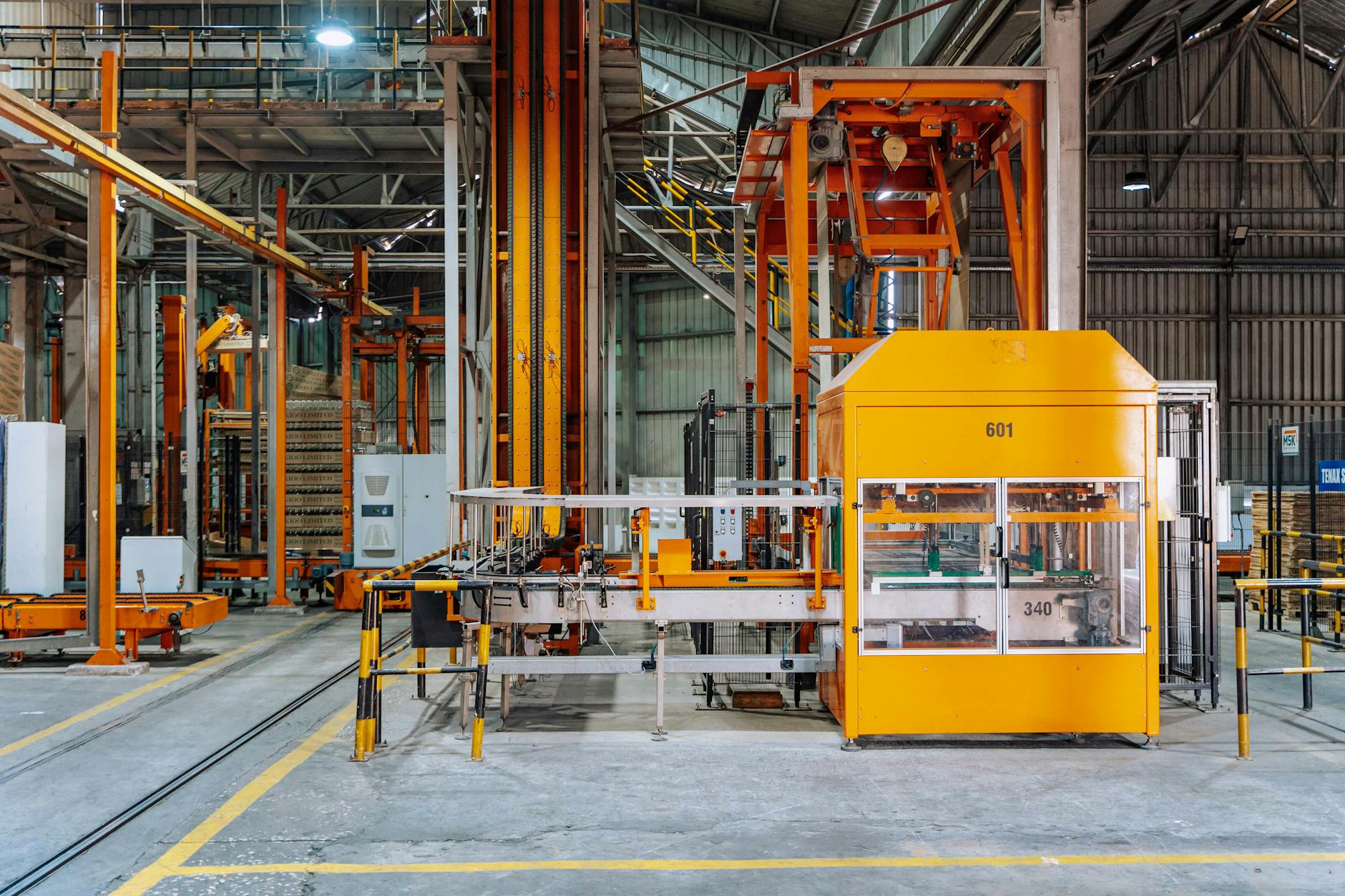
Factory automation represents the ideal testbed for robotics because it operates in controlled, repeatable environments where performance can be precisely measured and economic returns are immediately quantifiable. Unlike consumer robotics or exploratory research projects, industrial robots must demonstrate clear ROI, reliability at scale, and integration with existing manufacturing ecosystems. this harsh reality filters out speculative technologies and accelerates the development of genuinely useful solutions. Manufacturers like Toyota, TSMC, Foxconn, and Caterpillar are already using Nvidia’s Omniverse platform to build digital twins of their factories, creating virtual environments where robots can be trained, tested, and optimized before deployment in physical plants.
The advantage of factory automation as an innovation incubator is that it compresses the feedback loop. A consumer robotics company might wait years to understand if their product has product-market fit; a factory automation startup knows within weeks whether their solution improves throughput, reduces downtime, or cuts labor costs. This rapid iteration cycle accelerates technology maturation and attracts capital. Investors see measurable unit economics and repeatable sales processes, which is why Mind Robotics—a spinout from Rivian focused on industrial AI-powered robots—was able to raise $500 million in a Series A round in March 2026, co-led by Accel and Andreessen Horowitz. That kind of capital velocity indicates genuine belief in the near-term commercialization of factory robotics.
The Challenge of Competing Against an Entrenched Nvidia
While Nvidia’s dominance in AI chips is substantial, the robotics industry’s consolidation around its platforms also creates a significant moat that’s difficult to breach. Nvidia’s Omniverse ecosystem, Isaac Sim simulation tools, and partnerships with established robotics manufacturers create network effects that compound over time. Any company trying to displace Nvidia would need to offer not just faster chips, but an entire ecosystem—simulation software, training frameworks, partnerships with ABB, FANUC, and KUKA—that would take years and billions of dollars to replicate.
AMD released its MI350 series chips (including the MI355X in June 2025) positioned to rival Nvidia’s Blackwell B100/B200, with claims of 4x performance improvements, but AMD hasn’t yet built the equivalent robotics-focused partnerships and software ecosystem that would make it an immediate threat in factory automation applications. The real limitation here is that being the infrastructure layer provider—even if you’re exceptionally good at it—doesn’t guarantee you’ll capture the majority of value in the ecosystem. Historical precedent suggests that application-layer companies (like Figma in design, or Stripe in payments) often capture more value than infrastructure providers (like Nvidia capturing more than CPU makers ever did). This creates an opening for companies focused specifically on robotics software, fleet management, and factory-floor orchestration to emerge as the next major players, even if they ultimately rely on Nvidia’s chips as their foundation.
Capital Influx Signals Market Maturation and Competition
The venture capital landscape reveals where investors believe the next robotics leaders will emerge. Over 1,000 investors and 80+ top VC firms are actively focused on robotics, with mega-rounds becoming increasingly common. Skild AI, a company developing AI-powered robots for industrial settings, raised $1.4 billion in a single mega-round in early 2026, a signal that the market believes the winners in this space will be extremely large. RobCo, focused on AI-powered modular robots, raised $100 million in Series C funding led by Lightspeed Venture Partners.
These massive capital deployments suggest that investors expect the next generation of robotics leaders to emerge from companies founded in the last few years, not from incumbent robotics manufacturers trying to add AI capabilities. Institutional players like Khosla Ventures and Toyota AI Ventures (which manages a $200 million fund) are placing strategic bets on robotics companies, indicating that major corporations recognize they cannot innovate fast enough internally to keep pace with the robotics revolution. This creates an interesting dynamic: established manufacturers like Toyota and Caterpillar are simultaneously adopting Nvidia’s digital twin technology for their existing operations while funding startups that might disrupt their traditional robotics supply chains. The winners emerging from this capital surge will likely be companies that can solve specific, high-value problems in factory automation—whether that’s intelligent scheduling, predictive maintenance, or seamless integration across heterogeneous robot fleets.

Real-World Manufacturing Applications Driving the Transition
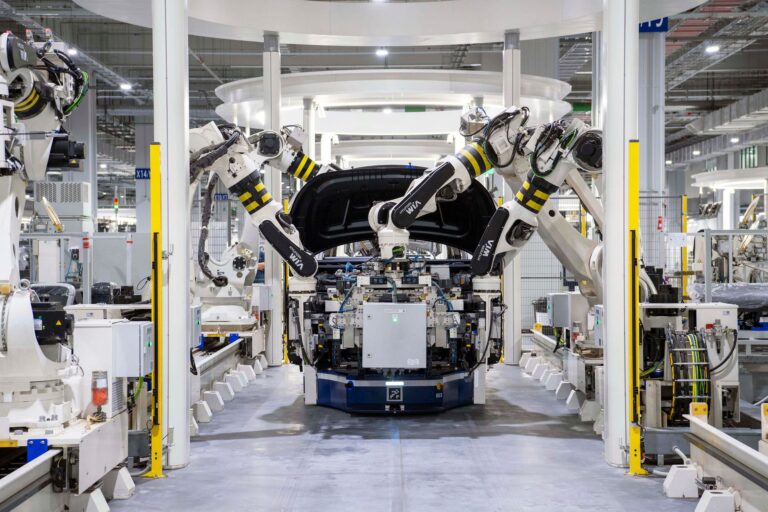
The theoretical case for factory robots is compelling, but the practical applications being deployed today show which technologies actually work at scale. Foxconn, one of the world’s largest contract manufacturers, is already using Nvidia Omniverse to simulate and optimize production lines before physical deployment. This allows Foxconn to run thousands of scenarios—different robot configurations, supply chain disruptions, demand variations—in virtual environments before committing capital to physical hardware changes. The same approach is being adopted by Lucid Motors and Wistron, manufacturers that have the most to gain from fully automated, AI-optimized production lines.
The comparison between traditional manufacturing automation and AI-powered factory optimization illustrates why this shift is inevitable. Traditional factory automation relies on hand-coded rules, predetermined sequences, and manual intervention when something goes wrong. An AI-powered factory, by contrast, can learn from continuous operation, adapt to variations in materials or demand, and predict failures before they occur. A manufacturer that implements predictive maintenance using AI can reduce unexpected downtime by 20-30%, an enormous advantage in competitive industries where margins are thin. This explains why manufacturers are willing to invest heavily in digital twins and robot-fleet orchestration software—the economic returns justify the investment.
Technical Barriers and the Challenge of Scaling AI in Manufacturing
Despite the momentum, significant technical challenges remain in deploying AI at scale in factory environments. Factory floors are messy, unpredictable places compared to the controlled environments where AI is typically trained. Lighting conditions vary, materials arrive with imperfections, and robots must coordinate with unpredictable human workers. A robot trained in simulation may perform poorly when deployed in a real factory, a problem known as the sim-to-real gap.
Companies like Nvidia are working to close this gap through techniques like domain randomization (training robots in thousands of slightly different simulated environments), but it remains an unsolved challenge for many applications. Another limitation is the data problem. AI models require enormous amounts of training data, and most factories don’t have years of operation logs in digitized, labeled format. Collecting, cleaning, and labeling factory data is expensive and time-consuming, which is why companies that can solve the data acquisition and labeling problem—turning raw factory footage or sensor streams into useful training data—have a significant competitive advantage. The warning here is that many robotics startups will fail not because their AI is inadequate, but because they underestimated the cost and complexity of deploying AI in real manufacturing environments.
Investment Opportunities Beyond Chip Manufacturers
The wave of capital flowing into robotics startups suggests that the biggest returns may come not from betting on Nvidia’s supremacy, but from investing in application-layer companies solving specific manufacturing problems. Consider that Mind Robotics’ $500 million Series A valuation implies the market believes the company could eventually reach multi-billion-dollar status—that’s not because robots are expensive to manufacture, but because the software and AI that optimizes robot deployment can be sold across thousands of factories. This is the software-scale-of-economics model that has worked for cloud computing, enterprise software, and now robotics.
Investors and manufacturers should also consider the modular robotics trend, where companies like RobCo develop reconfigurable robot systems that can be quickly adapted to different manufacturing tasks. This approach could bypass the traditional robotics manufacturer gatekeepers (FANUC, ABB, KUKA) by allowing factories to assemble and reconfigure robots without waiting for vendors to release new models. If modular robotics gains adoption, the companies that emerge as winners might not be traditional robotics manufacturers at all, but software platforms that coordinate heterogeneous robots and orchestrate complex manufacturing workflows.
The Path Forward for Factory Automation and Robotics Innovation
The convergence of AI, digital twins, and factory automation is creating an environment where innovations can be tested, validated, and deployed faster than at any previous point in manufacturing history. The next five years will likely see a significant shakeout in the robotics industry, where companies with clear paths to profitability and strong manufacturing relationships thrive, while those relying on speculative AI without real factory deployment falter. Nvidia’s role in this transformation will remain central—it’s unlikely any robotics company achieves scale without relying on Nvidia’s chips or software—but the most valuable companies may be those that build distinctive capabilities in domains Nvidia doesn’t own, such as factory fleet orchestration, supply-chain optimization, or human-robot collaboration.
The evolution of factory automation also suggests that the “next Nvidia” may not be a single company, but a constellation of winners across different layers of the robotics stack. One company might dominate factory optimization software, another might lead in modular robotics hardware, and a third might become the standard platform for collecting and processing factory data. This distributed ecosystem actually favors innovation more than a single dominant player would, as companies can focus on specific niches where they have genuine advantages rather than trying to compete across all segments.
Conclusion
The premise that the next Nvidia will emerge from factory automation contains a partial truth. Factory automation will indeed be the proving ground for robotics technology, and companies that solve critical manufacturing challenges will capture enormous value. However, the most likely scenario is not a single company displacing Nvidia, but rather Nvidia consolidating its infrastructure dominance while application-layer companies emerge as category leaders in factory robotics software and orchestration.
The $1.4 billion mega-round raised by Skild AI and the $500 million Series A for Mind Robotics signal that investors believe the biggest opportunities lie not in beating Nvidia at chips, but in building the software layer that orchestrates robots across millions of factory floors globally. For manufacturers, technology investors, and robotics entrepreneurs, the critical insight is this: the next decade of manufacturing innovation will be shaped by whoever can most effectively integrate AI, simulation, and real-world factory operations. That could be Nvidia itself, an unexpected startup, or more likely, a diverse set of companies each capturing value at different layers of the stack. The factories being built today with AI-optimized robots and digital twins represent the future, and the companies enabling that transformation—whether they build chips, software, or complete systems—will be the winners of the robotics revolution.