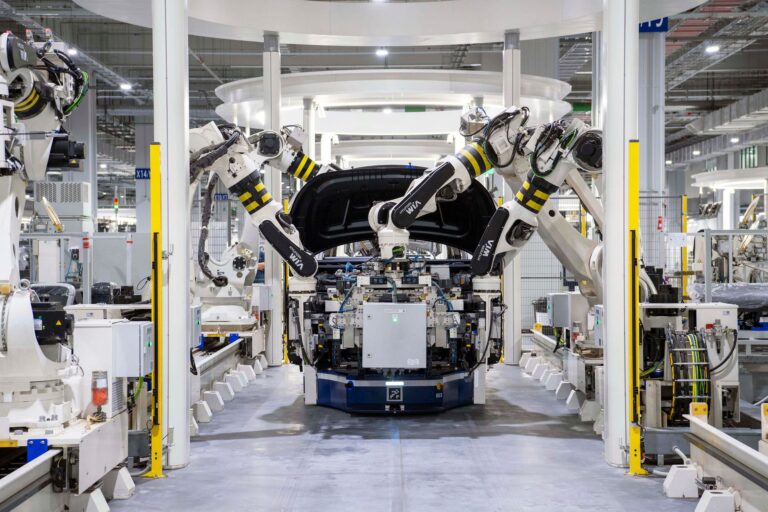

The bull case for ABB stock is not, despite the title, about global industrial robotics leadership. In fact, ABB agreed in October 2025 to sell its robotics division to SoftBank Group for $5.38 billion, a deal expected to close in mid-to-late 2026. The real investment thesis centers on ABB’s dominance in electrification and automation infrastructure, segments that are capturing far stronger margins and demand than the robotics business ever did. ABB’s first-quarter 2026 results demonstrate this shift: the company posted $8.7 billion in revenue (up 18% year-over-year), operational EBITA margins of 23.5% (up 320 basis points), and record order intake of 24% growth on a comparable basis.
The electrification segment alone surged 44% in order growth, driven by data center buildouts, electrical grid upgrades, and the energy transition. ABB’s strategic pivot away from commodity robotics and toward high-margin electrification and grid automation represents a fundamental strength, not a weakness. The robotics division generated $2.3 billion in revenue in 2024—only 7% of ABB’s total business—with an EBITA margin of 12.1%, well below the company’s group average of 18% or higher. With weak automotive demand and structural margin pressure, divesting robotics allows ABB to focus capital and attention on faster-growing, higher-margin businesses that align with secular trends reshaping global energy systems.
Table of Contents
- Why ABB Is Exiting Robotics, Not Leading It
- Electrification: The Real Engine of ABB’s Bull Case
- Motion and Automation Segments Sustain Growth Without Robotics Reliance
- Record Order Backlog and Future Revenue Visibility
- Free Cash Flow and Financial Strength Create Strategic Optionality
- Analyst Consensus and Valuation Context
- Secular Megatrends Provide Tailwind, Not Guarantee
Why ABB Is Exiting Robotics, Not Leading It
The robotics business, despite its historical prominence, became a strategic drag on ABB’s overall returns. ABB Robotics held a 14% global market share and carried a $1.5 billion backlog, yet margins remained compressed at 12.1%—far below what ABB’s electrification and grid businesses could achieve. Automotive manufacturing, which historically drove industrial robot demand, has faced tepid growth over the past five years, and the shift toward electric vehicles has actually reduced the complexity (and pricing power) of automotive assembly work.
By divesting robotics to SoftBank—a buyer with deep expertise in robotics and AI integration—ABB positions itself to compete aggressively in segments where it commands greater pricing leverage. This divestment decision reflects disciplined capital allocation. Instead of defending a low-margin commodity business, ABB can redeploy the $5.38 billion in proceeds toward organic growth investments, M&A in electrification, or shareholder returns. The comparison is instructive: Fanuc, the Japanese robotics competitor, trades on a price-to-earnings ratio of approximately 32x, while ABB trades closer to 18x—a significant valuation gap that reflects investor recognition that robotics is a lower-growth, lower-margin segment relative to grid and electrification infrastructure.
Electrification: The Real Engine of ABB’s Bull Case
Electrification revenue reached $4.6 billion in Q1 2026, up 21% year-over-year, and order growth surged 44% on a comparable basis. This segment is capturing exponential demand from three overlapping secular trends: the energy transition (renewable energy integration into grids), data center buildouts (driven by AI compute demand), and electrical infrastructure modernization (driven by aging grid assets and extreme weather resilience needs). A concrete example: data center operators are now the single largest growth driver for ABB’s electrification business, as each new hyperscale data center requires millions of dollars in electrical distribution, backup power systems, and grid connectivity infrastructure. Margin expansion in electrification is still underway, which creates upside for investors.
In the U.S. market, ABB noted that electrification margins are improving as price-cost gaps have begun to close. Management guided that this gap will shrink further in Q2 2026 and fully close by the second half of 2026, implying that electrification margins could expand materially from current levels. However, execution risk remains: supply chain constraints, labor cost inflation, and project-level pricing pressure could slow margin improvement. The lesson from Q1 is that revenue growth is outpacing margin expansion—growth of 21% does not directly translate to profit growth of 21%, and investors should monitor quarterly margin reporting carefully.
Motion and Automation Segments Sustain Growth Without Robotics Reliance
ABB’s Motion segment (which includes electric motors, drives, and automation for industrial processes) generated $2.1 billion in Q1 2026 revenue, up 18% year-over-year, while Automation (process automation, safety, and discrete manufacturing solutions) also reached $2.1 billion, up 16% year-over-year. Together, these segments provide diversified growth without reliance on the robotics business. Motion benefits from rising electrification trends (every electric motor replacement is an upsell opportunity), while Automation serves port operations, mining, food processing, and pharmaceutical manufacturing—sectors experiencing structural capacity expansion.
The growth profile for Motion and Automation is expected to remain in the high single-digit range going forward, according to management guidance. This is slower than electrification but more stable, as both segments serve essential infrastructure that cannot be deferred. A limitation investors should note: Automation margins have historically been lower than electrification, and the segment faces competition from specialized regional players. For example, Japanese manufacturers like Mitsubishi Electric have significant entrenched positions in process automation in Asia, which limits ABB’s pricing power in those markets.
Record Order Backlog and Future Revenue Visibility
ABB closed Q1 2026 with a record order backlog of $27.5 billion, providing approximately 18 months of revenue visibility based on current run rates. Total orders increased 24% on a comparable basis, the highest on record. This backlog insulates ABB from short-term cyclical downturns and gives the company pricing leverage as it executes large-scale projects. A specific example: a major electrical utility’s grid modernization project, once booked, remains locked in at contracted pricing for 12-24 months, allowing ABB to absorb supply chain cost increases through operational efficiency rather than price renegotiation.
However, order backlog also imposes execution risk. A $27.5 billion backlog must be fulfilled with correct project management, on-time delivery, and quality execution. Any major project delay or cost overrun can pressure near-term margins, which is why management commentary on backlog conversion and project execution matters more than headline backlog size. Additionally, backlog does not equal profit—a large backlog booked at low margins is not the same as a smaller backlog at high margins. Investors should compare ABB’s backlog-to-revenue conversion rates across quarters to assess whether execution is improving or degrading.
Free Cash Flow and Financial Strength Create Strategic Optionality
ABB generated $1.3 billion in free cash flow in Q1 2026, the strongest Q1 on record, while net income reached $1.3 billion, up 20% year-over-year, and earnings per share (EPS) grew 21% to $0.70. These metrics reveal a company generating robust cash that can be deployed for acquisitions, debt reduction, or dividends. The current dividend yield of 1.18% is modest, leaving room for dividend growth as cash flow accelerates further.
A key limitation is that free cash flow strength depends on working capital management, and high-growth businesses often experience working capital headwinds (inventory buildup, extended payment terms to customers). While ABB’s Q1 performance was strong, future quarters may not sustain identical cash generation if revenue growth accelerates faster than the company can collect cash from customers. The stock’s 52-week range of 45.29 to 86.48 CHF (Swiss francs) and recent all-time high of 108.95 CHF (June 2, 2026 closing) suggests the market has already begun pricing in strong cash generation expectations.
Analyst Consensus and Valuation Context
As of June 2026, ABB trades at a weighted average 12-month price target of 73.45 CHF, with analyst ratings split: five buy ratings and two sell ratings represent a neutral consensus overall. The stock’s current price of 81.28 CHF in Switzerland (ABBN on SIX) and approximately $98.50 on U.S. OTC markets (ABBNY) trades above the consensus price target, implying the market is pricing in execution risk or higher bull-case scenarios.
The analyst rating distribution—not strong consensus bullishness—suggests institutional investors view ABB as a solid operational performer but with limited near-term upside surprises. For context, the range of 12-month price targets spans 58.41 to 96.84 CHF, a spread indicating substantial disagreement about fair value. This wide range reflects uncertainty around the timing of the robotics divestment close, the magnitude of electrification margin expansion, and broader economic cyclicality risk to industrial spending.
Secular Megatrends Provide Tailwind, Not Guarantee
The ultimate bull case for ABB rests on three secular megatrends: the energy transition (renewable generation requires new grid infrastructure), electrification of processes (industrial facilities replacing hydraulic and fossil-fuel systems), and extreme weather resilience (grid hardening and redundancy). These trends are global, structural, and unlikely to reverse. A specific example illustrates the scale: the International Energy Agency estimates that the global electrical grid requires approximately $2 trillion in infrastructure investment through 2030 to integrate renewable energy and meet decarbonization targets. ABB’s electrification business is directly positioned to capture a meaningful share of this spending.
However, megatrends do not guarantee stock outperformance. Competitive intensity in electrification is rising, with players like Siemens, Schneider Electric, and Eaton also investing heavily in grid and electrification solutions. Currency headwinds (ABB reports in Swiss francs, which strengthens during risk-off periods) can pressure translated revenues for U.S. investors. next earnings are scheduled for July 16, 2026, which will provide updated guidance on whether Q2 and H2 2026 margin expansion materializes as management has guided.
- —