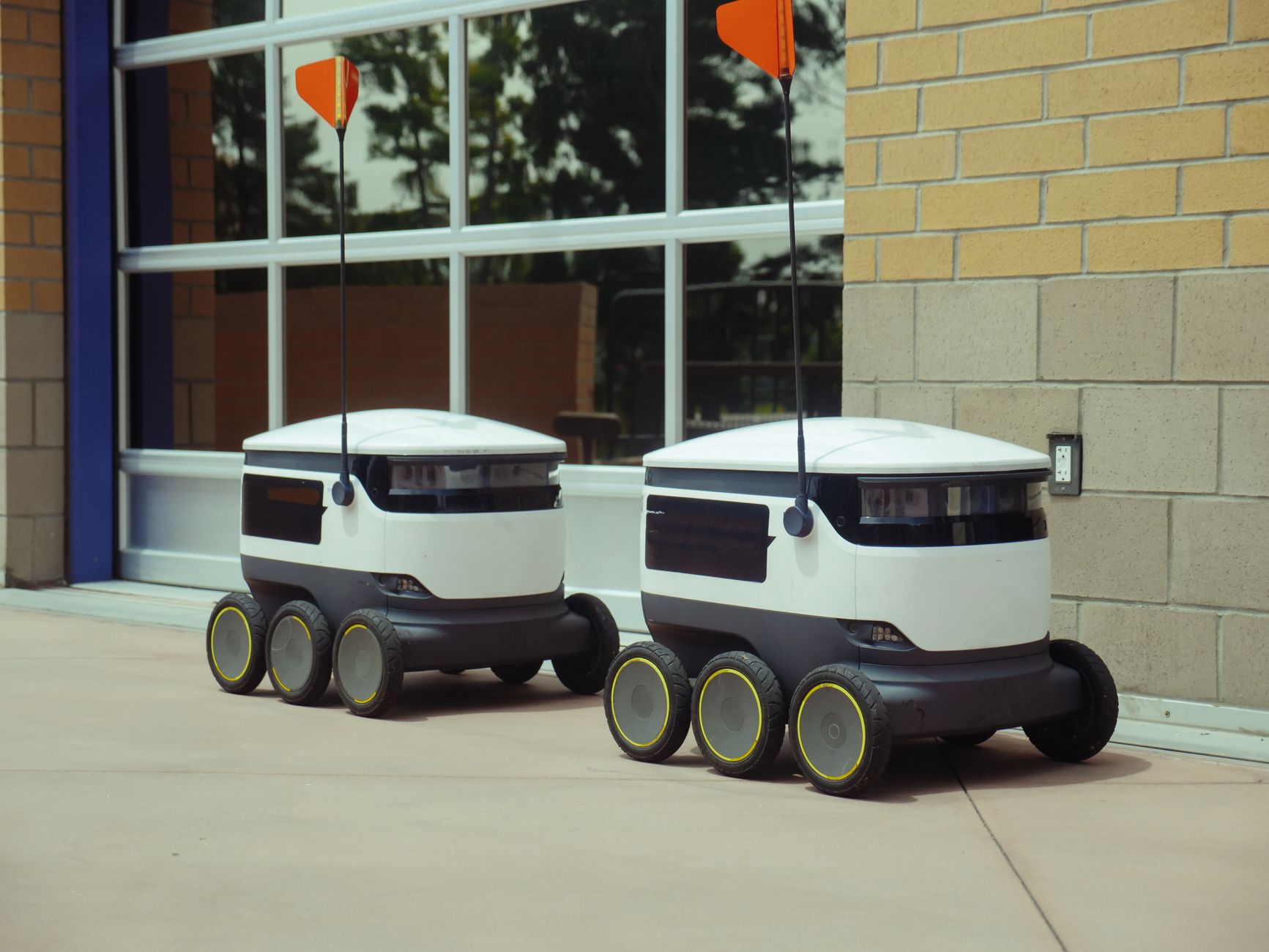

Yes, wheeled robotics forecasts show strong adoption and revenue growth, but "wheeled robotics platform industry" is not a consistently defined market. The closest measurable category is mobile robots, particularly autonomous mobile robots (AMRs) and automated guided vehicles (AGVs). Forecasts point to roughly 19% to 20% annual growth through 2030. However, buyers should compare market scope, deployment costs, and operational readiness before treating those figures as a business case.
Table of Contents
- What do the forecasts actually measure?
- How strong is current adoption?
- Which platforms are driving revenue?
- What could slow deployment?
What do the forecasts actually measure?
Interact Analysis focuses on material-handling mobile robots in manufacturing and logistics. It forecasts revenue rising from just under $5 billion in 2024 to $14 billion in 2030, an average annual growth rate of 19% in its January 2026 mobile-robots report. ABI Research uses a broader mobile-robot category.
Its forecast grows from $33.0 billion in 2026 to $68.9 billion in 2030, representing a 20.2% compound annual growth rate in its second-quarter 2026 market estimate. The $14 billion and $68.9 billion endpoints are therefore not competing estimates of identical sales. Interact covers material handling, while ABI's published figure includes a broader mobile-robot market.
How strong is current adoption?
The market has moved beyond pilots, especially in transportation and logistics. The International Federation of robotics recorded almost 200,000 professional service robots sold worldwide during 2024, a 9% increase from 2023. Transportation and logistics buyers purchased about 102,900 robots that year.
Roughly 81,800 were mobile intralogistics systems serving production supply, warehouses, and truck or pallet handling, according to the VDMA and IFR market release. Large deployments also demonstrate the potential scale. Amazon reported deploying its one-millionth robot across more than 300 fulfillment facilities and said its DeepFleet system aims to improve fleet travel efficiency by 10% in a June 2025 operations update.
Which platforms are driving revenue?
AMRs are the clearest revenue driver within ABI Research's broad forecast, contributing 53% of mobile-robot revenue in 2026. Unlike systems tied to a single physical route, AMRs are commonly evaluated as flexible fleet resources. Material handling is the most firmly documented opportunity.
The evidence covers production supply, warehouse movement, and truck or pallet loading and unloading rather than every possible wheeled robot application. Interact Analysis expects mobile-robot revenue growth to outpace fixed automation substantially. Its 19% annual forecast compares with only 2.4% for fixed automation, indicating that more investment may shift toward systems that can move through changing facilities.
What could slow deployment?
Fast market growth does not make individual projects simple. VDMA says mobile-robot deployments often require considerable customer investment and internal capacity, while Interact Analysis reduced its forecast by 12% after tariff uncertainty disrupted investment.
Before committing to a platform, buyers should verify: A forecast describes total market direction, not the return from a particular site. Buyers still need an application-specific case built around workload, deployment burden, and measurable operating improvements.
- Whether the forecast category matches the intended application.
- Whether the facility can support fleet integration and ongoing operations.
- Whether projected gains justify the required capital and staff capacity.
- Whether tariffs or other investment uncertainty could change timing.
- Whether a limited deployment can validate the workflow before expansion.