
Verify legged-robot claims by separating company release announcements from demonstrated capability, then checking research methods, trial conditions, failures, and applicable safety standards. In 2026, the strongest evidence combines a named physical robot, repeatable task metrics, disclosed limitations, and results outside ideal demonstrations. A release confirms that a company plans to deliver a product; a research paper shows what a system achieved under defined conditions. Neither alone proves broad commercial availability, general-purpose autonomy, or reliable performance in every workplace.
Table of Contents
- What does a company release actually establish?
- How should you read a research paper?
- Which test conditions change the result?
- What warnings count as red flags?
- How do standards fit the decision?
- Frequently Asked Questions
What does a company release actually establish?
Company announcements provide evidence about production plans, deliveries, and deployment commitments. Boston Dynamics announced on January 5, 2026, that production Atlas humanoids would ship to Hyundai and Google DeepMind, with all 2026 deployments already committed.
That establishes a release and planned deployments, not broad commercial availability. Boston Dynamics' January 5, 2026 announcement Read release language literally: A release becomes more useful when it identifies the robot version, customer or site, deployment timing, and intended task. It becomes less useful when a polished demonstration carries the whole claim without those details.
- "Production" addresses manufacturing status.
- "Ship" addresses planned delivery.
- "Deployment" identifies an intended operating site or partner.
- "All units committed" describes allocation, not open purchasing.
How should you read a research paper?
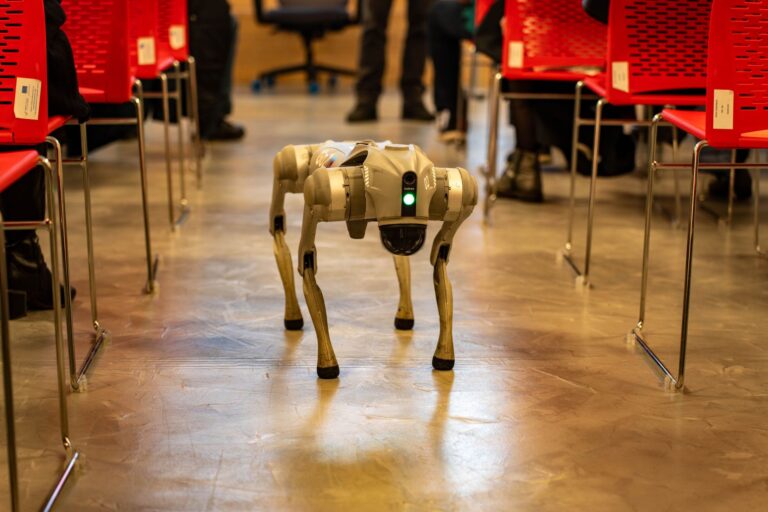
A paper defines a test. Start with the physical platform, environment, task, number of trials, success definition, and human involvement. Then ask whether the result measures a narrow capability or a broad one. The SLIM system reported nearly 80% success across 400 real-world episodes using a Unitree Go1, an arm, and a wrist camera.
Its task involved searching for cubes, grasping them, and transporting them to baskets. The result supports performance on that defined task, not general-purpose autonomy. The SLIM research paper Comparisons also need their test conditions. SLIM compared its system with an expert teleoperator using the same observation stream and allowing practice. Therefore, "1.5× faster than teleoperation" describes that study-specific benchmark, not a general claim that legged robots outperform humans.
Which test conditions change the result?
Legged robots can face conditions that a clean laboratory video does not reveal. NIST identifies slippage, uneven floors, dynamic obstacles, vibration, changing loads, and forced relocalization as recurring problems in localization testing. A credible claim should show how performance changes across those disturbances. NIST's mobility performance project Look for evidence that separates walking from completing useful work.
A robot may remain upright yet fail to localize, manipulate an object, communicate reliably, or recover from an interruption. The important question is whether the system completes the target task under realistic disturbances. NIST's response-robot methods cover mobility, manipulation, sensing, energy, communications, human-robot interaction, logistics, and safety using statistically significant data. Buyers can use those categories to request repeatable task metrics instead of relying on edited footage or speed records. NIST's response-robot performance standards project.
What warnings count as red flags?
Treat a product disclaimer as part of the evidence, not as fine print to ignore. Unitree's current G1 page warns that some advertised functions remain under development, requires users to maintain a safe distance, and tells buyers to understand humanoid-robot limitations. Those warnings weigh against treating demonstration features as mature capabilities.
Unitree's G1 product page Common red flags include: The 2025 legged-robot survey and original papers identify sim-to-real transfer—the move from simulation to physical hardware—as a continuing research problem. Evidence should therefore name the physical robot, terrain, trial count, failures, resets, human intervention, and whether results came from simulation or hardware. The Frontiers survey.
- A headline capability shown without trial counts or failure rates.
- A result that omits resets, human intervention, or teleoperation.
- A speed record without the terrain, load, or task definition.
- A simulation result presented as if it were a hardware deployment.
- A safety claim that names a standard without identifying its scope.
How do standards fit the decision?
A standards reference is meaningful only when its category matches the robot and use case. ISO 13482 covers earthbound personal-care robots and human-contact hazards, but excludes industrial, medical, military, flying, waterborne, and faster-than-20-km/h robots.
A statement that a robot is "ISO compliant" needs the applicable category and scope. ISO 13482 For a purchasing decision, build a claim record with four fields: the exact claim, its source, the test conditions, and the limitation. Then compare the record with the job the robot must perform, including terrain, payload, operating distance, human proximity, recovery procedures, and acceptable failure rate.
Frequently Asked Questions
Does a company release prove that a robot is widely available?
No. It can establish production, planned shipping, or committed deployments without establishing broad commercial availability.
Does an impressive research result prove general-purpose autonomy?
No. A result applies to the defined robot, task, environment, and comparison method used in the study.
What should a buyer request before accepting a performance claim?
Request the physical platform, terrain, trial count, success definition, failures, resets, human intervention, and safety-standard scope.
You Might Also Like
- How to Verify Exoskeletons Robotics Claims in 2026: company releases and research papers, Evidence, and Red Flags
- How to Verify Education Robotics Claims in 2026: company releases and research papers, Evidence, and Red Flags
- How to Verify Construction Robotics Claims in 2026: company releases and research papers, Evidence, and Red Flags