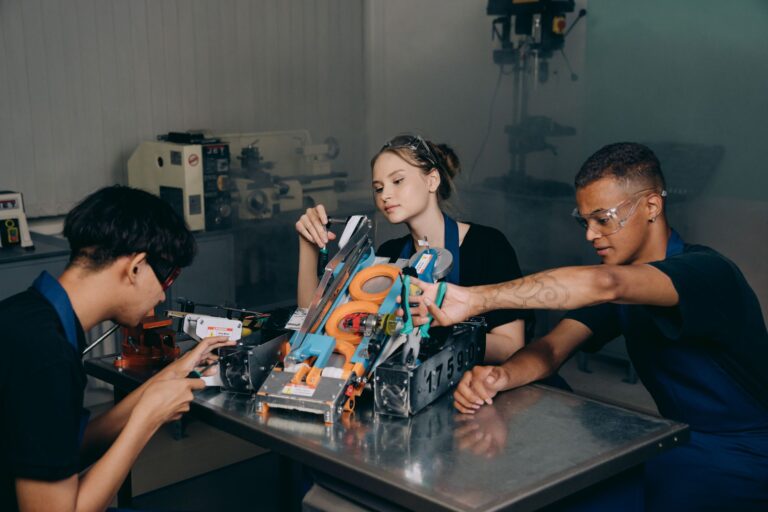

Startups test automation hardware before mass production by building small batches of prototypes and running them through functional, stress, and real-world pilot tests. They revise the design after each round before paying for tooling and volume manufacturing. Automation hardware here means physical devices used to sense, move, or control work, such as controllers, actuators, grippers, conveyors, and mobile robots. For a startup, testing must catch wiring errors, software faults, wear problems, and usability issues while changes are still cheap.
Table of Contents
- What does bench testing prove first?
- How do limited pilot deployments help?
- How do teams check reliability and safety?
- What must change before mass production?
What does bench testing prove first?
Bench testing checks whether each unit works as designed under controlled conditions. Engineers power the device, run its basic motions, and confirm sensors, motors, connectors, and firmware respond correctly. A second step compares performance against the product requirements. Teams measure accuracy, speed, payload, noise, heat, and power draw during repeated cycles.
Failures at this stage usually point to component choice, assembly error, or firmware logic. Startups often build simple fixtures to repeat the same test many times. A fixture is a fixed mount or jig that holds the device in place. Consistent fixturing makes results comparable across design revisions.
How do limited pilot deployments help?
Pilot deployments place a small number of units in real workplaces for supervised use. A warehouse, farm, lab, or factory cell exposes problems that never appear on a bench, such as dust, vibration, poor lighting, and operator workarounds.
Good pilots have clear boundaries. The startup defines the task, shift length, support plan, and success measures in advance. Engineers visit often, log failures, and watch how workers install, clean, reset, and troubleshoot the machine.
- Set one job for the pilot unit to perform
- Track uptime, jams, false stops, and operator interventions
- Record setup time and common handling mistakes
- Freeze the test design long enough to gather useful data
How do teams check reliability and safety?
Reliability testing repeats motion, loading, and environmental stress beyond normal use. Teams may run actuators for thousands of cycles, shake enclosures, spray water or dust, and cycle power to find weak cables, fasteners, seals, and solder joints. Safety checks run alongside reliability work. Engineers review pinch points, sharp edges, hot surfaces, stored energy, emergency stops, and failure behavior when power or communications drop.
Guards, interlocks, labels, and software limits often change after these reviews. Startups also test serviceability because downtime is costly for automation buyers. Replaceable wear parts, clear cable routing, accessible fasteners, and diagnostic messages reduce repair time. A design that is hard to open, clean, or calibrate will create support costs at scale.
What must change before mass production?
Design for manufacturing turns a working prototype into a product that factories can build consistently. Teams reduce part count, choose standard fasteners and connectors, set tolerances, and confirm suppliers can deliver key parts at the needed quality. Pre-production builds then verify the factory process itself. A small run on production tooling and fixtures reveals assembly mistakes, missing instructions, test gaps, and variation between units.
Each unit should pass the same acceptance test before shipment. Documentation is part of the product at this point. Clear assembly drawings, wiring diagrams, test procedures, spare-parts lists, and user guides prevent repeat errors. Startups that skip this step often find that a design that worked in the lab drifts once more hands and suppliers are involved.