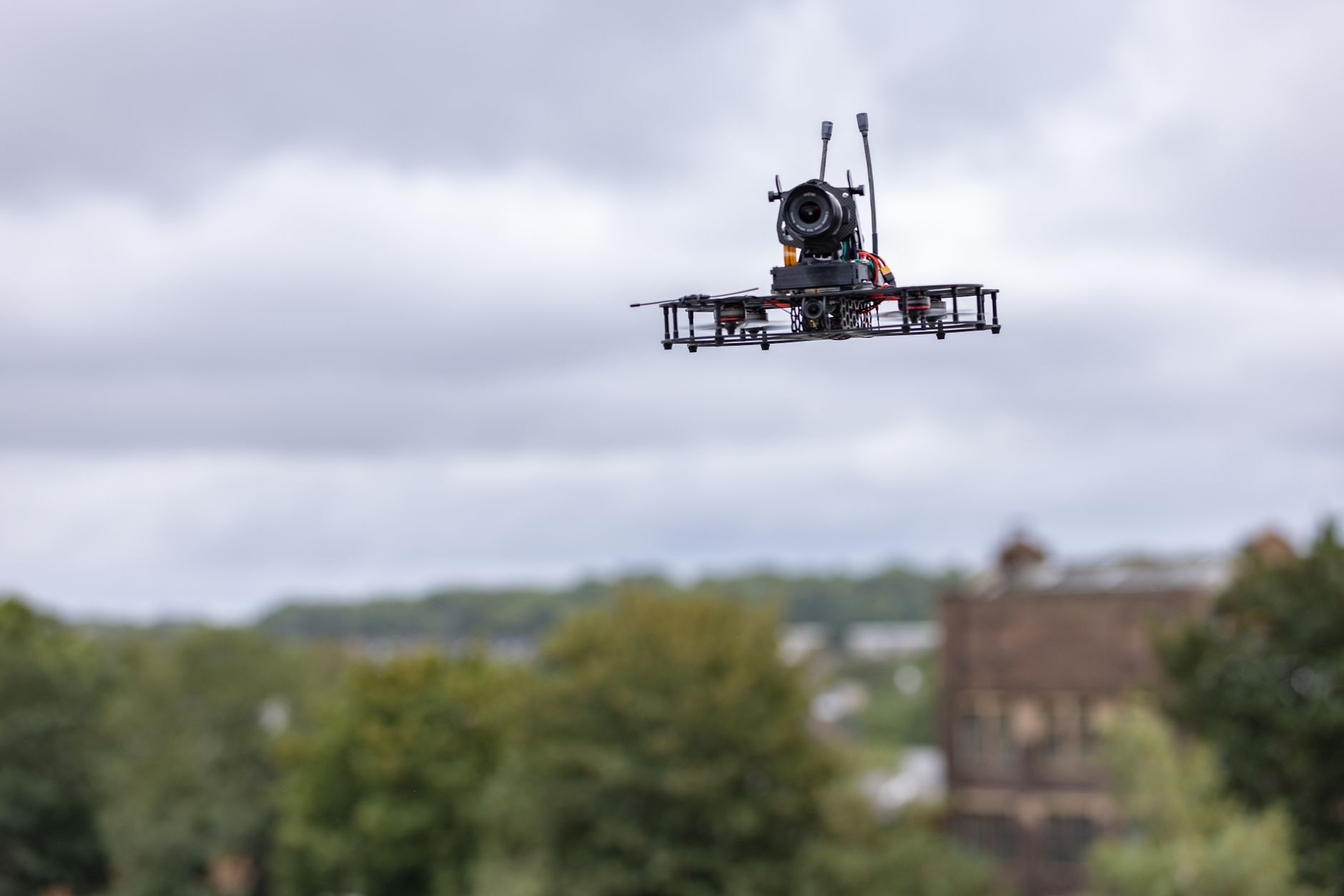

Axon Vision’s announcement of AI-assisted counter-drone system testing marks a significant milestone in the effort to integrate machine learning into autonomous threat detection at scale. The company’s work in the Czech Republic represents one of growing number of initiatives to move counter-drone capabilities from military-only applications into broader security contexts. Such testing programs are critical because they generate real-world performance data on how AI detection systems perform against actual drone signals, environmental interference, and operational constraints that controlled laboratory settings cannot replicate.
The integration of artificial intelligence with counter-drone hardware addresses a fundamental challenge in modern airspace security: the proliferation of commercial and unauthorized unmanned aerial vehicles has outpaced the deployment of effective detection methods. Traditional radar and signal-detection systems often struggle with small drones, false-positive rates, and the computational overhead of distinguishing legitimate commercial drones from potential threats. An AI-integrated approach promises to filter noise more intelligently and identify patterns that humans or basic algorithms might miss.
Table of Contents
- How Does AI Integration Improve Counter-Drone Detection?
- Technical Limitations and False-Positive Challenges
- Real-World Testing Environments and Their Value
- Integration Challenges in Operational Deployment
- Regulatory and Operational Compliance Issues
- Current Industry Applications and Deployment Models
- Implications for Counter-Drone System Evolution
How Does AI Integration Improve Counter-Drone Detection?
AI systems excel at pattern recognition across noisy data streams, which is precisely what counter-drone systems encounter in real airspace. Where a conventional detection system might trigger alerts on every radio signal in a given spectrum band, an AI model trained on thousands of drone signatures can distinguish between background interference and genuine unmanned aircraft. This capability becomes more valuable in urban environments or near airports where legitimate drone activity, commercial Wi-Fi, cellular signals, and even weather radar all compete for attention on the same frequencies.
The testing phase matters because it moves the system from theoretical capability into observable performance. A system trained on laboratory-generated drone signals must prove itself against the messier reality of actual airspace. Variables like reflections from buildings, interference from power lines, and seasonal atmospheric conditions all affect how well the AI maintains its discrimination accuracy. The Czech Republic’s terrain and infrastructure composition would have provided a particular test environment for validating whether the system generalizes beyond its training scenarios.
Technical Limitations and False-Positive Challenges
One persistent obstacle in AI-driven detection systems is balancing sensitivity and specificity. A system configured to catch every possible drone signal will generate false alarms from legitimate sources, exhausting operators and degrading trust in the system. Conversely, a system tuned to minimize false positives risks missing actual threats. This tradeoff affects every machine learning application in security, and counter-drone systems are no exception. Even well-trained models may struggle with novel drone designs, unusual flying patterns, or adversarially crafted signals designed to evade detection.
Data quality represents another fundamental constraint. AI models are only as reliable as the data they were trained on, and the drone landscape evolves continuously. Commercial manufacturers release new models regularly, and adversaries modify drone designs specifically to avoid detection. This means counter-drone AI systems require continuous retraining and validation against emerging hardware and tactics. A system deployed successfully today might find its accuracy degrading within months as the operational environment changes. The testing program itself likely revealed scenarios where the AI performed poorly, pointing to gaps that require additional model refinement.
Real-World Testing Environments and Their Value
Operating counter-drone systems in actual airspace—even in a controlled testing program—generates data that no simulation can fully replicate. Real radio propagation includes multipath reflections, localized interference spikes, and environmental factors that simulators approximate but never perfectly capture. The Czech Republic, as a Central European location with mixed urban, industrial, and rural infrastructure, provides a particular spectrum environment against which to validate performance. Different regions have different licensed wireless usage patterns, different electromagnetic environments, and different drone operation patterns, so testing in multiple geographies strengthens confidence in system robustness.
Testing also surfaces integration challenges between the AI detection engine and the broader counter-drone system. Detection is only the first step; a complete system must locate the drone, classify its type or threat level, and potentially trigger countermeasures or alerts. The AI component may perform perfectly in isolation yet create bottlenecks or latency issues when integrated with direction-finding hardware, RF sensors, and operator interfaces. Field testing reveals these friction points before full deployment.
Integration Challenges in Operational Deployment
Integrating AI into existing counter-drone architectures requires solving both technical and organizational problems. A security operation may already depend on human operators making final threat-assessment decisions. Adding an AI layer means retraining personnel to interpret and trust machine learning outputs, understanding when AI recommendations should override human judgment and when they should not. This human-in-the-loop dynamic is far more complex than simply deploying a detection algorithm.
The comparison to air defense systems more broadly illustrates this challenge. Military air defense has used automated detection for decades, yet operators remain in critical decision-making roles because the cost of a false positive or false negative is high. Counter-drone systems face the same reality, albeit at a smaller scale. Axon Vision’s system likely incorporates multiple layers of human review and confirmation, which limits the pure speed advantage that AI automation theoretically provides. The real benefit may lie in reducing operator fatigue and improving consistency rather than eliminating human judgment entirely.
Regulatory and Operational Compliance Issues
Counter-drone systems operate in a gray zone between security necessity and regulatory constraint. Many jurisdictions have rules restricting the use of RF jamming or other active countermeasures against drones, even when those drones pose security threats. This means detection and classification systems must often feed into a decision-making process that involves law enforcement or military coordination before any action is taken. An AI system that generates false positives in such an environment does not merely waste resources—it potentially triggers unnecessary escalation procedures and regulatory scrutiny.
Privacy and spectrum rights present additional complications. An AI-powered detection system that constantly monitors wireless signals in a populated area may inadvertently capture evidence of other wireless activity unrelated to drones. The legal and ethical boundaries of such monitoring vary by jurisdiction. Testing in the Czech Republic likely included evaluation of how the system handles these compliance requirements, ensuring that its detection methods do not stray into illegally intercepting civilian communications or monitoring protected spectrum without authorization.
Current Industry Applications and Deployment Models
Several security sectors now deploy counter-drone systems: airports, military installations, border protection agencies, and critical infrastructure operators. AI integration is particularly valuable at airports, where hundreds of legitimate aircraft operations occur daily and the detection system must distinguish authorized from unauthorized airspace use while processing enormous amounts of radar and radio data. Similarly, border security agencies benefit from AI systems that can identify patterns of unauthorized drone operations while filtering routine cross-border civilian activity.
The business model matters for deployment. A system offered as software running on existing hardware has lower adoption barriers than one requiring new infrastructure. Testing in a field environment allows vendors to identify which parts of their system are truly hardware-dependent and which could be implemented as software updates or retraining cycles on customer hardware already in place.
Implications for Counter-Drone System Evolution
Successful field testing validates the approach and often points toward the next generation of questions. Having confirmed that AI-integrated detection works in a real environment, researchers and developers typically shift focus to questions like: Can the system adapt to new drone designs without full retraining? How does performance degrade gracefully as computational resources decrease? Can multiple counter-drone systems share threat intelligence and learn from each other across installations? The test in the Czech Republic likely answered some of these questions while opening others.
Field data becomes valuable intellectual property for Axon Vision and its partners, informing both product refinement and the technical foundation for subsequent versions. For the broader counter-drone industry, successful demonstration of AI integration at this scale serves as proof that the technology can move beyond laboratory conditions into operational reality, even if each deployment environment introduces its own unique challenges.
- —