
The autonomous last-mile delivery market is splitting into two distinct investment paths: pure robotics specialists building physical delivery platforms, and established food delivery giants integrating autonomous fleets into their existing operations. Robotics-focused plays like Serve Robotics, Starship Technologies, and newly public Agility Robotics offer direct exposure to the technology layer, while platforms like DoorDash and Uber Eats provide diversified revenue streams with autonomous delivery as a margin-expanding component. The choice depends on your risk tolerance, time horizon, and conviction about whether autonomous delivery’s economics will eventually favor specialized hardware companies or established logistics networks.
The timing matters because the market is accelerating. The autonomous last-mile delivery market is projected to grow from $38.01 billion in 2025 to $49.23 billion in 2026, with forecasts reaching $137.7 billion by 2030—a compound annual growth rate of 29.3 percent. Within that, the autonomous delivery robots market itself is smaller but faster-growing, valued at $1.33 billion in 2026 and forecast to reach $3.27 billion by 2031 at a 19.74 percent CAGR. For investors deciding between a pure robotics play and a food delivery platform bet, these numbers tell you the market isn’t abstract—it’s already large, profitable in pockets, and expanding rapidly.
Table of Contents
- Who’s Leading the Robotics-First Autonomous Delivery Play?
- The Private Robotics Giants Still Chasing Scale
- Starship Technologies: The Deployment Benchmark
- Food Delivery Platforms as Autonomous Delivery Acquirers
- The Economics That Matter Most
- Serve Robotics as a Stock Proxy
- The Overall Robotics Sector Backdrop
Who’s Leading the Robotics-First Autonomous Delivery Play?
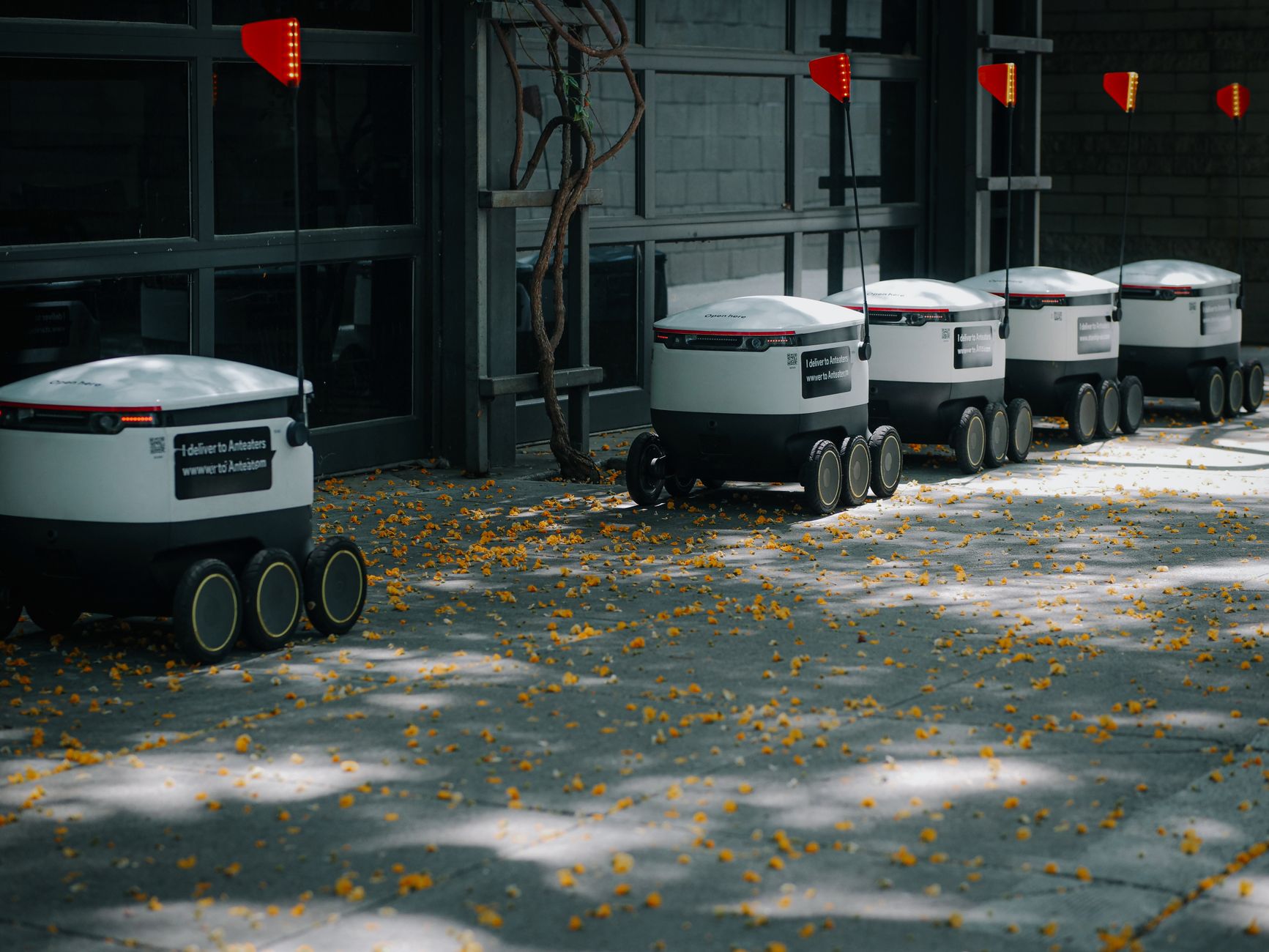
Serve robotics represents the most accessible pure-play autonomous delivery robot stock. The company had deployed 2,000 robots across 44 cities as of mid-2026, with fleet revenues growing from roughly $200,000 to nearly $2 million in the first quarter of 2026 alone. On July 14, 2026, the stock traded at $5.85 with a market cap of $450.7 million, though it had declined 25.3 percent over the prior three months—a reminder that robotics stocks experience volatility as deployment momentum fluctuates. Serve’s partnership with Uber Eats across seven major markets (Los Angeles, Miami, Dallas-Fort Worth, Atlanta, Chicago, Fort Lauderdale, and Alexandria, Virginia) gives it distribution without the burden of building a consumer-facing platform. The risk with Serve is unit economics and scale.
The company is profitable on a per-delivery basis—autonomous sidewalk robots reduce per-delivery costs by up to 40 percent compared to human couriers—but profitability at fleet scale depends on maintaining high deployment density and utilization rates. A slowdown in merchant adoptions or a single major incident could pressure margins or force fleet reductions, which would immediately crater the stock price given the company’s limited revenue base. Agility Robotics took a different route, going public in 2026 through a merger with Churchill Capital Corp XI, marking the first major humanoid robotics IPO. Humanoid robots have broader applications than sidewalk delivery, including warehouse fulfillment and manufacturing, which diversifies the revenue opportunity but also means Agility’s stock price is less directly correlated to last-mile delivery performance. Boston Dynamics, which filed its confidential S-1 in May 2026 with an expected public listing by Q4 2026, similarly positions itself as a general-purpose robotics player rather than a last-mile specialist.
The Private Robotics Giants Still Chasing Scale
Three of the most well-capitalized autonomous delivery startups remain private but represent the bulk of actual deployed robots. Nuro has raised $2.1 billion at an $8.6 billion valuation and has hundreds of Level 4 autonomous vehicles operating in California, Texas, and Arizona—these are not small sidewalk robots but autonomous vans capable of handling larger orders. Figure AI, building general-purpose humanoid robots, sits at a $39 billion valuation. Apptronius (presumed to be the figure being referenced) has a $5.5 billion valuation and $350 million raised, focusing on humanoid robots for logistics.
The challenge with investing in private robotics companies is timing. Many of these startups will eventually go public, but when they do, their valuations may be substantially lower than current paper values. Private market valuations often reflect venture capital sentiment and available capital rather than demonstrated unit economics. Consider that Nuro, despite raising $2.1 billion and deploying hundreds of vehicles, remains private—a signal that the path to profitability, even at scale, is not straightforward enough to attract IPO-ready valuations yet. For equity investors, waiting for a public listing means accepting the risk that valuations compress during the IPO process.
Starship Technologies: The Deployment Benchmark
Starship Technologies has become the deployment leader by pure volume. As of April 2026, the company completed 10 million deliveries, operating 3,000 robots across 300 locations in 8 countries. The robots have completed 200 million road crossings, averaging 125,000 crossings per day. In Finland, Starship has achieved 20 percent market penetration for grocery delivery—perhaps the clearest proof point that autonomous delivery can penetrate mainstream consumer behavior, not just serve early adopters.
Starship’s unit economics are compelling: the company delivers groceries at a $3 to $4 lower cost per delivery than traditional courier fulfillment. That margin advantage is durable because autonomous delivery scales with grid density—the more deliveries a robot fleet completes in an area, the faster the capital is paid back. Starship remains private, but when the company eventually files an S-1, the deployment data and repeat consumer adoption in Finland will carry more weight than a pitch deck. The major risk is that regulatory changes—stricter rules around robot operation on sidewalks, insurance requirements, or liability frameworks—could make current deployment models uneconomic. Early adopters in permissive markets like San Francisco and Helsinki have built valuations on environments that may not replicate globally.
Food Delivery Platforms as Autonomous Delivery Acquirers
DoorDash launched Dot, its own autonomous delivery robot, with an inaugural delivery in Fremont, California on March 5, 2026, and expanded to the Phoenix metro area by mid-year. Dot reaches speeds up to 20 mph and uses an all-electric design—not fundamentally different from Starship’s approach, but built and controlled by DoorDash rather than a third party. This is a critical difference. DoorDash can integrate robot deliveries into surge pricing, customer targeting, and merchant economics in ways that an independent robot operator cannot. If a Dot delivery costs DoorDash $1.50 to execute and a human courier costs $4, DoorDash captures the $2.50 spread; Starship, by contrast, captures spread only at the robot-operator level, leaving the platform with conventional margins.
Uber Eats took a partnership approach, launching a global collaboration with Starship Technologies where robots operate at Level 4 autonomy and can complete deliveries in under 30 minutes for distances up to 2 miles. The partnership hedges Uber’s bet—it gets autonomous delivery without building the robots internally, but it loses control over robot utilization and pricing. Coco Robotics, launched with Uber Eats in San Jose in April 2026, represents a third model: partnered robot operator, specific to Uber. The fragmentation here matters for investors. If you hold DoorDash stock, you own Dot’s upside and downside directly. If you hold Uber, you own partnership upside but with diminished leverage if autonomous delivery becomes dominant.
The Economics That Matter Most
Over 60 percent of delivery costs are attributable to the last mile—driver time, vehicle fuel, and the labor of completing short, dispersed routes. Autonomous robots eliminate the driver, which is why autonomous sidewalk robots reduce per-delivery costs by up to 40 percent. That savings multiplies across a large fleet. For context, the global food delivery market is valued at $650 billion, and if autonomous robots can penetrate even 20 percent of that market at a 40 percent cost reduction, the economic windfall is enormous. But that assumes adoption, regulatory approval, and consumer acceptance converge simultaneously.
Consumer expectations are already aligned with autonomous benefits. Eighty percent of consumers expect same-day delivery; 77 percent want orders within 2 hours; 98 percent say delivery experience impacts brand loyalty. These are not niche preferences—they are the operating baseline in urban markets. Autonomous robots deliver faster and cheaper, which satisfies the speed expectation and enables platforms to expand same-day delivery into lower-revenue-per-order geographies. The risk is that regulators crack down on sidewalk robot operations before consumer habit is established in enough markets. A single high-profile incident—a robot causing a collision with a child, for example—could trigger liability rules that make autonomous sidewalk operations uneconomic even with a 40 percent cost advantage.
Serve Robotics as a Stock Proxy
For investors who want autonomous delivery exposure without the diversification risks of food delivery platforms, Serve Robotics is the most direct play. The company’s stock price has already absorbed significant volatility—down 25.3 percent in three months—which means some of the skepticism is priced in. The P/E ratio of -2.89 reflects that the company is not yet profitable on a GAAP basis, but that is expected for a firm in deployment scale-up phase. What matters for Serve shareholders is whether fleet revenue continues to grow at the rate it did in Q1 (from $200K to nearly $2M quarterly), and whether the company can maintain or expand margins as utilization scales.
Serve’s partnership with Uber Eats is double-edged. On one hand, Uber’s scale and merchant relationships accelerate robot deployments. On the other hand, if Uber decides to prioritize Uber Eats’ own robotics projects or shift volume to cheaper alternatives, Serve’s revenue could stall. The company has no direct control over demand or pricing beyond its service agreement with Uber—that concentration risk is significant for a small public company.
The Overall Robotics Sector Backdrop
The broader robotics sector is expected to grow from $76 billion in 2023 to $218 billion by 2030, a 14 percent compound annual growth rate. Autonomous last-mile delivery represents a slice of that market, and within that slice, humanoid and specialized autonomous vehicles are displacing traditional logistics labor in specific geographies. For investors, the question is whether to bet on the slice (pure autonomous delivery) or the whole market (robotics broadly). Agility Robotics and Boston Dynamics offer broader exposure, but their stock prices will respond to progress across all robotics verticals, not just delivery.
Serve and Starship (if it goes public) offer concentrated exposure to last-mile economics but carry concentration risk if regulatory or competitive pressures narrow that market. As of mid-2026, the autonomous delivery market had proven demand (10 million Starship deliveries, 2,000 Serve robots deployed across major metros, active partnerships with Uber and DoorDash) and unit economics that work in high-density urban geographies. The constraint now is regulatory clarity and consumer habit formation at scale. Investors choosing between robotics leaders and food delivery platforms are essentially choosing between betting that autonomous delivery becomes the dominant fulfillment mode (favoring Serve and future Starship IPOs) or that autonomous delivery becomes a margin-enhancing tool for incumbent platforms (favoring DoorDash and Uber). The data suggests both are happening, but at different speeds in different markets.