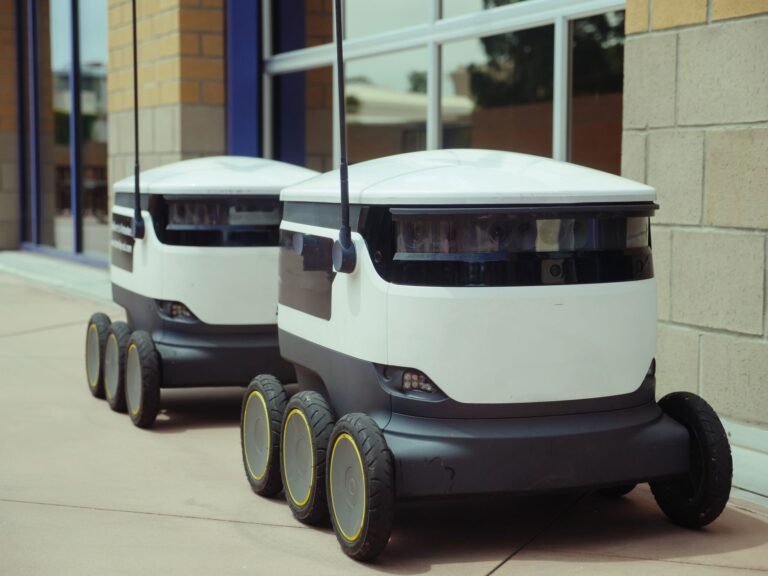

GFAI, or Guardforce AI Co., Limited, functions as a threat detection intelligence platform for robotic security systems—much like how Palantir integrates disparate data sources to reveal hidden patterns. The company has deployed autonomous robots equipped with AI-driven threat detection capabilities across critical infrastructure worldwide, including hospitals, supermarkets, transportation stations, and government facilities. These robots operate as mobile intelligence nodes, identifying threats through facial recognition, COVID-19 screening, behavioral anomaly detection, and real-time access tracking before threats escalate into incidents.
The comparison to Palantir extends beyond marketing: both companies excel at converting raw surveillance data into actionable security intelligence. Where Palantir connects intelligence from government and corporate sources, GFAI’s robots collect threat signals from physical spaces and process them through AI algorithms designed to catch anomalies humans might miss. A supermarket chain in Thailand using GFAI’s robots can now identify individuals flagged in security databases, track unauthorized access attempts, and detect potential safety violations—all without deploying additional human security staff.
Table of Contents
- How GFAI’s AI Threat Detection Differs from Traditional Security Robotics
- Deployment Scale Across Asia-Pacific Infrastructure
- Facial Recognition and Behavioral Anomaly Detection
- Market Positioning Against Established Security AI Competitors
- The Nasdaq Compliance Challenge and Stock Price Reality
- Healthcare Expansion and the MGAI Acquisition
- The Future of Autonomous Threat Detection in Physical Spaces
- Conclusion
How GFAI’s AI Threat Detection Differs from Traditional Security Robotics
Traditional security robots function as mobile cameras—they move through spaces and humans monitor their feeds. GFAI’s architecture inverts this relationship by placing the intelligence in the robot itself. The system analyzes video feeds in real-time, cross-references facial recognition against threat databases, and alerts security teams only when genuine anomalies arise. This reduces alert fatigue and false positives that plague conventional surveillance networks. A hospital using GFAI’s concierge robots can screen visitors for health risks, identify individuals on watchlists, and enforce access protocols automatically rather than relying on overworked security personnel to notice threats during a shift.
The platform’s integration of multiple threat signals—facial recognition, behavioral analysis, and environmental monitoring—creates the layered detection capability that distinguishes it from single-function security devices. Unlike robots that only detect physical intrusions or temperature anomalies, GFAI’s system correlates multiple data points to build threat profiles. This multi-signal approach mirrors how intelligence agencies like those served by palantir operate: threats emerge from patterns across disparate datasets, not individual data points. However, this sophistication comes with a critical limitation: accuracy depends entirely on the quality of training data and threat databases the system references. Facial recognition systems are known to exhibit higher error rates against certain demographics, which means GFAI’s robots inherit these biases. A 2023 NIST study found error rates varied dramatically by age, gender, and skin tone—a serious concern for an AI-driven security system deployed in public-facing locations like transportation stations where false identifications could lead to wrongful detentions or discrimination.

Deployment Scale Across Asia-Pacific Infrastructure
Guardforce AI has deployed its threat detection robots across Asia-Pacific infrastructure with measurable presence in supermarkets, hotels, government facilities, and hospitals. The February 2026 extension of its retail partnership with a Thailand-based global sportswear brand signals market confidence—the company committed to adding five additional retail locations in 2026 and one in 2027. These aren’t pilot projects; they’re sustained operational deployments meant to replace or augment human security staff. In transportation stations, GFAI’s robots conduct COVID-19 screening while simultaneously running facial recognition against watchlists, killing two security objectives with a single deployment. What makes these deployments noteworthy is their dwell time—these robots operate continuously across shifts, requiring the infrastructure to handle autonomous threat detection at scale.
Unlike security consultants who work during business hours, GFAI’s robots function 24/7, creating continuous threat intelligence streams. This continuous operation exposes a significant limitation: the robots require reliable network connectivity, sufficient power infrastructure, and ongoing model refinement as threat landscapes evolve. A single router failure at a hospital could blind the entire threat detection system for that location. The Thailand sportswear partnership also reveals GFAI’s market strategy: retailers use these robots to manage both external threats (shoplifters, security risks) and internal risks (employee compliance, access control). This dual-purpose deployment justifies higher capital expenditure per location than traditional security cameras, which explains the company’s focus on high-traffic, high-value facilities rather than low-volume locations. Supermarkets benefit directly from reduced theft, but hospitals benefit from reduced medical errors through enhanced access control—the value proposition shifts based on facility type.
Facial Recognition and Behavioral Anomaly Detection
GFAI’s robots integrate facial recognition as their primary threat identification mechanism, but the system extends beyond matching faces to watchlists. The robots track behavioral patterns—unusual dwell times in restricted areas, access attempts by unauthorized personnel, erratic movement patterns that might indicate intoxication or medical emergencies. A hotel using GFAI’s system can automatically alert staff when a guest tailgates into a restricted floor, when someone lingers unnaturally long near the safe room, or when a flagged individual enters the premises. This behavioral layer transforms the system from a passive camera into an active threat monitor. However, behavioral anomaly detection requires the system to understand what constitutes “normal” behavior for specific facility types. A guest spending thirty minutes outside a conference room is suspicious in a bank but routine in a hotel.
GFAI’s deployment strategy across diverse facility types—hospitals, supermarkets, transportation hubs—requires continuous retraining of behavioral models. This creates an ongoing maintenance burden that often exceeds the initial deployment cost. The March 2026 acquisition of MGAI, focused on healthcare-specific agentic AI, suggests Guardforce is recognizing that one-size-fits-all threat detection models fail in practice. The warning here is critical: behavioral anomaly detection systems excel at identifying outliers but struggle with context. A person moving quickly through a hospital could be a doctor responding to an emergency or an intruder fleeing a crime. Without contextual understanding, the system generates false positives that eventually cause staff to ignore alerts altogether—precisely the “alert fatigue” that leads to real threats being missed. Security research shows that human operators ignore 80% of automated alerts, making the behavioral detection layer only as effective as the response protocols around it.

Market Positioning Against Established Security AI Competitors
GFAI trades at $0.52941 USD as of April 2026, with Wall Street analysts setting a consensus price target of $4.50—representing potential 750% upside if consensus holds. This significant valuation gap reflects the market’s uncertainty about whether GFAI can execute its growth strategy while managing financial headwinds. Compare this to more established security robotics companies: Cognito’s security robots focus on environmental monitoring and intrusion detection without the facial recognition layer, positioning them as lower-risk but lower-capability systems. Boston Dynamics’ robots focus on inspection and mobility rather than threat detection, creating different competitive dynamics. GFAI’s competitive advantage centers on vertical integration—Guardforce owns the robot hardware, develops the AI software, and operates the deployment infrastructure. This differs from companies like Palantir, which license software to organizations that operate their own infrastructure.
GFAI’s model requires higher capital expenditure but captures more revenue per deployment and creates stronger switching costs. A hospital running GFAI robots can’t easily switch to a competitor without replacing hardware, retraining staff, and rebuilding threat databases. The tradeoff is significant: GFAI’s capital-intensive model limits market reach. The company requires customers with sufficient volume to justify the hardware and installation costs, which means mid-market and enterprise customers rather than small security firms or low-traffic facilities. This creates a narrower addressable market than pure-software security plays. For customers, this means higher initial costs but potentially lower total cost of ownership through integrated operations and support.
The Nasdaq Compliance Challenge and Stock Price Reality
Guardforce AI received a Nasdaq non-compliance notice on December 12, 2025, requiring the stock price to reach $1.00 or above by June 10, 2026—a 180-day cure period. With the stock trading at $0.52941 as of April 2026, the company has roughly 47 days to achieve a 89% stock price increase or face delisting. This compliance pressure creates real operational risk that investors and customers should understand. A delisted company faces reduced institutional investment, lower analyst coverage, and reduced credibility with enterprise customers who require financial stability from their vendors. The company authorized up to $5 million in share repurchases (effective February 20, 2026) as a traditional mechanism to support stock price, but $5 million represents less than 1% of typical daily trading volume—an insufficient amount to move the needle significantly.
Management’s reliance on this strategy suggests limited confidence in fundamental business growth solving the compliance issue. More concerning: the stock price decline suggests the market is pricing in execution risk around the MGAI acquisition and retail expansion strategy, indicating investors doubt near-term profitability. This presents a concrete warning for customers considering GFAI deployments: contract for long-term support and ensure your threat detection systems don’t depend entirely on Guardforce cloud infrastructure or ongoing software updates. A delisted company might pivot toward acquisition, exit the threat detection market entirely, or reduce investment in product development. Organizations deploying GFAI robots in critical infrastructure should demand source code escrow and transition guarantees in contracts.

Healthcare Expansion and the MGAI Acquisition
Guardforce closed its acquisition of MGAI in March 2026, signaling strategic focus on healthcare-specific threat detection and agentic AI. This move indicates the company recognizes that general threat detection models underperform in specialized verticals. Healthcare facilities require threat detection that understands medical workflows, recognizes staff movements as legitimate rather than anomalous, and identifies genuine emergency situations (medical events) versus security threats.
MGAI’s healthcare AI expertise addresses this specialization gap. The acquisition also signals Guardforce’s evolution from hardware-centric robotics toward software-centric agentic AI systems that can operate with less direct human oversight. Healthcare robots using MGAI’s technology could theoretically detect adverse events, identify medication errors, and recognize patient safety risks—expanding the threat detection mandate beyond security into clinical operations. This diversification reduces GFAI’s dependence on the security vertical and opens larger healthcare IT markets.
The Future of Autonomous Threat Detection in Physical Spaces
The threat detection robotics market faces inevitable convergence: as AI models improve, the capability gap between hardware-integrated systems like GFAI and pure-software platforms like Palantir will narrow. Within five years, expect more companies to integrate threat detection into commodity robots (DJI drones, Boston Dynamics Spot, mobile manipulators) using software licenses rather than proprietary hardware. This commoditization will compress margins for hardware-centric players like GFAI while expanding the threat detection market overall.
However, GFAI’s early deployment advantage in Asia-Pacific creates a moat: the company’s robots have months of operating data from real facilities, which trains threat detection models that new competitors must build from scratch. This data advantage, combined with the March 2026 MGAI acquisition’s healthcare specialization, positions Guardforce to remain relevant as the market evolves. The critical variable is whether the company survives its Nasdaq compliance challenge and executes its healthcare expansion strategy—both of which remain uncertain as of April 2026.
Conclusion
GFAI’s comparison to Palantir is apt: both companies build intelligence systems that convert raw data into actionable threat signals. Where Palantir operates in the intelligence and law enforcement space, GFAI operates at the intersection of physical security and healthcare infrastructure, deploying autonomous robots that perform continuous threat assessment at scale. The company’s February 2026 retail partnership extension and March 2026 MGAI acquisition demonstrate meaningful commercial traction and strategic focus on vertical specialization.
The critical constraint on GFAI’s growth is not technical but financial: the June 2026 Nasdaq compliance deadline creates immediate uncertainty around the company’s stability. Organizations evaluating GFAI deployments should price in this regulatory risk, structure contracts for business continuity if the company faces acquisition or restructuring, and ensure threat detection systems don’t depend entirely on proprietary infrastructure. For robotics specialists monitoring the threat detection market, GFAI represents the leading edge of hardware-integrated AI security—a positioning likely to evolve rapidly as the market matures.