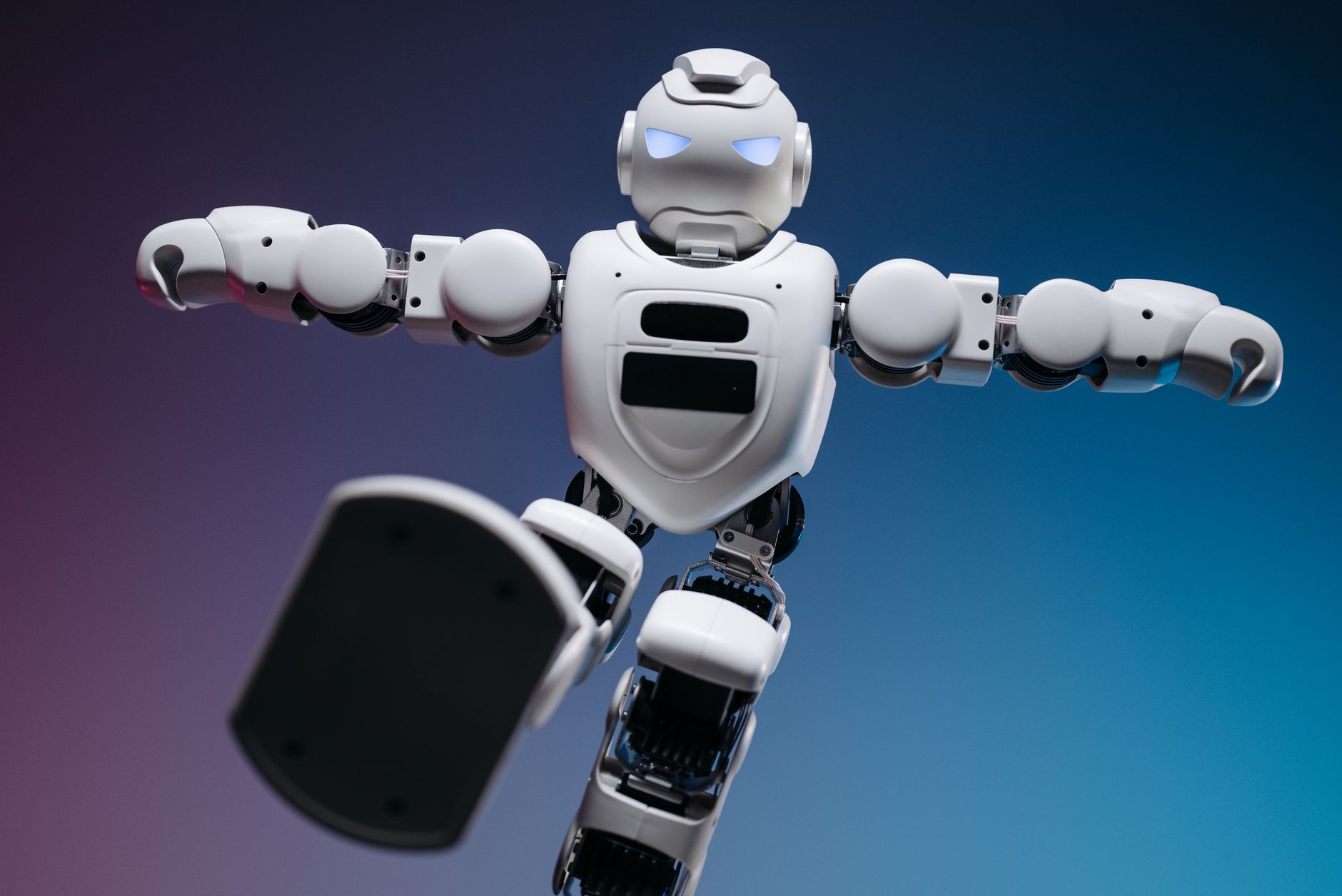

GENTO's humanoid builds upward from joint torque sensing, not downward from a body design. Tianji Intelligence started with in-house MEMS joint torque sensors in 2015, then stacked integrated joints, force-controlled arms, and full-body systems into GENTO humanoids. GENTO is an independent humanoid-robot brand incubated by Tianji Intelligence. It builds complete humanoid systems on TIANJI force-controlled arm technology to give AI models physical action.
Table of Contents
- Why start with force?
- What is the sensing stack?
- What did the dexterous hand demonstrate?
- How does this connect to AI and factory use?
Why start with force?
Without force sensing, a robot replays planned motion but cannot adapt to resistance. It also cannot record useful contact data from the task.
Robotics & Automation News reports that torque feedback changes that outcome, according to its account of the design. Regulated pushing becomes possible for assembly, insertion, wiping, and teleoperation. Those contact-rich tasks also produce better training data for imitation and manipulation models.
What is the sensing stack?
The next layer packs motor, reducer, driver, encoder, and brake into one integrated joint module. That unit is about 25% lighter than comparable designs and runs four-loop closed-loop compliant impedance control.
The arm platform built on those joints detects torque down to 0.02 N·m, against a 1–5 N·m industry norm. According to GENTO, the same platform offers 0.3 N·m absolute accuracy, a 160 Hz torque loop, 15,000 N/m stiffness, and ±0.03 mm repeatability, in GENTO's account of its arm performance.
What did the dexterous hand demonstrate?
At CoRL 2026 in Austin, GENTO applied the same approach to a 750-gram, 21-degree-of-freedom dexterous hand. It has five thumb joints and four joints per other finger, measures 200x96x45 mm, and senses 0.02 N·m per joint at 160 Hz.
The Robotics Media reports those specifications from the show debut, in The Robotics Media report from CoRL 2026. Small joints with fast torque feedback let each finger feel contact instead of only reaching a position. That matters for sliding, pinching, holding soft objects, and two-hand coordination.
How does this connect to AI and factory use?
Nvidia mounted two GENTO hands on a custom Marvin Pro humanoid to demonstrate its GR00T 2 foundation model. The demo task was preparing banana yogurt with both hands.
Tianji says it shipped 30,000-plus industrial robots and 2,000-plus force-controlled arms in 2025 to more than 45 robotics companies. Backers include Yaskawa Electric and Everwin Precision after about $140M in Series B funding. For automation buyers and developers, the practical read is direct:.
- Choose force-controlled arms when tasks involve contact, fit, friction, or deformable objects.
- Use teleoperation on torque-sensing hardware to collect contact signals, not only video and positions.
- Test insertion, wiping, polishing, and bimanual food or lab handling before assuming position control is enough.
- Treat the hand as task hardware with limits: rated life is 1 million no-load grasps.


