
iRobot Corporation (IRBT) stands as the genuine pioneer of consumer robotics, having brought the first practical robot vacuum into American households and transformed what was once science fiction into everyday appliance reality. The company’s Roomba, launched in 2002, didn’t invent the concept of a robotic vacuum—that distinction belongs to earlier inventors—but iRobot succeeded where others failed by creating a robot that actually worked reliably in real homes at a price consumers would pay. Today, with over 40 million robots sold worldwide and a market cap that has fluctuated between $2-10 billion over the past two decades, IRBT fundamentally changed consumer expectations about what robots could do.
The path to becoming this pioneer wasn’t straightforward. Founded in 1990 by Rodney Brooks, Colin Angle, and Helen Greiner, iRobot spent its first dozen years developing robots for military and research applications before recognizing a massive untapped opportunity: the household cleaning market. When Roomba launched at $199 (equivalent to roughly $330 today), it was a revelation—not because it cleaned better than a person with a vacuum, but because it cleaned while you did something else, and it actually returned to its dock to charge itself. That combination of autonomous operation and persistent learning marked the true beginning of consumer robotics.
Table of Contents
- How Did iRobot Become the First Consumer Robot Company to Succeed?
- The Roomba’s Technology—Surprisingly Simple by Design
- Expanding Beyond the Vacuum—iRobot’s Product Evolution
- The Consumer Adoption Curve—Why Roomba Went Mainstream
- The Limitations That Robot Vacuums Still Haven’t Fully Solved
- The Business Model Evolution and Financial Performance
- iRobot’s Legacy and the Future of Consumer Robotics
- Conclusion
How Did iRobot Become the First Consumer Robot Company to Succeed?
The key to irobot‘s breakthrough was understanding that early consumer robots didn’t need to be perfect—they needed to be good enough to save time and practical enough that owners wouldn’t relegate them to a closet after three months. The original Roomba used simple bump-and-turn navigation, infrared sensors, and brush designs adapted from industrial floor cleaners. It wasn’t elegant engineering; it was pragmatic engineering. Competitors like Electrolux had launched robot vacuums in Europe years earlier but failed to achieve meaningful market penetration because their devices were expensive, unreliable, or too specialized for typical homes.
What separated irbt was its willingness to iterate and improve systematically rather than demand perfection before launch. Roomba went through multiple hardware revisions in its first five years, with each generation addressing real owner complaints: improving edge-cleaning performance, extending battery life, reducing entanglement in pet hair, and refining the docking mechanism. The company also benefited from timing—by 2002, lithium-ion batteries were finally becoming affordable enough to power a multi-hour cleaning cycle, dual-core processors could handle obstacle detection without draining power, and manufacturing costs had declined enough to hit a price point that triggered mainstream adoption. A robot vacuum launched ten years earlier would have faced insurmountable battery and cost constraints.
The Roomba’s Technology—Surprisingly Simple by Design
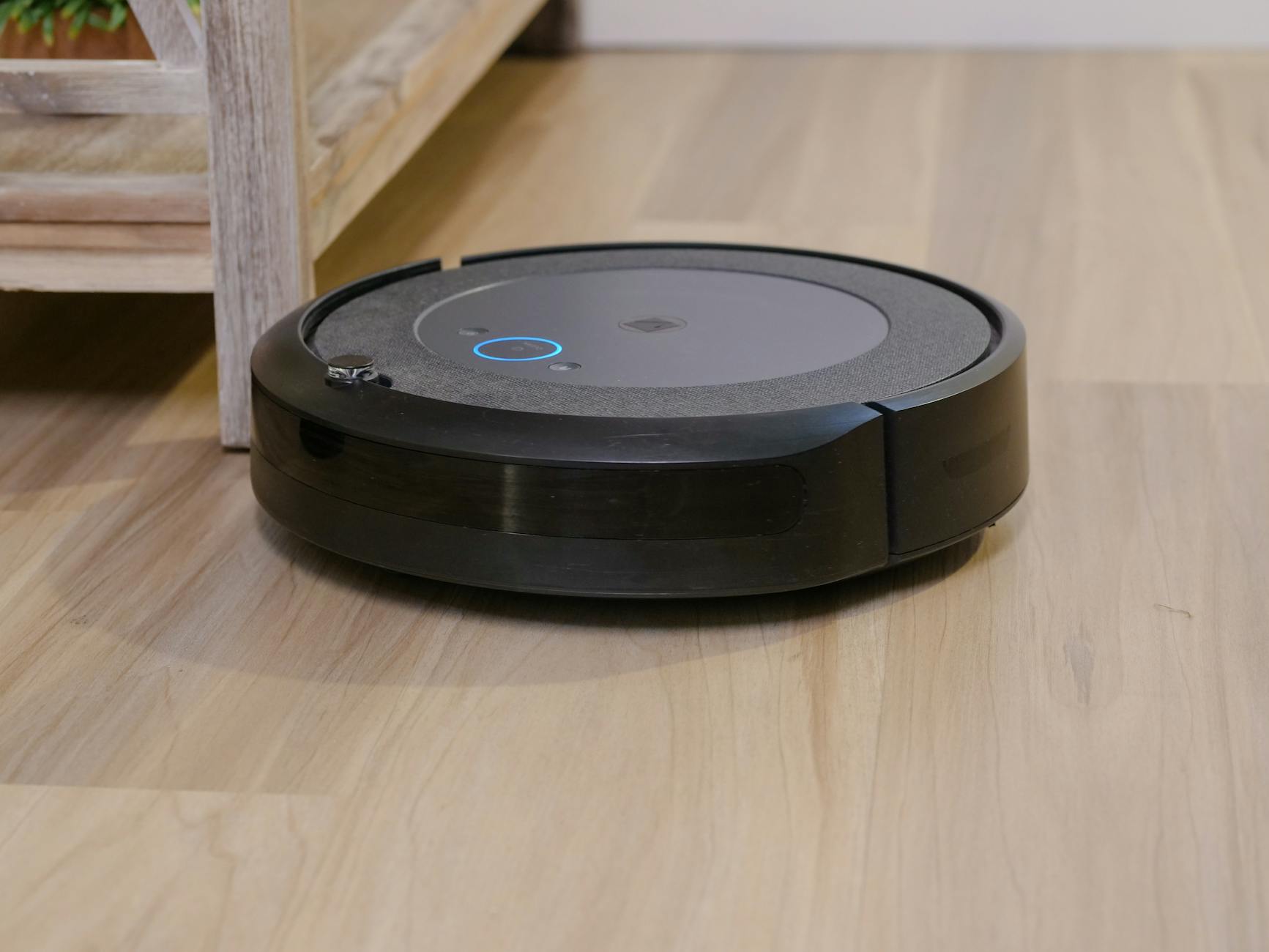
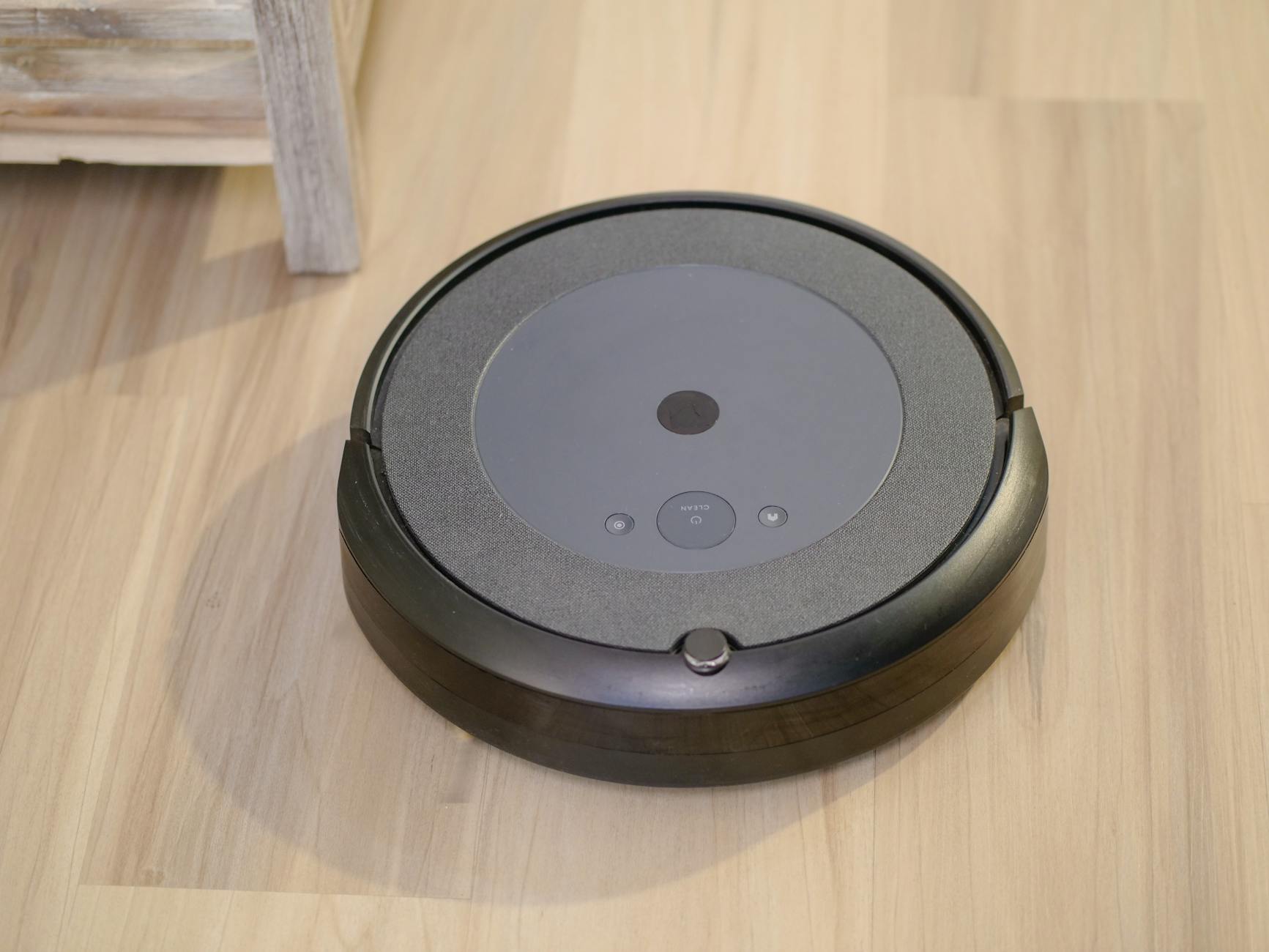
The original Roomba’s navigation system relied on what engineers call “bump-and-turn” logic: move forward until hitting an obstacle, turn, continue. This appears primitive compared to modern LIDAR-based mapping, but the limitation was actually an advantage for a first-generation product. The robot didn’t need to create a perfect map of your home—it just needed to cover most of the floor eventually through randomized movement patterns. Over a one-hour cycle, even a seemingly inefficient path would result in 85-90% floor coverage for typical homes, which exceeded most consumers’ expectations and certainly beat letting dust accumulate. The actual cleaning mechanism was where iRobot’s industrial robotics background showed.
Rather than trying to replicate the aggressive suction of an upright vacuum, Roomba used three brush systems working in concert: a side brush that extended out to reach corners and baseboards, a main brush that agitated carpet fibers and debris, and a backbrush that pushed dirt toward the suction port. This hybrid approach meant Roomba could operate on lower energy consumption while still achieving decent results on both hard floors and carpet. However, this also revealed an important limitation: robot vacuums have never performed as thoroughly as a quality upright vacuum on deep carpet or in heavily trafficked areas with ground-in dirt. They excel at maintenance cleaning—preventing dust buildup—but struggle with deep-clean scenarios. Owners who expected Roomba to replace their traditional vacuum often experienced disappointment until they adjusted their expectations.
Expanding Beyond the Vacuum—iRobot’s Product Evolution
Following Roomba’s success, iRobot expanded into related consumer robotics applications. The company launched Scooba (a wet floor cleaning robot) in 2005, Looj (a gutter cleaning robot) in 2008, and several other specialized devices. The strategy made theoretical sense—apply the same autonomous platform to other cleaning tasks—but execution proved harder than expected. Scooba required complex fluid handling and more sophisticated navigation around wet surfaces; Looj needed different power and sensor requirements to work safely on gutters; and most other variants never achieved Roomba-level reliability or affordability.
The lesson here was that consumer robotics success isn’t simply about applying robot platforms across different domains. Each application requires domain-specific engineering, and not all household tasks have the same ROI as vacuum cleaning. A homeowner might accept a robot that cleans 85% of the floor efficiently, but they won’t accept a wet floor cleaner that leaves dangerous slippery spots or requires constant human intervention. Of the many products IRBT attempted, only Roomba achieved truly mass-market adoption, though the company later found success with Braava (a mopping robot that launched in 2012) by positioning it as a complement to Roomba rather than a replacement for traditional cleaning methods.
The Consumer Adoption Curve—Why Roomba Went Mainstream
The transition from luxury novelty to mass-market essential took roughly a decade. In 2003, owning a Roomba marked you as an early adopter or someone with significant disposable income—the device cost around $500-600 (in today’s dollars) and didn’t integrate with smart home systems or smartphones. By 2010, prices had dropped to $200-300, reliability had improved substantially, and early adopters’ positive word-of-mouth had overcome skepticism. The turning point came when Roomba became referenced in popular culture and when network effects kicked in: owners started comparing models with friends, sharing tips in online communities, and driving sales through social proof rather than marketing campaigns.
A practical comparison helps illustrate this: in 2005, you might spend 45 minutes weekly vacuuming your home; with a Roomba, you’d spend 5 minutes emptying the dustbin and removing tangled hair from the brush—a net time savings of 40 minutes per week, or roughly 34 hours per year. For busy professionals, that value proposition became compelling enough to justify the $400-600 investment. However, this calculation depended on certain conditions: homes needed to be relatively decluttered (leaving objects on the floor defeats a robot vacuum), floor plans needed to avoid narrow passages where robots get stuck, and owners needed to manage expectations about cleaning thoroughness. Renters, pet owners with excessive shedding, or people with complex home layouts sometimes found the utility lower than expected.
The Limitations That Robot Vacuums Still Haven’t Fully Solved
Two decades after Roomba’s launch, certain fundamental challenges persist. The first is object recognition and manipulation—robot vacuums still cannot pick up a sock, move a toy, or navigate around obstacles with the dexterity a human has. They simply map around obstacles or, with older models, bump into them. A single shirt left on the floor might cause a robot to get stuck or spend ten minutes trying to navigate around it. Modern robots with LIDAR and AI have improved this somewhat, but the core limitation remains: consumer robots operate at a level of environmental awareness far below human perception.
The second limitation is cost versus performance. A high-end robot vacuum today costs $400-1000, while a premium upright vacuum costs $200-400. The robot is more convenient but less effective at deep cleaning. This tradeoff has pushed the market toward two parallel tracks: robot vacuums for busy professionals and younger homeowners who value convenience, and traditional vacuums for families with pets, large homes, or specific cleaning requirements. IRBT’s recent push into premium models with advanced mopping features and self-emptying dustbins reflects an attempt to close this gap by adding capabilities, but it also pushes prices toward $1500-2000, limiting the addressable market. Additionally, there’s growing concern about robot vacuum reliability and repair costs; if your Roomba’s navigational system fails after five years, repair costs can rival the original purchase price.
The Business Model Evolution and Financial Performance
iRobot’s path from startup to public company reflects consumer robotics’ broader trajectory. When the company went public in 2005, it was riding a wave of Roomba enthusiasm; its IPO price was set at $18 per share, and the stock eventually reached $99 per share during the 2010s growth period. However, the business model has always depended on replacement cycles and market expansion rather than revolutionary innovation. Roomba owners typically upgrade every 5-8 years, providing steady recurring demand.
The company’s high point came around 2018-2019 when it shifted toward premium self-emptying models and smart-home integration, pushing average selling prices higher. A real financial example: between 2015 and 2020, IRBT’s revenue roughly doubled from $500 million to $1.2 billion, primarily through higher-priced models and international expansion rather than significantly higher unit sales. This margin expansion strategy worked until the pandemic-driven supply chain disruptions and, later, increasing competition from Chinese manufacturers (Ecovacs, Dreame, Roborock) who could deliver competitive products at lower prices. IRBT’s market leadership faced erosion; by the early 2020s, the company’s stock reflected slower growth expectations and recognition that the consumer robot vacuum market was maturing and fragmenting.
iRobot’s Legacy and the Future of Consumer Robotics
Regardless of IRBT’s financial trajectory, its fundamental contribution to robotics and consumer technology is irreversible. The company proved that robots could transition from industrial and research applications to consumer markets, that consumers would embrace autonomous systems if they delivered genuine time savings, and that iteration and pragmatism beat perfection in emerging product categories. Every consumer robot that has launched since—from robotic lawn mowers (which existed earlier but weren’t profitable) to robot mopping systems to window-cleaning robots—owes a debt to Roomba’s success in establishing consumer acceptance. Looking forward, iRobot and its competitors face a frontier defined by AI and multi-task capability.
Future robots might combine vacuuming, mopping, and light object manipulation in a single platform, or they might integrate with broader smart home systems to manage multiple cleaning tasks. However, they’ll likely continue facing the same fundamental tradeoff: convenience versus performance. A truly capable household robot would need computer vision sophisticated enough to recognize and avoid (or pick up) any household object, manipulation systems flexible enough to handle diverse furniture arrangements, and enough battery capacity to clean a large home thoroughly. The cost of that robot would put it far beyond the consumer market IRBT built. IRBT remains the pioneer not because it solved all the problems, but because it recognized which problems didn’t need solving to create genuine consumer value.
Conclusion
iRobot Corporation was the first company to successfully bring consumer robotics into millions of households, and the Roomba remains the definitive proof that autonomous robots could be practical, affordable, and genuinely useful in everyday life. The company’s success didn’t come from revolutionary breakthroughs in AI or robotics—it came from pragmatic engineering choices, willingness to iterate based on real-world feedback, and timing that aligned with advances in batteries and manufacturing costs. For two decades, IRBT’s leadership in consumer robotics was nearly uncontested, and Roomba became synonymous with robot vacuums much like Kleenex became synonymous with facial tissues.
Today, as the market matures and competition intensifies, IRBT’s role has evolved from sole pioneer to established market leader facing new challenges. The company’s longer-term future depends not on refinement of the existing robot vacuum category—which has largely matured—but on expansion into adjacent categories and integration with broader smart home ecosystems. Regardless of financial outcomes, iRobot’s historical significance in demonstrating that consumer robotics was viable remains secure. If you own a robot vacuum today, whether it’s a Roomba or a competitor’s product, you’re benefiting from the market and expectations that iRobot created.